
iroh on RP2350: A Firmware Engineer's Bring-Up Guide for Wi-Fi Mesh on the Pimoroni Presto
By Rachel Williams — Electronics & Engineering (Electronicseng), EmbeddedSystems desk.
The short answer: iroh, the modular networking stack written in Rust, now executes natively on the RP2350 microcontroller, and the published demonstration keeps secure peer-to-peer mesh links alive over Wi-Fi on the Pimoroni Presto touchscreen board — no gateway, no broker, and no hand-rolled NAT pinning.
For firmware teams the result matters less as a product launch than as a boundary marker. QUIC-class transport, key-based addressing and automatic path migration were Linux-device features until now. The port is described by Rüdiger Klaehn, whose blog post walks through the engineering process and the deliberate workarounds; the reproducing code sits in the iroh-pico-examples repository on GitHub. What follows is the practical layer on top of that: memory arithmetic, bring-up order, the traps, and where the radio hardware actually comes from.
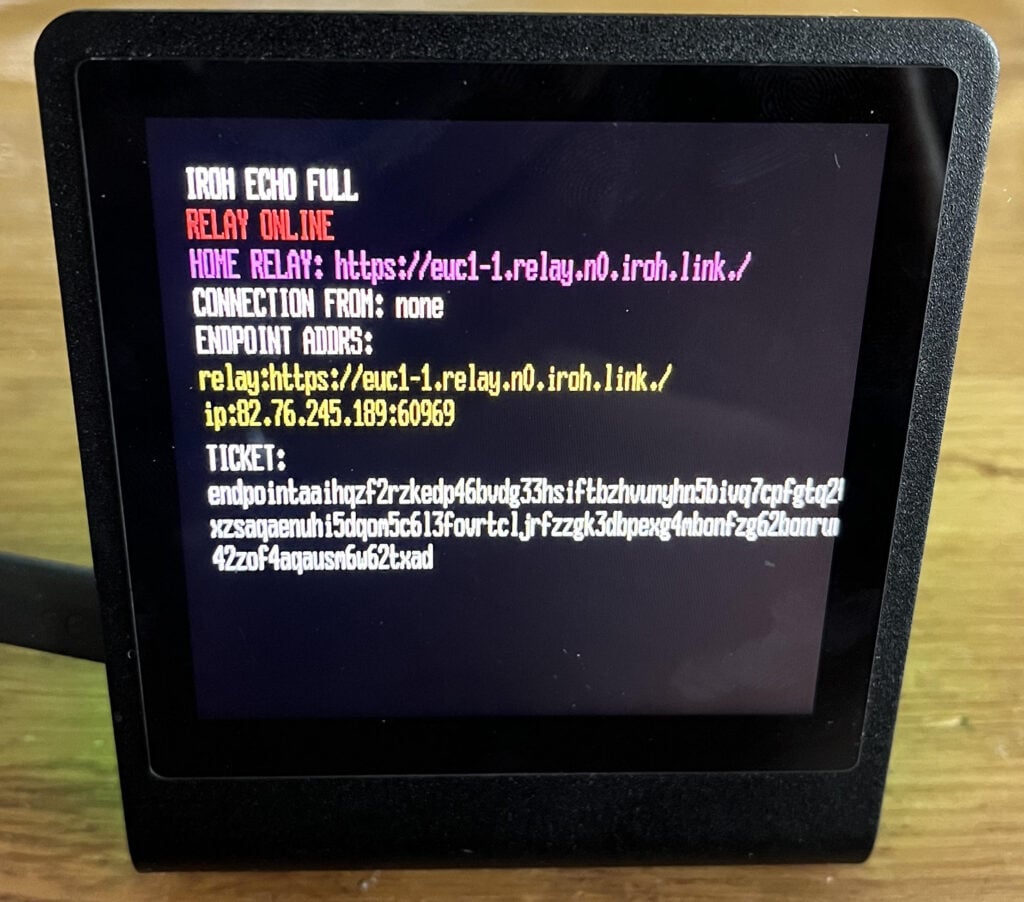
What Does iroh Give an MCU That a Plain Socket Does Not?
Conclusion first: iroh replaces "connect to this IP address" with "connect to this public key", then owns discovery, hole punching and route maintenance. It ships as a lightweight native library intended to be embedded directly inside an application rather than run beside it as a daemon.
The building blocks let devices, apps and cloud instances form mesh networks across IP-based links such as cellular and Wi-Fi, and across non-IP networks including Bluetooth-LE and LoRa. Two dated release facts belong in a design note: iroh reached its 1.0 stable line on June 15, 2026, freezing the wire format and public API; QUIC multipath — one endpoint holding Wi-Fi and cellular simultaneously and migrating a live connection between them — appears in the v0.95.1 release notes dated Nov 5, 2025 (iroh.computer/roadmap). The project page sums the pitch up as "no central server, no NAT config", a line carried there from Michael Neale, founder of Mesh LLM.
How Much RAM Does a QUIC Endpoint Cost on RP2350?
Conclusion first: run this arithmetic before writing a line of firmware, because the constraint that shaped the port is memory, not clock speed. The iroh team states plainly that the stack does not currently support no_std — the microcontroller build carries a standard-library dependency, and the setup code must run purely from internal RAM (iroh.computer/blog/iroh-on-rp2350).
RP2350 is what makes that survivable. Its 520 KB of on-chip SRAM is addressed as one region but physically split into ten banks, so the cores, DMA and the PIO subsystem can access memory in parallel; there is 8 KB of one-time-programmable memory, and the dedicated QSPI controller maps up to 16 MB of external flash or PSRAM into the address space. Internal SRAM sits uncached but at single-cycle latency, which is why parking hot network buffers there buys determinism as well as capacity. The bank map and the XIP cache sizing are documented in the official Raspberry Pi RP2350 datasheet.
| Constraint | RP2040 | RP2350 | Why it bites an iroh port |
|---|---|---|---|
| On-chip SRAM | 264 KB, four banks | 520 KB in ten banks | std + async task arena + TLS buffers all allocate from here |
| External PSRAM via QSPI | Supported | Up to 16 MB, optional second chip select | Headroom for relay and address-lookup paths |
| Cores | 2x Cortex-M33 | 2x Cortex-M33 or 2x Hazard3 RISC-V, 150 MHz | Radio driver housekeeping typically claimed on the second core |
| Secure boot / OTP | Limited | 8 KB OTP, documented trust functions | Peer keys deserve a tamper-resistant home |
An external yardstick helps size expectations. An EMQX proof of concept that carried MQTT over QUIC on an ESP32-C3 reported a binary of roughly 1.6 MB and only 39,564 bytes of heap still free once the session was established, out of about 320 KB of usable SRAM (emqx.com, published Sep 2025). Different stack, different toolchain — but the shape of the problem is identical: QUIC plus TLS on an MCU eats heap, and your application buffers sit on top of that bill.
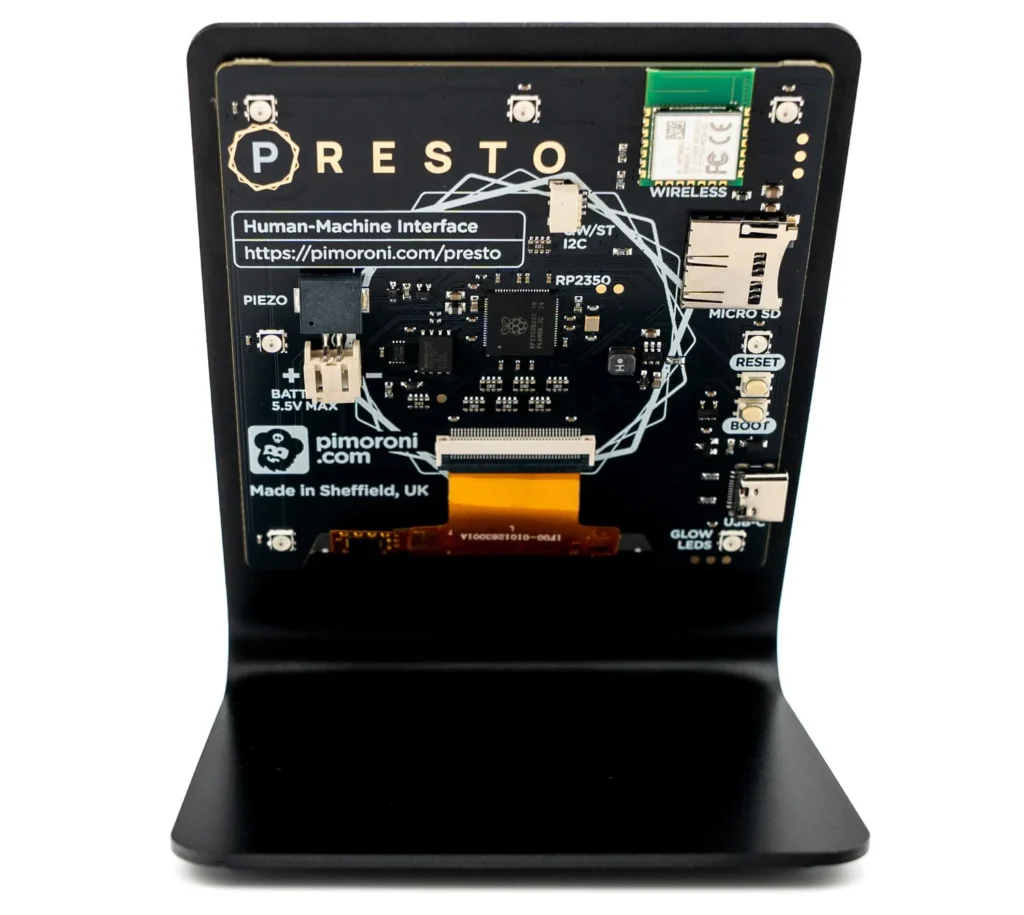
Rear side of the Pimoroni Presto, the RP2350-based board that supplied the Wi-Fi interface and the 480 x 480 square touchscreen in the iroh demonstration.
Step-by-Step: Bringing Up an iroh Node on the Presto
- Clone iroh-pico-examples and read the two build targets side by side before choosing one: a bare Raspberry Pi Pico 2 with no radio attached, and the Presto, which adds wireless plus a display. Pimoroni's own setup notes describe the Presto as an RP2350 board with MicroPython and Pico SDK support (learn.pimoroni.com).
- Pin the Pico SDK revision the repository names. The examples track the SDK commit used by Pimoroni's working Presto firmware, and their submodule set carries TinyUSB, lwIP and the CYW43 driver — floating those versions is the quickest route to a binary that flashes happily and never associates.
- Set up the Rust toolchain for the correct target triple, link in a heap allocator, and turn on allocator watermark logging on day one rather than after the mesh "randomly" stalls.
- Move bring-up code and the initial task arena into internal RAM through the linker script; leave cold paths execute-in-place from QSPI flash where the cache hit rate justifies it.
- Provision credentials over the debug console. On the Presto the touchscreen can serve as the provisioning surface instead of baking a SSID and passphrase into firmware.
- Bring up a single endpoint, print its key, and confirm address lookup resolves before you test any mesh topology. Address lookup and relay only come into scope when the wireless interface works and enough PSRAM is behind it (iroh compatibility notes).
- Pair two nodes, exchange data over a stream, then deliberately kill Wi-Fi on one side to observe the fallback path and measure reconnect time.
- Only after steps 1-7 pass, scale to three or more nodes and exercise Bluetooth-LE or LoRa transports for the links Wi-Fi cannot reach.
Common Pitfalls That Break iroh Builds on RP2350
- Planning for no_std. The stack does not support it yet, so a "minimal" Rust MCU build is the wrong starting assumption; budget for a standard-library heap.
- Running setup code from flash. Boot-time code that must sit in internal RAM will pass on a bench build with a small binary and fail once your own features grow.
- Expecting relay or discovery without PSRAM. On constrained RP2350 designs those services are out of reach even when local mesh traffic works, so a demo that connects on the desk can still fail behind a real firewall.
- Treating the API as frozen. Even after 1.0, the project's own history includes a large rename in Oct 2025 (Node became Endpoint, NodeId became EndpointId); pin versions in your lock file and read release notes before an SDK bump.
- Ignoring the second core. On CYW43-class designs the wireless driver's housekeeping lives on the other core, so single-core interrupt-latency assumptions and bare-metal timing measurements stop being valid.
- Debugging with logs only. Mesh failures are path failures. Capture endpoint keys, candidate addresses and interface-change events, and keep a serial console or SWD trace attached — this is where a hardware debug probe earns its cost.
iroh Endpoint vs. a Conventional lwIP TCP Client: Which Do You Ship?
| Dimension | iroh endpoint | Classical TCP/lwIP client |
|---|---|---|
| Peer identity | Public key; address is derived at runtime | Fixed IP and port, usually provisioned |
| NAT behaviour | Hole punching with relay fallback | Needs port forwarding or an always-reachable server |
| Transport | QUIC: concurrent streams, datagrams, no head-of-line blocking | TCP over IPv4/IPv6, single ordered stream |
| RAM profile | Heavier: async runtime, crypto and buffer pools | Lighter and easier to size statically |
| Topology | Device-to-device mesh, plus apps and cloud instances | Star topology to a broker or gateway |
| Maturity on MCU | Experimental port, first-class on desktop and server | Decades of field hardening |
Read that table as a selection rule rather than a ranking: ship the TCP client where your network is under your control and RAM is brutal; reach for iroh where endpoints are behind unknown NATs, when devices must talk to each other without a broker, or when a prototype needs to survive being moved between Wi-Fi and cellular.
Where Does the Wireless Hardware Come From? Raspberry Pi Radio Module 2
An MCU core carries no radio, so the connectivity half of the design is a separate decision. Last year, the first standalone Wi-Fi and Bluetooth radio module in the Raspberry Pi line arrived: Raspberry Pi Radio Module 2, built for use with Raspberry Pi microcontrollers and packing the same Infineon CYW43439 radio found on Raspberry Pi Pico W and Pico 2 W. That makes it a sensible option for RP2040- and RP2350-based products that need turnkey wireless rather than an RF certification programme of their own.
Pairing RP2350 with Radio Module 2 gives real-time compute and connectivity at an affordable cost point, which is precisely the combination Raspberry Pi Approved Reseller Pimoroni exploited when it built the Presto desktop companion used in the iroh demo. If your own board follows that pattern, budget the SPI path, the shared antenna and the driver's second-core load exactly as the reference port does.
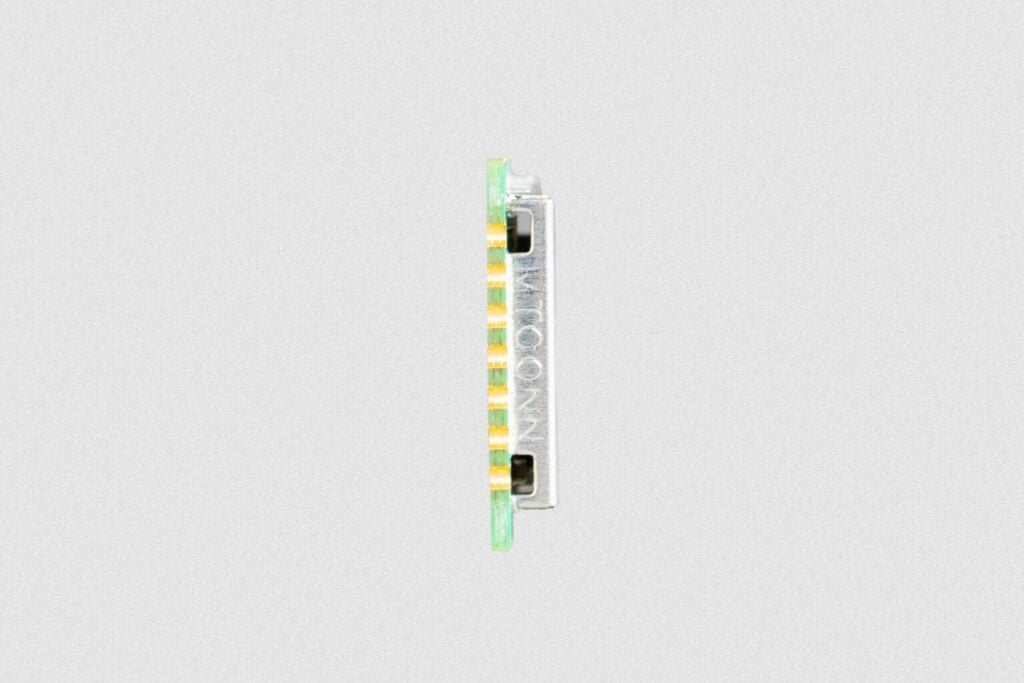
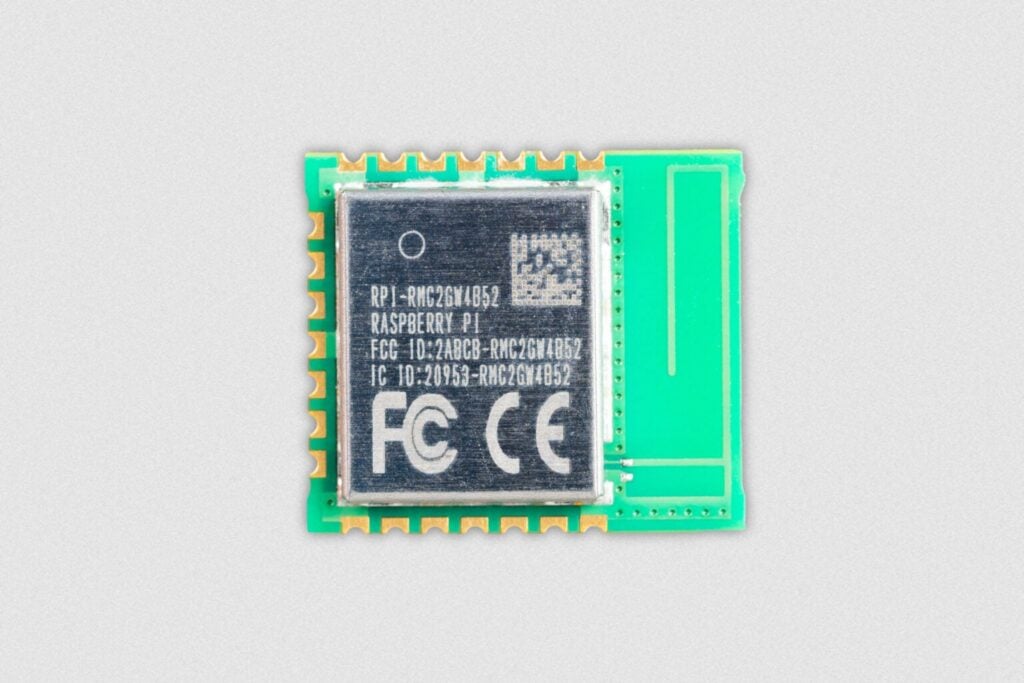
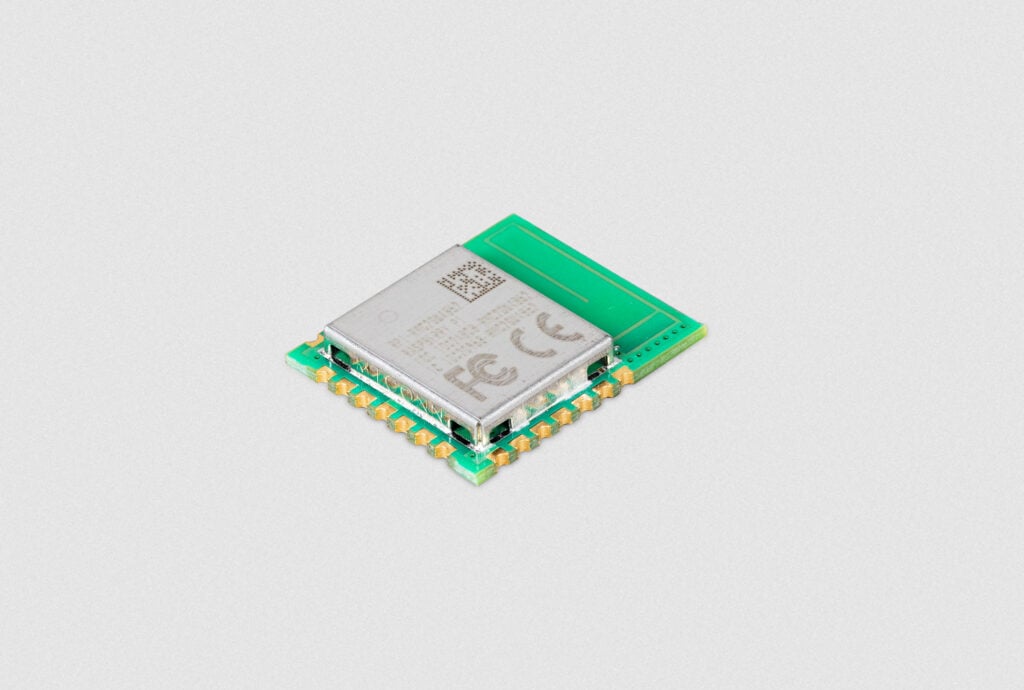
Three views of the compact Radio Module 2 footprint: side, top and mounted.
Power and Latency: What an Always-Connected Mesh Node Really Costs
Conclusion first: a persistent iroh endpoint is a keep-alive workload, and keep-alives are the enemy of a battery design. RP2350 offers sleep and dormant states, with dormant driven by a low-power oscillator (LPOSC) that can still wake the system from a timer — the mechanism you want between synchronisation windows.
Field numbers are worth reproducing on your own hardware rather than trusting: developers on the Raspberry Pi forums report roughly 2.5 mA in dormant and 3.5 mA in sleep on RP2350 boards using the hardware_sleep module from pico-extras, and note that radio, regulator and pull-up networks routinely dominate whatever the core does. Our analysis for mesh products: treat the wireless link as the constant and the CPU as the variable, then duty-cycle the transport — stay dormant, wake on timer or PIO interrupt, open a QUIC stream, exchange, close, sleep. That shape keeps the peer-facing advantages of iroh without paying for an always-on radio.
FAQ: iroh on Microcontrollers, Answered for Practitioners
Can I run this on Raspberry Pi Pico 2 instead of the Presto?
Yes — the reference material covers a Raspberry Pi Pico 2 running without Wi-Fi, alongside the Presto build with Wi-Fi and a touchscreen. Expect fewer features, since discovery and relay paths depend on a working radio and sufficient RAM.
Do I need to know Rust and async programming?
Practically, yes. The port is a Rust standard-library environment; the published evaluation of iroh in general puts its adoption barrier at medium-to-high, requiring Rust, async and some network debugging experience.
Does an iroh mesh replace Bluetooth-LE or LoRa links?
No, it complements them. The stack is designed to form mesh networks over IP-based links and over non-IP networks including Bluetooth-LE and LoRa, so short-range radios stay useful for the last few metres.
Is this ready to ship in a product?
Treat the RP2350 port as prototype-grade even though iroh 1.0 fixed the wire format: the microcontroller build is explicitly a demonstration environment, so validate heap margins, watchdog behaviour and recovery from failed hole punching before committing to it.
Action Checklist Before Your First Commit
- Freeze the Pico SDK revision and the submodule set (TinyUSB, lwIP, CYW43 driver) in version control.
- Reserve internal RAM for bring-up code in the linker script and assert that assumption in CI with a map-file check.
- Add PSRAM to any board that must rely on relay or address lookup.
- Instrument heap watermarks, reconnect counts and path-change events from the first build.
- Validate a two-node direct connection, a relay fallback and a power-cycle recovery on the target hardware.
- Store peer keys in protected or OTP-anchored storage, never as plain strings in flash.
For questions on this build walkthrough or the resource numbers above, reach the EmbeddedSystems desk at info@electronicseng.com.
Sources Consulted
- iroh on RP2350 — engineering notes on std support and internal-RAM constraints: https://iroh.computer/blog/iroh-on-rp2350
- Reference examples repository, iroh-pico-examples on GitHub: https://github.com/n0-computer/iroh-pico-examples
- iroh release roadmap, including v0.95.1 dated Nov 5, 2025: https://www.iroh.computer/roadmap
- RP2350 datasheet, SRAM banking and QSPI memory map: https://pip.raspberrypi.com/documents/RP-008373-DS-rp2350-datasheet.pdf
- EMQX, "Can ESP32 Run MQTT over QUIC?" resource measurements: https://www.emqx.com/en/blog/can-esp32-run-mqtt-over-quic
- Pimoroni Presto hardware and setup guide: https://learn.pimoroni.com/article/getting-started-with-presto