
Electronicseng General Guide: Using 48V Power and Zonal Architecture to Simplify Smarter Vehicles
For engineers examining vehicle electrical platforms, the transition from a conventional 12V supply to a 48V supply is best understood as a systems-level trade: more electrical headroom with less mass and fewer tangled interfaces. This Electronicseng General overview explains the reusable logic behind zonal layouts, the reason low-voltage connector standards matter, and how teams can prepare future features without treating every new function as a separate wiring problem.
The basic shift: less current, less wiring burden
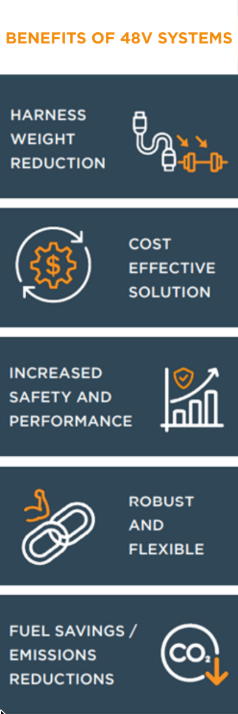
Vehicle electronics have grown dense enough that older wiring strategies can feel close to their practical limits. Sensors, automated steering, and driver assistance all demand power, yet designers must keep mass under control. When power is transferred at a higher voltage, the required current falls. A 48V approach therefore creates room for features that a stretched 12V system would carry poorly.
That change is not only about electrical capacity. Because lower current can allow thinner wires and smaller connectors, some vehicle designs can reduce conductor mass by as much as 75 percent. With fewer losses in the distribution path, platform efficiency and range can improve. The route also opens space for electrically driven compressors, active chassis, active steering, and energy-recovery behavior that benefit electrified and hybrid platforms.
Zones replace scattered electronic islands
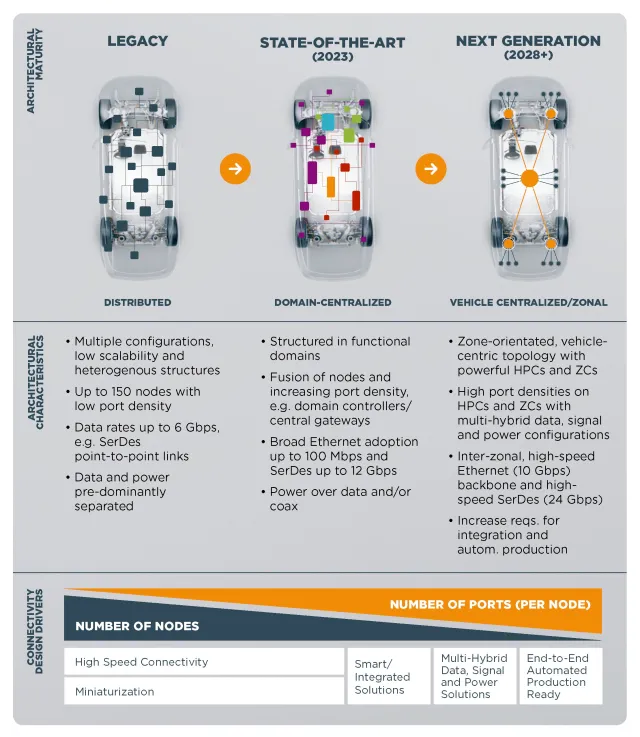
A conventional domain structure places many electronic control units (ECUs) in dispersed locations, producing a web-like harness. Each added camera, lamp, or sensor can extend a new path across the vehicle, increasing assembly work, mass, and failure possibilities.
A zonal model sorts hardware by physical area—front, rear, left door, right door, and similar regions—then assigns a local zonal computer to manage that area. A central vehicle computer connects the zones, preserving communication while reducing cross-car wiring. The result is a topology that is easier to assemble and easier to expand: new capability can be attached near its physical location instead of threading another long cable through an already crowded harness.
Why connector design becomes a system constraint
Increasing supply voltage does not make connector engineering optional; it changes the safety envelope. Load connection and disconnection can still produce arcing if controls are inadequate. The design must preserve enough creepage and clearance, especially when moisture, dust, or debris may collect in the interface.
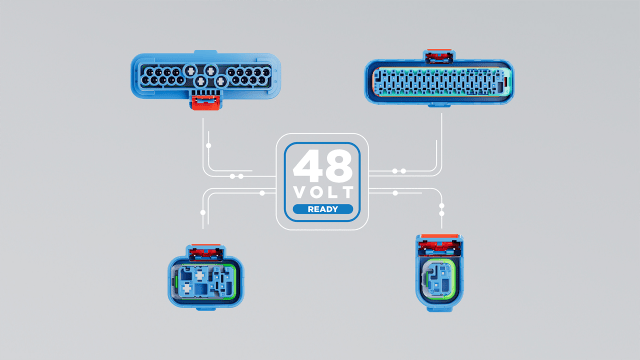
The Low Voltage Connection Standard (LVCS) is described in the source material as developed for 48V operation. TE Connectivity is noted as the leading engineering partner with a production-ready solution, using 48V safety margins from the start rather than adapting legacy 12V connector assumptions. That matters because the interface is where electrical performance, environmental exposure, assembly repeatability, and worker safety meet.
Assembly support is another practical layer. Positive gripping, horizontal and vertical retention, and guiding features help both human workers and robots seat connectors reliably. Electronic confirmation can notify vehicle software when a connection is not fully sealed. These functions turn a mechanical fitting into a verifiable system step.
Standardized interfaces reduce part complexity
The source material points out that modern vehicles may contain more than 150 different connector types, which increases part-number burden and assembly ambiguity for OEMs and suppliers. A consolidated LVCS roadmap that narrows available options to 13 fully standardized 48V-compatible interfaces supports simpler harness layouts, fewer failure candidates, and easier scaling across vehicle families.
For teams building zonal platforms, interface control is not a purchasing detail; it is architecture work. Early reduction of interface variety lets electrical design follow the physical zone plan, so each added feature does not force a wholesale harness redesign. In broader engineering terms, it is the same method used in other complex electronics projects: control variability at the boundary, then let internal function change more freely.
Preparing for unknown future loads
Vehicle requirements are unlikely to stop growing. Future models may add more sensors, new comfort functions, or additional electronic actuators. The practical answer is not over-engineering every worst case at the outset, but building a flexible power and communication backbone that can absorb change as architectures mature.
Early collaboration between vehicle manufacturers and component suppliers supports that flexibility. If connector and electrical architecture partners join during advanced development, the interface strategy can anticipate expected loads while leaving room for needs not yet defined. The same forward-looking mindset also touches software: when steer-by-wire, brake-by-wire, electric compressors, and other loads share a 48V network, control logic must balance distribution, including moving load demand between 48V subsystems and the main traction battery when needed.
Factory and field benefits
Lighter harnesses and fewer connector part numbers reduce material consumption and simplify assembly. Fewer manual fitting variations improve repeatability, while standardized geometry and guiding features support automated harness work. Over time, these improvements can lower production cost and make advanced architectures commercially practical, which ultimately benefits vehicle users through easier maintenance, better energy performance, and a simpler service path.
Checklist for engineers evaluating a 48V zonal approach
- Start by grouping loads and controllers by physical zones, not only by function labels, so harness crossings are minimized early.
- Compare power needs against the mass and loss limits of a 12V harness before deciding whether 48V distribution is necessary.
- Review creepage, clearance, sealing, and arcing risk at every interface that may be mated or unmated under load.
- Limit connector variant count where possible; the source article describes a consolidation from more than 150 types toward 13 standardized 48V options.
- Confirm that retention, guidance, and, where available, electronic sealing confirmation fit the intended assembly line, whether human or automated.
- Engage supplier teams before the architecture freezes, so future loads and software-managed power distribution can be anticipated.
Common misconceptions
- 48V is only a battery or converter change. The article presents it as an enabler for zonal layout, lower wiring mass, safer connector design, and production automation.
- Lower current means the connector can be treated like a legacy part. LVCS and TE Connectivity solutions are described with 48V margins and environment-aware safeguards, not simple 12V replacements.
- Standard interfaces reduce design freedom. By controlling interface variety early, platform teams can add capability without constantly redesigning harnesses.
FAQ: general engineering takeaways
What is the central benefit of 48V power?
For the same delivered power, a higher voltage lowers current, which can reduce wire size, connector size, mass, and electrical losses. In vehicle applications, the source material notes that reduced losses and mass can support efficiency and range improvements, including where advanced driver assistance and electrified subsystems raise demand.
Why do zones matter if 48V already improves wiring mass?
48V addresses the electrical side of the problem; zonal architecture addresses the topology. When hardware is managed by nearby zones and linked through a central computer, fewer long cross-vehicle paths are needed. The two changes together make expansion easier than treating each new feature as an isolated cable run.
How does connector standardization relate to reliability?
Fewer interface variants can simplify assembly and reduce points where operators or robots might select the wrong part. In the article, LVCS-supported designs include retention, guiding, and possible electronic confirmation, turning connection quality into a checkable condition rather than an assumption.
Is this only an automotive story?
The implementation details are automotive, but the general lesson is reusable: when a system adds many connected functions, designers should reduce path complexity, standardize boundaries, and build margins for future loads. That is the kind of transferable method Electronicseng General aims to surface for hardware and electrical engineering readers.
Closing perspective
The path to smarter vehicles is not simply to add more sensors and more cables. It is a disciplined redesign of how power, data, and interfaces coexist. A 48V supply gives engineers a better starting point for managing rising electrical demand, while a zonal layout keeps the architecture readable as functions multiply. Standardized low-voltage connectivity helps turn that reading into manufacturable, inspectable, and scalable hardware. For Electronicseng General readers, the broader value is clear: the most useful platform upgrades are those that simplify future change, not just optimize today’s specification.