
Crop-Disease Sensing Leaves the Lab: An Embedded Engineer's Guide to Multispectral Trade-offs | Electronicseng General
By Felix Campbell, Electronics & Engineering
Twelve days after planting, in a greenhouse at North Dakota State University, two trays of soybean seedlings looked identical. A hyperspectral camera disagreed: it had already separated plants carrying sudden-death syndrome from healthy ones. For hardware teams, that result is less about exotic optics than about a trade-off — capture fewer wavelengths, at lower cost, and still keep enough signal to act on.
The work belongs to Xin "Rex" Sun, director of the Peltier Institute for Advancement in Agricultural Technology at North Dakota State University. His team reported spectral differences emerging several days to roughly a week before symptoms. The method has not been validated in the field, which is exactly where an embedded engineer should start asking about calibration, data volume and payback.
What does a spectral camera measure that the eye cannot?
A normal colour sensor folds reflected light into three broad bands — red, green and blue. A hyperspectral imager slices the same light into many narrow bands, so a change in leaf chemistry or water status shows up as a change in the reflectance curve while the leaf still looks green.
Sun's laboratory recently took delivery of a short-wave infrared (SWIR) camera covering approximately 1,000 to 2,500 nm, with more than 200 spectral bands. That breadth is a research requirement, not a product spec: nobody knows in advance which bands will separate a particular disease.
"That's the beauty of using hyperspectral imaging technology," Sun said. "It's all about selecting the bands."
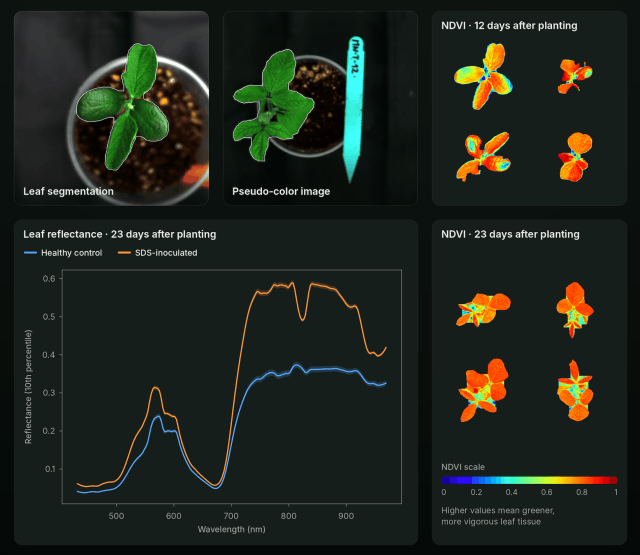
Soybean sudden-death syndrome detection using hyperspectral imaging technology (Source: Rex Sun and Febina Mathew | North Dakota State University)
Why can two or three wavelengths outperform a six-figure camera?
Because discovery is the expensive phase, not deployment. Once two or three wavelengths are shown to separate diseased plants from healthy ones, a multispectral camera built around those bands can take over from the research instrument.
That is not a thought experiment for Sun's group: the lab already runs multispectral cameras with four to 10 bands. Such hardware costs hundreds or thousands of dollars, against the six-figure sums attached to some research-grade hyperspectral systems — and against the tens or hundreds of thousands of dollars a full hyperspectral setup can absorb once optics, mounting and processing are counted.
Band count also sets the compute budget. Extensive hyperspectral measurement campaigns can produce hundreds of gigabytes or more, which is a storage and radio problem before it ever becomes a model problem. Third-party accounts of agricultural drone work land in the same range; Wilco Imaging, for instance, puts a single survey of a medium-sized farm at hundreds of gigabytes of hypercube data.
"If we can find three or four bands out of the hyperspectral imaging, those small processors can process them," Sun said. "Then it can be fast enough in the field to give you a good result."
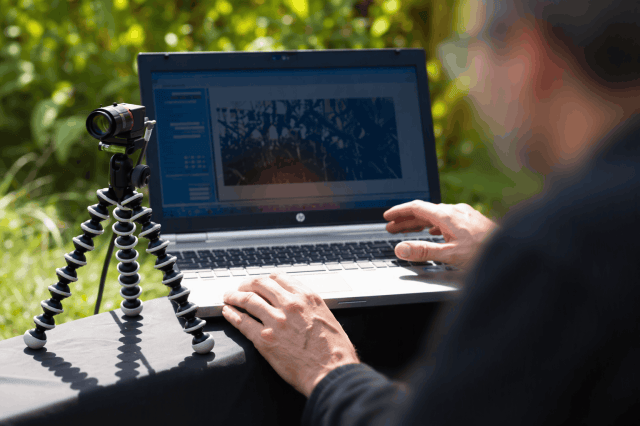
A snapshot multispectral camera used in the field (Source: imec)
| Camera class | Bands captured | Typical hardware cost | Data per survey | Where it fits |
|---|---|---|---|---|
| RGB | three broad bands | consumer pricing | megabytes | canopy cover, scouting, logistics |
| Multispectral | four to 10 bands | hundreds or thousands of dollars | megabytes to gigabytes | disease indices, on-machine decisions |
| Hyperspectral | 100 bands and above; 200 spectral bands in Sun's SWIR unit | tens or hundreds of thousands of dollars | hundreds of gigabytes or more | band discovery, model training, research |
For embedded teams the pattern is familiar: it is the same push toward local inference described in our look at edge AI workflows, where the model runs beside the sensor instead of in a data centre.
How does imec put spectral filters on the sensor itself?
imec, the Belgian semiconductor research organisation, attacks the cost from the fabrication side rather than the optics side. Carolina Blanch, a senior researcher working on hyperspectral imaging applications, agrees that most uses do not need the full spectrum.
"We typically start with high-resolution spectral cameras that capture around 100 bands, then identify which ones are most relevant," she said. "For most applications, 10 or fewer bands are sufficient."
A sensor tailored to a single crop disease would be a poor product, though. imec therefore also develops standardised parts with nine, 16, or 25 spectral bands, so one design serves several applications and the wafer cost is shared across a wider market.

Imec's Carolina Blanch
Klaas Tack, technical lead of hyperspectral imaging at imec, explains the step that removes the separate light-splitting optics used in conventional hyperspectral cameras.
"We developed a process in our fab where we integrate the filters with the detector," he said. "Because we're doing this at wafer level, we're manufacturing many detectors at the same time."
The result is fewer parts, less weight, less alignment work and — critically for field hardware — snapshot capture, which records spatial and spectral data in a single exposure. That sidesteps the motion artefacts of scanning cameras when the sensor rides a tractor or a drone, or when wind moves the canopy mid-scan.
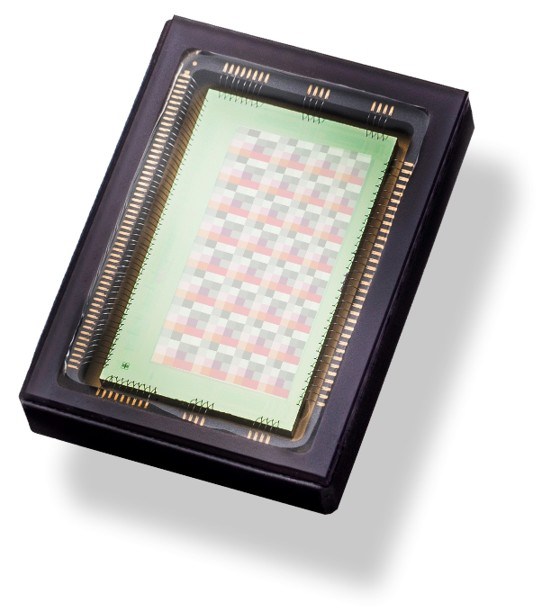
A snapshot multispectral detector with 25 bands organized in 5 × 5 patterns of pixels. Because of the small size of the pixels, the picture shows an artistic impression of this layout. (Source: imec)
Volume is the remaining lever. Spectricity, an imec spin-off aimed at mobile devices, shows what high-volume CMOS production does to unit cost; its S1 sensor packs 15 channels across 400–700 nm into a phone-sized module, which is a manufacturing model rather than an agronomic instrument. "When the volume is high enough, you can dramatically reduce the cost," Tack said.
Where does the lab-to-field gap still bite?
Three places in practice: the detector, the inference and the installation.
Start with the detector. Some diseases and stresses separate in visible and near-infrared bands; others need SWIR, where plant chemistry and water status show more clearly. SWIR detectors cost more than standard CMOS, and Tack notes that filter integration on them is more complex, so the wafer-level cost curve does not transfer automatically.
The curve is moving, though. Emberion reported in 2024 that its SWIR image sensor can be manufactured for less than €50 in large-volume production — a production-cost figure for a die, not a camera price, and best read as a direction of travel rather than a quotation.

Imec's Klaas Tack
Then the inference. Disease, nutrient deficiency and drought can push the spectrum in similar directions, especially before symptoms appear. Sunlight changes, soil background and canopy geometry modulate every measurement. Sun's team keeps collecting imagery across varied conditions for that reason, and a validated band set for field diagnosis of soybean sudden-death syndrome does not exist yet.
Finally the installation. Any sensor that must survive a season outdoors inherits the same maintenance questions as other field nodes; our review of a vibration rain node on a PV array argues for treating a candidate signal as advisory until it is proven against ground truth.
Sun is building a field platform that would carry sensors through a crop, diagnose problems and eventually support intervention, replacing laboratory analysis with processing on the machine. Tack argues the visible and near-infrared technology is ready for application developers: "I think today we can provide them with the technology that is required," he said, though he will not predict when agricultural products reach widespread deployment.
Sun expects significant progress in five or six years and keeps returning to validation. "If you're a farmer, you need to think twice," he said of buying an expensive hyperspectral system. "If I spend that much money, I want to know how soon I get my money back."
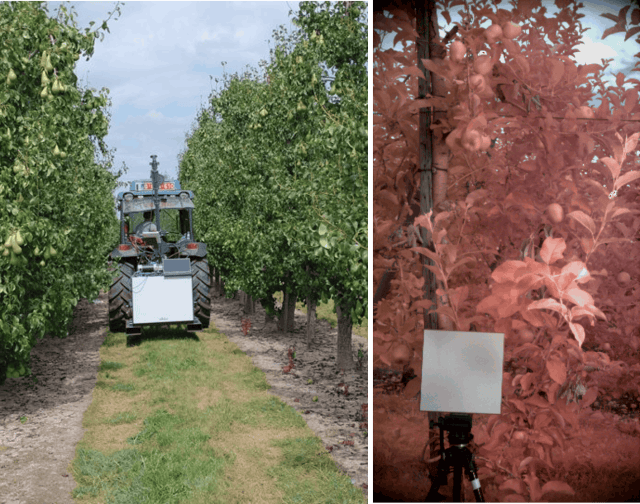
In-field demonstration of a multispectral camera used to detect fire blight in orchards (Source: imec)
That payback question is sharper than it looks, because the agronomic upside is uneven. Kansas State University's agronomy extension puts historical soybean yield losses from sudden-death syndrome at roughly 1 to 25 percent, with severe fields going higher — enough to justify scouting, not enough to justify a six-figure instrument on every farm.
What do engineers get wrong about spectral sensing?
- Assuming more bands means better decisions. Beyond the bands that carry disease information, extra channels add data volume, calibration drift and processing load without improving the decision.
- Treating greenhouse accuracy as field accuracy. A band set validated in one greenhouse, one cultivar and one growth stage is a hypothesis, not a product requirement.
- Assuming SWIR is always needed. Some stresses separate cleanly in visible and near-infrared; paying for SWIR everywhere is a common over-spec.
- Quoting camera price as system cost. Optics, housing, power, calibration targets and compute usually dominate the installed bill.
FAQ: spectral crop-disease detection
How early can a spectral camera detect soybean sudden-death syndrome?
In the North Dakota State University greenhouse trial, the separation was visible Twelve days after planting — several days to about a week ahead of symptoms. Field validation is still pending, so treat the number as a laboratory result.
How much does the hardware cost?
Research-grade hyperspectral systems run from tens or hundreds of thousands of dollars. Multispectral cameras with four to 10 bands run from hundreds or thousands of dollars. What separates them in practice is not the price tag but whether the band set has been validated.
Can a phone-class multispectral sensor do disease diagnosis?
Not on its own yet. Spectricity's 15-channel visible-range part demonstrates the manufacturing economics; it does not cover SWIR and has not been validated for agronomic diagnosis.
What limits accuracy in the field?
Overlapping spectral signatures from different stresses, changing sunlight, soil background and platform motion. Snapshot capture removes one of those variables, not all four.
When will this be practical on farms?
Sun points to meaningful progress in five or six years; Tack says the sensor technology is available now but will not forecast deployment dates.
What should you check before committing a board?
- Name the disease, the cultivar and the growth stage, then confirm candidate bands against field spectra rather than lab spectra alone.
- Trace the data path end to end: sensor output, local storage, radio link and inference. A campaign that produces hundreds of gigabytes or more will kill more projects than model accuracy will.
- Choose snapshot or scanning capture from platform motion, not from datasheet convenience; wind and vehicle speed set the exposure budget.
- Justify SWIR explicitly. If it is required, budget for detector cost and for the harder filter integration.
- Build the payback case with the grower before adding channels — the honest test is still, "If I spend that much money, I want to know how soon I get my money back."
- Leave a calibration path in the design: dark-current reference, white panel, and revalidation across seasons.
Corrections and questions: info@electronicseng.com.
Sources and further reading
- imec, hyperspectral imaging programme and wafer-level filter integration — https://www.imec-int.com/en/hyperspectral-imaging
- imec, hyperspectral imaging technology (filters deposited on commercial CMOS) — https://www.imechyperspectral.com/en/hyperspectral-imaging-technology
- Kansas State University Agronomy eUpdate, sudden death syndrome in soybeans — https://www.agronomy.k-state.edu/eupdates/2026/issue-1118-august-27/sudden-death-syndrome-in-soybeans.html
- Wilco Imaging, hyperspectral imaging in agriculture — https://wilcoimaging.com/blogs/wilco-imaging-blog/hyperspectral-imaging-in-agriculture
- Spectricity, what is multispectral imaging — https://spectricity.cc/spectricity-insights/what-is-multispectral-imaging/
- Emberion, ultra-low-cost SWIR sensor announcement — https://www.emberion.com/emberion-oy-introduces-groundbreaking-ultra-low-cost-swir-sensor/