
SDR as the Physical AI Link: A Practical 5G Integration Guide | Electronicseng General
SDR is the practical bridge between a physical AI model and the wireless link it depends on: it moves PHY-layer functions into software running on CPUs, DSPs, vector engines or GPUs, so a link can be re-tuned without a hardware respin. The trade is real. RF front-end discipline, the power budget and validation depth decide whether that flexibility becomes a shipping product. This guide runs the integration sequence, the supply-chain position and the pitfalls that separate a bench demo from a deployable design.
What SDR actually changes at the physical layer
SDR implements the key radio functions in programmable processing resources, supported by FPGAs and dedicated ASIC accelerators. Digital up- and down-conversion, modulation and demodulation, channel coding, synchronisation and equalisation become configurable instead of fixed at tape-out. Within the hardware's capabilities and the standards' requirements, developers can tune those functions rather than accept whatever a modem exposes.
The question to settle first is not SDR versus standard modem. It is which behaviours the application must support and who is allowed to change them. A factory robot may need predictable low latency to coordinate with adjacent machines. An inspection camera may need considerable uplink capacity to send detailed images. A drone beyond terrestrial coverage may need a non-terrestrial link, while a remote sensor must protect its battery. Each mode pulls a different combination of capacity, delay and energy.

Programmable connectivity is the link between AI decisions and the physical environment.
Why a 3GPP feature is not yet your platform's feature
3GPP defines capabilities for low-latency services, high data throughput, direct device-to-device (D2D) links and non-terrestrial connectivity. A product still has to implement and integrate the relevant capabilities; a feature being in a standard does not make it available on every platform, because business models and use cases filter what silicon vendors enable.
The release timeline is the part most planning documents skip. 3GPP froze the NR-NTN work in Release 17 in June 2022, and Release 18 further integrates satellite access into the 5G system. D2D and sidelink work has carried across several releases. Treat a freeze date as the start of a silicon and software availability window, not as a shipping date, and budget at least one release cycle between a standard being stable and your platform supporting it.

Each application mode imposes its own capacity, delay and energy demand.
How to build the SDR chain: a practical sequence
- Freeze the modes before the hardware. List the connectivity modes the product must support in its first deployment, plus the two you can add later. A robot that alternates between coordinated movement and image collection has two profiles; write both down as latency, throughput and energy budgets.
- Partition the processing deliberately. Keep deterministic, low-latency functions such as FFT/iFFT, DDC/DUC and filtering on the FPGA, and place heavier work such as multi-layer MIMO or AI-adjacent inference on a GPU or accelerator. CPU cores handle control and scheduling.
- Specify the RF front end by bandwidth and dynamic range, not by part number. Instantaneous bandwidth, dynamic range, channel count and tuning range determine what the converter and the filters must do.
- Close the converter and clock budget. Derive the sampling rate from the signal bandwidth with headroom for transition bands and anti-aliasing; check the FPGA SERDES lane rate, the lane budget and the JESD204 version, and confirm whether subclass 1 deterministic latency is needed.
- Set the power and thermal envelope early. Programmable processing is efficient only when the software is optimised for the platform; an unoptimised stack on a power-limited device costs more than the modem it replaced.
- Define what the AI layer may request. Write the interface before the algorithms: what information must be exchanged, how quickly, over what coverage area, and which parts of the network can be controlled.
| Dimension | Standard modem | SDR-based platform |
|---|---|---|
| Control surface | Configuration within exposed parameters | Signal processing, scheduling and radio behaviour via software |
| Time to change behaviour | Vendor roadmap and firmware releases | Weeks to months of in-house engineering |
| Validation burden | Shared with the modem vendor | Carried by the product team, end to end |
| Best fit | Fixed, high-volume use cases | Shifting requirements, mixed modes, specialised deployments |
Field evidence for software-defined radio processing at scale arrived in October 2025, when SoftBank's AITRAS trial demonstrated 16-layer multi-user MIMO on GPUs running a fully software-defined 5G stack. NVIDIA's telecoms VP Soma Velayutham framed the result as architectural: future wireless networks need a software-defined, AI-native RAN rather than more bespoke silicon. That is the same logic a product team applies one link at a time.
What can the radio tell the AI layer?
A programmable radio also reports the conditions it operates in. Link quality and interference measurements explain whether a connection can support the application. With suitable hardware, signal processing and system support, the same signals can contribute to positioning and sensing.
These are three different capabilities with three different validation requirements. Link measurements describe communications conditions; positioning estimates where devices are; sensing may detect movement or changes in the surroundings. Combining them improves decisions, but each needs its own implementation and its own acceptance criteria.
In a network that supports relaying or mesh operation, routing can take signal quality, delay and available capacity into account. Position and movement information can anticipate a weakening link, so the system evaluates an alternative route before the current connection fails. A measurement is only useful when it triggers an appropriate response: a change in transmission settings, a deferred upload, or an honest report that the requested service cannot be maintained.
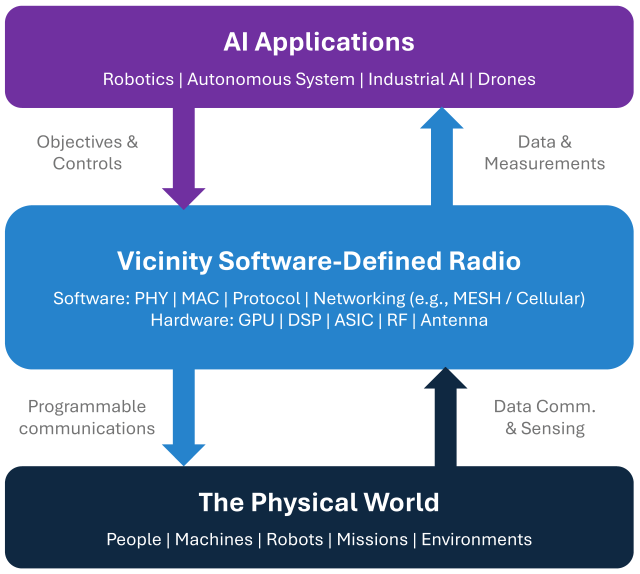
Radio measurements feed back into observation, decision and adaptation.
How does the AI layer talk to the radio?
The next step is to expose that feedback through application interfaces. An AI application states what information it needs and its delivery requirements; the communications software maps those requests to supported controls. This separates application intent from the details of radio implementation.
A robot may request priority for coordination messages and extra capacity for inspection images. The framework evaluates those requests against current resources, applies the supported settings and reports the resulting service. A request for a particular performance level is always checked against what the system can actually deliver.
Information also flows back. If a link degrades, the robot can reduce its upload rate, process more data locally, or reconsider a task that depends on remote information. Deciding what stays on the device is a local autonomy boundary question, and it belongs in the architecture rather than in a later firmware patch. Where the workload sits across the cloud, edge or hybrid split changes how much the radio has to carry, so it should be settled with the link budget rather than after it.
What goes wrong most often?
- Assuming open source is free. Adapting and optimising an open stack for a specific platform is substantial work, particularly where processing capacity and power are limited.
- Testing throughput only. Validation must cover latency and its variation, behaviour during movement or interference, recovery after interruptions, and operation with multiple devices.
- Ignoring processor load. A receiver improvement can raise processor load; a scheduling change can disturb other traffic. Updates need system-level assessment.
- Leaving acceptance criteria vague. Criteria should follow the application's needs, so a passing test demonstrates useful performance in the intended setting.
- Skipping regression discipline. Version control and careful feature integration are what keep new capabilities from breaking behaviour customers already rely on.
What does it take to reach a commercial product?
Turning a laboratory prototype into a commercial product requires the device to deliver the required wireless performance inside practical limits on power consumption, cost, size and heat, while remaining reliable and maintainable. Meeting those requirements depends on how efficiently the software uses the hardware, which is why platform-specific optimisation comes before scale-up.
Communications software IP supplies the algorithms, protocol implementation and hardware integration that make this practical. Vendors such as Vicinity, working across 5G base stations and terminals, positioning, D2D communications and non-terrestrial networks across multiple 3GPP releases, provide a starting point rather than a finished product. Standards establish interoperable behaviour; implementation choices determine the resources needed to deliver it.
Ownership and licensing deserve explicit attention. Customers keep ownership of their commercial products and control of their roadmap, but access to and rights to modify the underlying communications software depend on the agreed licensing arrangement. Making that distinction clear early prevents a support and roadmap problem later.
Chain position matters as much as the IP. A terminal improvement is hard to deliver when its requirements depend on infrastructure behaviour that cannot change; a base-station enhancement has limited value if connected devices cannot support it. Where a deployment permits control of both ends, coordinated development creates room to optimise the complete system, and partners across silicon, baseband, RF, antennas and core networks determine how quickly that room can be converted into a bill of materials.
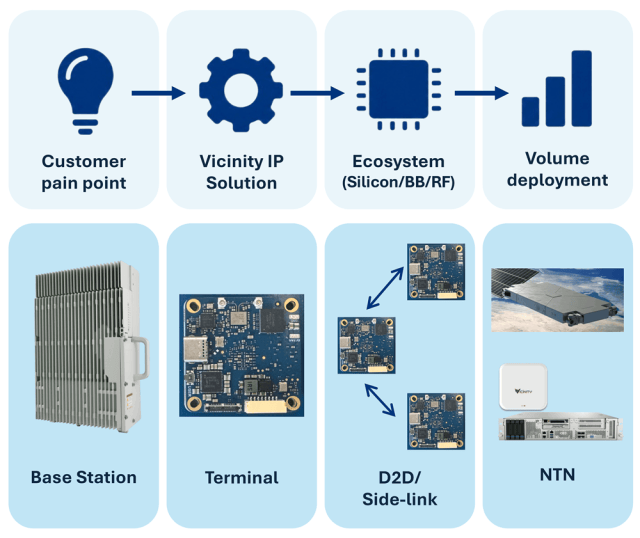
From a defined use case to a deployable product across the partner chain.
The budget line that moves first is not the modem bill of materials. It is validation and integration hours, and the schedule risk sits in the RF front end and the software partition, not in the protocol stack. A practical collaboration starts with a defined use case and measurable operating requirements, then selects the required capabilities, validates them together, and builds a route to commercial production.
FAQ
Is SDR the same as a 5G modem?
No. A standard modem is a fixed implementation that exposes a defined set of controls. SDR implements radio functions in programmable processing resources, so behaviour can be changed in software within the hardware's limits. Many products use both: a modem for the baseline link and programmable processing for specialised modes.
Does SDR mean writing my own PHY?
Not necessarily. Communications software IP supplies validated protocol implementation and hardware integration, so a team starts from a working baseline and modifies what the application actually needs. The cost is in integration and validation, not in writing every algorithm from scratch.
What does non-terrestrial support require on a device?
At minimum, a compatible RF chain and the protocol support to handle the timing and Doppler characteristics of a satellite link. Because 3GPP froze NR-NTN in Release 17 and extended it in Release 18, a device should be specified against a named release rather than a vague NTN-ready claim.
How much of the link do I need to control to benefit?
You benefit most where application requirements change after deployment or where a standard modem does not expose the behaviour you need. If your requirements are fixed and the modem covers them, the added validation burden of SDR may not pay back.