
Electronicseng General: Elektor System Check, Industrial RF Direction, FPGA Confidence, and AI Questions
This Electronicseng General briefing turns a community poll into a practical reading aid: it separates what respondents have tried, what development confidence looks like, and which obstacles keep technologies from reaching regular use in industrial RF topics covered by Elektor System Check. The point is not to rank tools by novelty, but to understand how survey signals can inform preparation, risk review, and learning paths for engineering teams that work with automation, wireless links, and connected systems.
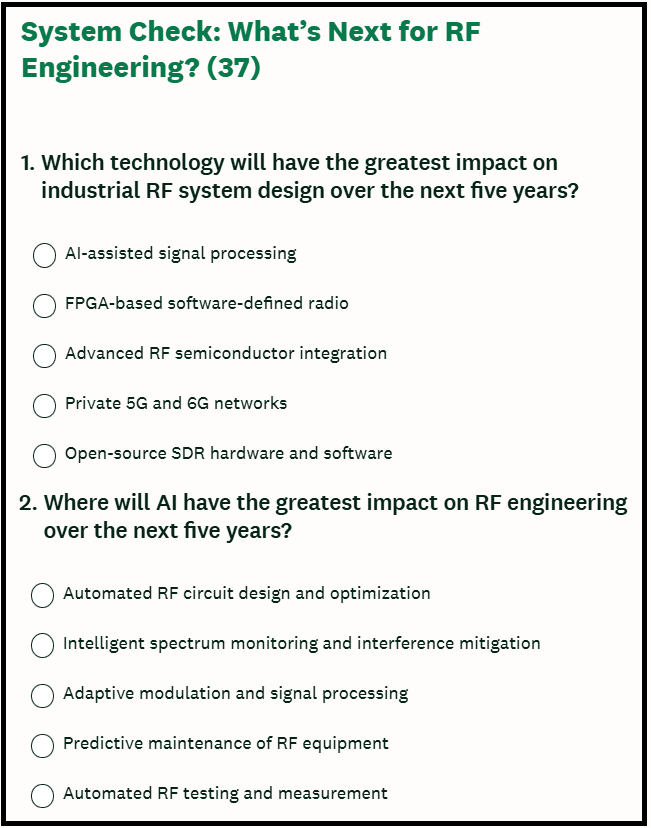
Industrial RF design is positioned here as part of broader infrastructure: automation relies on it, wireless communications depend on it, and connected systems bring it into daily operation. The newer System Check therefore asks the community to look forward rather than backward, asking which technologies may shape the future and where AI could matter most. This gives readers a way to read the survey as a scenario-planning input, not as a specification sheet.
Earlier FPGA results as a reusable signal
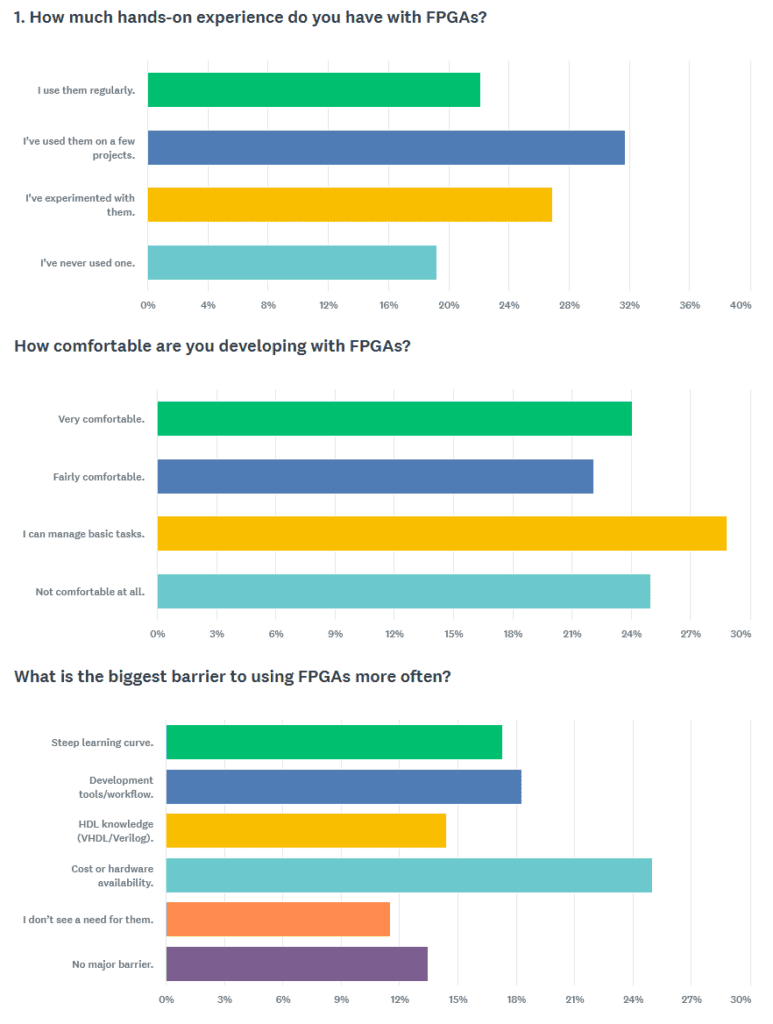
Before the RF future question, respondents were asked about FPGA involvement. The published pattern is useful because it shows a common gap in technical communities: awareness can be wide, while repeated production exposure is narrower. The figures below are quoted as survey signals, not as universal adoption targets.
Experience mix in the community
| Response category | Reported share |
|---|---|
| Uses FPGAs regularly | 22% |
| Has used FPGAs in several projects | 32% |
| Has experimented with FPGAs | 27% |
| Has never used an FPGA | 19% |
This distribution helps separate three different states that are often discussed as if they were the same: routine use, repeated project use, and exploratory use. In planning conversations, those states imply different needs: an established workflow, a pilot path, or a low-risk learning sandbox.
Development confidence is not a single number
| Confidence state | Reported share |
|---|---|
| Very comfortable with development | 24% |
| Fairly comfortable with development | 22% |
| Able to manage basic tasks | 29% |
| Uncomfortable with development | 25% |
Confidence is spread enough that a team should not assume a single skill baseline. The result also highlights that technical maturity in a broader field does not automatically transfer into comfort with a specific development model. This is a useful reminder for general engineering programs: adjacent expertise may reduce mystery, but it does not remove tooling, workflow, and syntax demands.
What respondents identified as barriers
- Cost and hardware availability appear as the leading constraint, around 25%.
- Development tools and workflows are cited by 18%.
- A steep learning curve is cited by 17%.
- HDL knowledge is cited by 14%.
- About 11% report no need for FPGAs.
- About 13% report no major barriers.
The barrier set is mixed. Some respondents appear constrained by access, while others are constrained by process, skill, or perceived relevance. That mix matters because the response differs: procurement and lab access address one category; training, templates, and toolchain reviews address another; use-case mapping addresses the “no need” and “no major barriers” categories.
What could broaden practical adoption
For the survey community, FPGAs remain appealing as a powerful option. The article identifies three directions that could make adoption easier: affordable hardware, approachable development environments, and practical learning opportunities. In a general engineering context, those can be read as readiness dimensions: cost of entry, usability of the path from idea to test, and availability of guided practice.
Engineering notes for general readers
Read as a method, this recap offers a way to treat survey data: look for whether a result describes exposure, confidence, constraint, or opportunity. Exposure tells whether a technology is present in daily practice. Confidence tells whether people feel able to use it. Constraint tells what stops the next step. Opportunity tells what change would make use more reachable. That framework is transferable to many hardware, embedded, and RF-adjacent decisions, even when the specific topic differs.
Quick evaluation checklist
- Define whether you are measuring first contact, repeated use, or production dependency.
- Ask whether confidence means basic tasks or comfortable development, because those are not equivalent.
- Separate availability barriers from workflow barriers before choosing a remedy.
- Map learning-curve concerns to concrete activities: guided exercises, examples, reviews, and tool familiarization.
- Treat “no need” responses as a fit question, not as a rejection of the technology itself.
Common misconceptions
- Confusing familiarity with readiness: the reported experience levels show that awareness and regular use can differ.
- Assuming one percentage tells everything: confidence and barriers are different questions, and they can point to different decisions.
- Reading the “no major barriers” response as “no action needed”: it may simply mean current needs are already met.
- Treating cost as the only obstacle: tools, workflow, learning curve, and HDL knowledge were also reported.
FAQ
What is being surveyed here?
The newer part of the Elektor System Check asks the community about industrial RF futures and where AI could matter most. The earlier part summarizes FPGA usage, development confidence, and barriers.
Why are FPGA results relevant to an industrial RF article?
Because the report uses the earlier System Check results as background evidence about how engineers experience a powerful technology: interest exists, exposure is uneven, confidence is mixed, and practical constraints vary.
Does the survey conclude that FPGAs are mandatory?
No. It reports that around 11% see no need, while 13% report no major barriers, and the adoption discussion focuses on affordability, usability, and learning opportunities.
Can the barrier list be used directly for planning?
It can be used as a signal, not as a substitute for project review. It helps decide what to ask: access, tooling, workflow, skill, and fit.
What should readers avoid doing with the data?
Avoid treating one percentage as a universal verdict. Separate experience, confidence, constraints, and opportunity before making decisions.