
Google Cloud TPU 8tx Confidential AI: What the 5th Gen AMD EPYC Host Actually Controls
Confidentiality in Google Cloud TPU 8tx is decided in the host, not inside the accelerator. It is the first cloud Tensor Processing Unit system with hardware-enforced confidential computing, and that property comes from 5th Gen AMD EPYC processors carrying the virtualization layer through AMD Secure Encrypted Virtualization (SEV): prompts, model weights and intermediate tensors remain encrypted until a connected TPU has been verified and admitted. The buying question therefore shifts from peak FLOPS toward host bandwidth, attestation latency and qualification cadence.
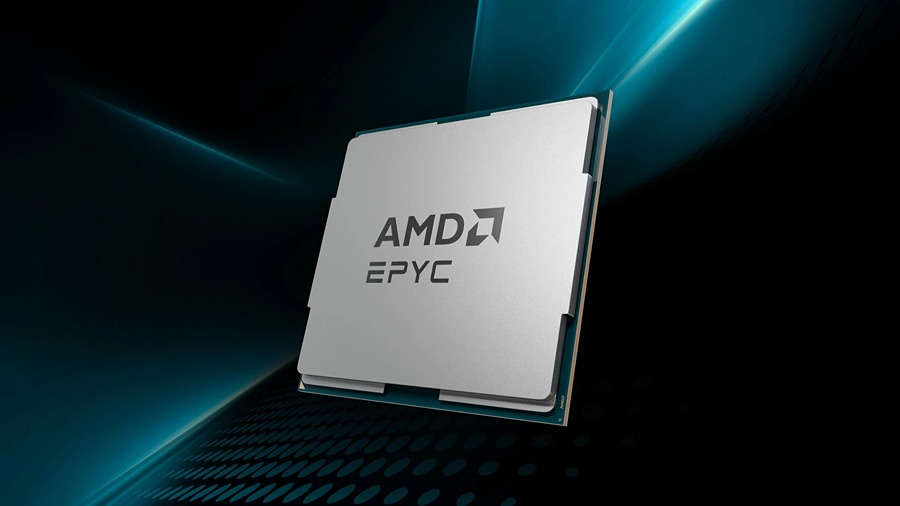
Google and AMD announced the TPU 8tx system on November 9, 2026; the host socket, not the accelerator die, is where the isolation boundary is drawn.
What Does Hardware-Enforced Mean on Google Cloud TPU 8tx
In one line: the trust boundary is anchored in CPU silicon and then extended outward to the accelerator, rather than being asserted by the hypervisor or the container runtime.
AMD states that 5th Gen AMD EPYC processors power the host infrastructure for Google Cloud TPU 8tx, which makes it the first cloud Tensor Processing Unit system to provide hardware-enforced confidential computing. Three separate mechanisms carry that claim, and it is worth naming them separately because engineers have to test them separately:
- Encrypted in-use memory. Workload orchestration, data preparation and high-throughput communication with TPU accelerators all run on the host, where the AMD Secure Encrypted Virtualization capabilities in EPYC processors — the building blocks of the wider AMD Infinity Guard feature set — keep customer prompts, model weights and intermediate data encrypted in CPU memory.
- Device admission before direct memory access. Before an accelerator is granted access to protected memory, its identity and security configuration are verified. That check, not encryption alone, is what turns a normal PCIe link into part of a trusted execution environment.
- Isolation during execution. Hardware isolation is maintained while the accelerator runs, so protection extends beyond the CPU into connected devices and in transit between host and accelerators.
This is not a new security island. AMD EPYC processors already underpin Google Cloud's confidential computing portfolio: Confidential VMs, Confidential GKE, Confidential Space, Confidential Managed Service for Apache Spark and Confidential Dataflow all rely on AMD SEV technologies. TPU 8tx extends the same host-rooted model to confidential AI acceleration, which is why the announcement matters more as a platform event than as a product launch. The practical payoff AMD describes is that enterprises can run inference, fine-tuning and reinforcement learning on sensitive data at scale, and can use private information inside reasoning and agentic AI applications.
Why the Host CPU Is the Control Point, Not a Footnote
Because every byte that reaches a TPU crosses host-managed queues first, the host's memory and I/O envelope caps what the accelerator can actually be fed.
The silicon in question is the EPYC 9005 series, code-named Turin, which AMD launched on October 10, 2024 on the Zen 5 and Zen 5c core designs, spanning 8 to 192 cores on a single SP5 socket. The platform numbers that matter for confidential inference are unglamorous but decisive: 12 DDR5 channels at up to 6,400 MT/s, up to 6 TB of memory per socket, and 128 PCIe Gen 5 lanes with CXL support. Those lanes are shared between accelerators, NICs and NVMe, so a host configuration that looks adequate in a GPU server can starve a TPU node whose tensors arrive as staged, batched and pre-tokenised payloads.
Two further details explain how the accelerator gets pulled inside the TEE. AMD's SEV-TIO white paper describes PCIe Integrity and Data Encryption (IDE) streams plus a device-measurement flow that lets a SEV-SNP guest establish trust in an assigned PCIe device, which is the generic mechanism behind "verified identity and security configuration." On the software side, kernel enablement is still moving: Linux 6.19 picked up the TSM (TEE-IO Device Security manager) and PCI trust path that device encryption depends on. Any engineer evaluating TPU 8tx should therefore ask two questions that the FLOPS datasheet never answers: what host CPU utilisation looks like during data preparation, and whether the attestation toolchain in the guest supports their kernel and driver baseline.
How Much Does Isolation Actually Cost
Short answer: the measurable penalty sits mostly in memory-bound host phases and in operational complexity, not in the accelerator's math. Long answer: treat any single percentage as workload-specific.
Published measurement work on AMD SEV-SNP and Intel TDX — including ACM Queue's practitioner write-up and academic benchmark studies — consistently finds that memory-encryption overhead on CPU-bound work stays in the low single digits, with the larger penalties landing in memory-intensive phases rather than in arithmetic kernels. Cloud vendors have published their own confidential-VM benchmark series on AMD SEV with Secure Nested Paging, including Oracle Cloud Infrastructure in October 2026. Since confidential inference is accelerator-bound, our own read — explicitly flagged as analysis rather than a vendor claim — is that the first-order cost is admission and orchestration time, not tokens per second.
| Cost dimension | CPU-only TEE (AMD SEV Confidential VMs) | Host + accelerator TEE (Google Cloud TPU 8tx) | What to measure in a PoC |
|---|---|---|---|
| Memory path | Encrypted DRAM traffic; low single-digit hit on CPU-bound code | Same host-side cost, plus staged tensor traffic into the accelerator | Tokens/sec delta at fixed batch and context length |
| Device admission | Not applicable; software stack only | Accelerator identity and security state verified before DMA | Cold-start and per-node restart latency |
| Software compatibility | Mature x86 guest image and tooling reuse | x86 host stack plus accelerator runtime and attestation services | Porting effort for existing serving code |
| Fleet change | Socket-level upgrade inside an existing platform generation | New accelerator generation, new host SKU, new attestation toolchain | Qualification cycles consumed per quarter |
| Power envelope | Host TDP ranges up to 500 W on flagship SKUs | Accelerator TDP dominates; host still sets rack floor | kW per rack and cooling headroom |
Where TPU 8tx Sits in the AI Silicon Supply Chain
The host CPU is designed in years before an accelerator generation ships, which is why the TPU 8tx decision reads as an attach-rate event.
AMD reports that for more than 10 leading hyperscalers and frontier AI labs, EPYC processors are the host CPU of choice, spanning systems built with AMD Instinct GPUs, Nvidia GPUs and custom accelerator silicon. That positions the x86 host as a neutral, repeatable control plane: a customer who has already qualified the CPU across accelerator options lowers the risk of adopting someone's Tensor Processing Unit, and keeps the established x86 software ecosystem intact.
Google Cloud Compute Engine is where that history is visible. The two companies have collaborated across multiple EPYC generations, covering general-purpose, compute-intensive, storage-intensive and accelerated workloads that lead up to current Google Cloud Compute Engine C4D, N4D, H4D, Z4D and G4 virtual machines. They have also worked at the corporate security level for years, including deep reviews of AMD security processor firmware by Google security experts — an unusually strong signal, because firmware review is a recurring engineering commitment, not a press-release item.
Cadence is the second-order effect worth watching. Google shipped TPU 8t and TPU 8i at Google Cloud Next in April 2026 and added TPU 8tx plus TPU 8i Max on November 9, 2026, taking the eighth-generation family to four systems in one calendar year. Each new system resets host qualification, driver validation and capacity planning; combined with the stateful, bursty agent workloads that push CPU capacity in data centers, this raises the value of a host platform whose socket, memory and lane budget stay stable across accelerator churn. The upstream constraint set is well documented in our constraint-by-constraint scorecard of wafer, package, tool and power: capital is accumulating ahead of delivered AI compute. Sizing of the confidential-computing market itself remains unreliable — Mordor Intelligence puts 2026 at USD 15.15 billion rising to USD 172.95 billion by 2031, while Precedence Research starts 2026 at USD 24.35 billion — so treat those figures as directional only.
Three Misreadings Worth Correcting
- "The TPU does the confidential computing." Enforcement is rooted in the host. AMD SEV carries the memory protection; the accelerator is admitted into that boundary only after verification.
- "Confidential computing means my model is encrypted at rest." At-rest and in-transit encryption are separate controls. What hardware isolation adds is protection while data is in use — the state that AI serving actually spends its time in.
- "Isolation always costs double-digit throughput." Measured CPU-side overheads cluster in the low single digits for compute-bound code; the real tax shows up in admission latency, attestation operations and fleet re-qualification.
Risks: What Can Break the Business Case
First, commercials. Google had not published pricing or general-availability dates for TPU 8tx or TPU 8i Max at announcement, so any confidential-inference cost model built today is a placeholder. Second, toolchain maturity: measured boot, device certificates and attestation-policy management are operational burdens that regulated buyers underestimate, and kernel or driver baselines can lag the hardware. Third, single-source host silicon: concentrating the trust root in one CPU vendor's secure processor simplifies the chain of trust but concentrates supply and firmware-vulnerability risk, on top of the HBM, substrate and test-time pressure already running through AI hardware. Fourth, compliance reality: hardware isolation is an input to a regulated-data programme, not a substitute for key custody, residency controls and audit evidence.
Action List for Engineers and Buyers
- Baseline the host first: measure CPU utilisation, DDR5 bandwidth occupancy and PCIe lane allocation during data preparation before comparing accelerator generations.
- Request the attestation flow in writing — what is measured, who verifies it, and what happens on a failed check at node restart.
- Verify your guest kernel and driver baseline against the trusted-I/O enablement path rather than assuming the hypervisor handles it.
- Model tokens-per-dollar with isolation overhead included, and rerun at your real context length and batching, not at the vendor's sweet spot.
- Book qualification capacity for the next two accelerator generations; four systems in twelve months is the cadence signal to plan against.
FAQ
Why pair Google's own TPU with a third-party x86 host at all?
Because the confidential-computing root has to live somewhere with a mature virtualisation and security-processor stack. 5th Gen AMD EPYC processors provide that root, and reuse across Confidential VMs, Confidential GKE, Confidential Space, Confidential Managed Service for Apache Spark and Confidential Dataflow means the verification model is already familiar to auditors.
What stays protected during a TPU 8tx run?
Prompts, model weights and intermediate data remain encrypted in CPU memory and in transit between host and accelerators, with hardware isolation maintained during accelerator execution.
Is this relevant if I am not running sensitive data?
It changes the conversation less for public-model serving than for fine-tuning, reinforcement learning and agentic pipelines that touch customer records, clinical or financial corpora, or licensed models a provider will not release without in-use protection.
Which workloads did AMD explicitly call out?
Inference, fine-tuning and reinforcement learning at scale, plus reasoning and agentic AI applications that need sensitive information in the loop.
Bottom Line: Follow the Qualification Curve, Not the Peak FLOPS Number
The headline is a confidential accelerator; the engineering story is a host platform that has been qualified long enough and widely enough — more than 10 hyperscalers and frontier labs, and the C4D, N4D, H4D, Z4D and G4 line on Google Cloud Compute Engine — to absorb a fourth TPU system in one year without resetting the entire fleet. For capacity planning, read the next four quarters as follows: confidential-inference demand will be gated by pricing disclosure and attestation tooling, while host-CPU attach stays the durable part of the design-in. Track the yield and qualification curve of the host-plus-accelerator combination rather than the isolated throughput figure, and treat any 2026 confidential-computing market number as an estimate with wide error bars.
Sources
- AMD investor relations, "AMD EPYC Expands Its Leadership at the Foundation of AI" — https://ir.amd.com/news-events/press-releases/detail/1304/amd-epyc-expands-its-leadership-at-the-foundation-of-ai
- Google, "Our newest TPUs: 8tx and 8i Max, built for the agentic era" (November 9, 2026) — https://blog.google/innovation-and-ai/infrastructure-and-cloud/global-network/tpu-8i-max-and-8tx/
- AMD, "SEV-TIO: Trusted I/O for Secure Encrypted Virtualization" white paper — https://www.amd.com/content/dam/amd/en/documents/developer/sev-tio-whitepaper.pdf
- AMD, Secure Encrypted Virtualization developer page — https://www.amd.com/en/developer/sev.html
- Lenovo Press, 5th Gen AMD EPYC platform specifications (SP5, 12-channel DDR5-6400, 128 PCIe Gen 5 lanes) — https://lenovopress.lenovo.com/lp2038-lenovo-thinksystem-servers-with-5th-gen-amd-epyc
- D. Kaplan et al., "Enabling confidential computing with AMD SEV-SNP," ACM Queue — https://queue.acm.org/doi/10.1145/3623392
- Oracle Cloud Infrastructure, SEV-SNP performance-impact benchmarks on Confidential VMs — https://blogs.oracle.com/cloud-infrastructure/amd-sev-snp-performance-on-oci-confidential-vms
- LWN, "PCI/TSM: Enabling core infrastructure on AMD SEV-TIO" — https://lwn.net/Articles/1046061/
- ServeTheHome, "Google TPU 8tx Pairs AMD EPYC Turin Hosts with Confidential Computing" — https://www.servethehome.com/google-tpu-8tx-8i-max-amd-epyc-turin/
- Mordor Intelligence, Confidential Computing Market — https://www.mordorintelligence.com/industry-reports/confidential-computing-market