
Semiconductor Design Choices: ABLIC's viewphii Ultrasound Stack vs. Battery-less Leak Sensing, Compared
For teams weighing an integrated analog front end against a discrete probe build, or wired rope sensing against energy-harvesting detection, ABLIC's two fastest-moving product families — the viewphii ultrasound transmitter/receiver stack and the CLEAN-Boost TM battery-less water leak sensor — trade silicon cost for cabling, wiring and maintenance labour. Both can now be scored against conventional alternatives on voltage headroom, detection physics, retrofit effort and supply risk. This evaluation does exactly that, and closes with where each option is the correct design-in.
How is one analog supplier still growing in a flat cycle?
Short answer: application-specific analog, not commodity supply. Satoshi Hanazawa, Director, Senior Vice President and CPO, describes the company as a comprehensive analog semiconductor manufacturer organised around five key sectors — lithium-ion battery protection, automotive power management ICs, medical and high-voltage applications, magnetic and temperature sensors, and battery-less water leak sensors. The thread linking them is a low-power-consumption discipline inherited from watch semiconductors and refined over more than half a century.
The number that matters to buyers: the analog market stayed flat from 2023 to 2025 under post-pandemic excess inventory and correction, yet the company still recorded over 10% year-over-year sales growth in FY 2025. Hanazawa attributes this to consistently delivering high-value-added parts that customers select first.
Put that next to the macro picture. World Semiconductor Trade Statistics projected the total semiconductor market to grow 22% to USD 772 billion in 2025 and by more than 25% to about USD 975 billion in 2026, with memory and AI logic leading the curve, while third-party trackers size the analog segment near USD 94 billion in 2025 rising to roughly USD 99 billion in 2026. Read together, double-digit analog growth during a flat segment is outperformance rather than a tide-lift — a signal that design-in activity is concentrating in differentiated signal-chain silicon. Hanazawa notes the AI sector already draws fierce competition and demands rapid response, and flags humanoid robots, commercial drones and autonomous driving as the next demand pools.

Is an integrated TX/RX chipset better than a discrete ultrasound front end?
Verdict: yes, when the probe itself is the product; no, when channel count and thermal budget are unconstrained. ABLIC's strength has been transmitter ICs for ultrasound diagnostic systems. In December 2024 the company acquired Socionext's medical business, adding low-power, compact, lightweight receiver LSIs with high diagnostic image quality, and converting a transmit-only position into complete transmitter-receiver solutions. Hanazawa's framing is that combining transmission and reception technology is what allows the viewphii series for handheld devices to keep evolving.
The voltage jump is the part engineers should evaluate first. Product materials cite viewphii-Gen 3, a digital pulser IC supporting a ±100V transmit voltage for medical applications; ABLIC's own newsroom states that this new pulser raises output from ±40V in the previous generation, and that the third-generation model is scheduled for mass production in 2027. A higher transmit rail excites the piezo elements harder, which improves sensitivity from deep tissue and from small vessels — the classic weakness of battery-powered handheld probes. The trade-off, stated as analysis rather than vendor claim, is that a ±100V rail pulls in high-voltage switch ICs, tighter EMI and isolation layout rules, gate-drive losses and probe-cable parasitics, so the integration has to be judged at system level, not per chip.
Timing for evaluation is near: the expanding viewphii handheld series is scheduled to be presented at RSNA 2026 in Chicago, Illinois, this November, alongside the lineup and roadmap for transmitter ICs and high-voltage switch ICs targeting higher performance, functionality and reliability for conventional cart-based systems. ABLIC's long-standing collaboration model with medical device manufacturers lets OEMs evaluate ICs early in development and move quickly to mass production once parts are complete, which is why medical-related business has been growing fast.
| Front-end option | Transmit rail | Integration | Portability | Where it wins |
|---|---|---|---|---|
| Cart-based system (discrete pulser, HV switches, system beamformer) | Typical high-voltage rails, large channel counts (industry practice, not a vendor figure) | Low per-chip, high at board level | Mains-powered, bench-bound | Deep imaging, high channel count, unrestricted thermal budget |
| Handheld probe, previous-generation digital pulser | ±40V (ABLIC newsroom) | Medium-high | Single-probe, battery-friendly | Point-of-care scanning, lowest system cost |
| viewphii third-generation model / viewphii-Gen 3 | ±100V | High — TX and RX in-house after December 2024 | Keeps compact, lightweight form factor | Deep-tissue and micro-vessel definition without giving up portability |
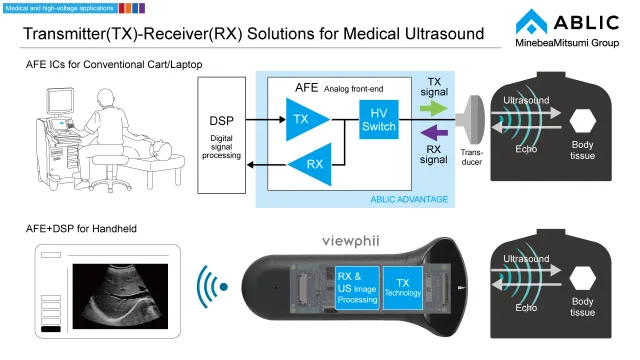
Figure: transmit–receive chipset pairing for ultrasound diagnostic systems (image credit: ABLIC).
When does a battery-less sensor beat conductive rope in a liquid-cooled facility?
Verdict: wherever wiring is the cost, and wherever the liquid has low conductivity. The battery-less water leak sensor runs on CLEAN-Boost TM, a power storage and boost circuit technology. The wireless node harvests the tiny electrical charge produced when it contacts water, which lets it register a few drops and cuts false alarms. Most competing sensors read the resistance change between electrodes; ABLIC's device instead exploits the chemical reaction between water and metal, so it still responds to pure water with low electrical conductivity — the condition in which conventional conductive detection goes blind.
Demand is moving from its historic home. These sensors were traditionally fitted in factories and buildings, but water-cooled AI servers are pulling enquiries from data centers. Because there is no power wiring and no battery replacement, the bands can be retrofitted into existing infrastructure in large data centers and smart city developments in Europe. Adoption is already broad in Japan, with a strong track record and trial tests under way at several infrastructure facilities; for the US and EU markets the company obtained FCC certification, a communication and safety standard, and started sales last year. In June 2026 the sensor appeared at an international trade show overseas for the first time, BOMA 2026 in Los Angeles, California, where it attracted considerable interest. Field evidence outside buildings is also emerging: ABLIC reported that verification results for the sensor on an actual bridge were presented at the JSCE Conference.
Hardware changes shipped with the Western rollout are worth noting in a spec comparison. For the US and EU launch, the Japan-market model was upgraded with roughly twice the communication range of its predecessor and a wider operating-temperature envelope, up to 85°C, according to ABLIC's October 2025 release and subsequent trade coverage. Vendor product pages list Bluetooth Low Energy 5.0 beacon transmission, sensing bands in 0.5 m, 2.0 m and 5.0 m lengths, sub-five-minute reporting in tap water, and a LoRa variant under development — figures to confirm against datasheets before committing a design.
Market pull can be sized with third-party estimates, which differ but converge in direction: MarketsandMarkets put data center leak detection systems at about USD 400 million in 2025 and USD 1.3 billion by 2032, while Stratview Research has liquid cooling rising from USD 2.2 billion in 2025 to USD 7.9 billion by 2031 at a 23.2% CAGR. Treat these as order-of-magnitude signals, not procurement inputs.
| Approach | Power | Low-conductivity water | Retrofit effort | Maintenance | Known weakness |
|---|---|---|---|---|---|
| Conductive rope / cable (electrode resistance) | Loop or mains-powered controller | Poor — needs ions in the liquid | Cabling plus controller runs | Rope replacement and periodic calibration | Condensation and cleaning water can trigger alarms; contamination degrades the sensing element |
| Battery wireless point sensors | Internal cell | Depends on probe conductivity threshold | Low | Battery swaps across a large node fleet | Dead nodes are usually discovered too late |
| CLEAN-Boost TM battery-less band | Harvested from the water–metal reaction itself | Yes, by design | No power wiring, no battery to replace | Band is the consumable, not a cell | Analysis: energy exists only while wet, so dry-state link integrity must be handled by the gateway or inspection routine |
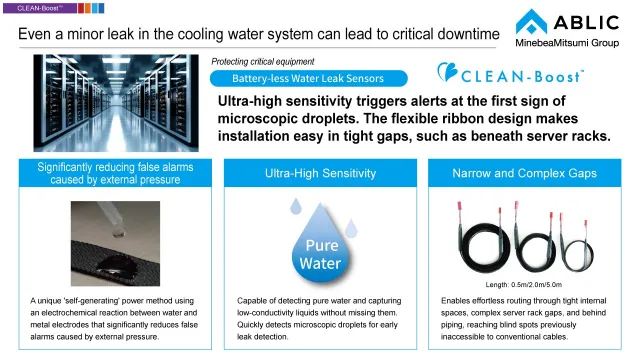
Figure: characteristics and deployment overview of battery-less water leak sensors aimed at data centers (image credit: ABLIC).
Where do ESS, BBU and 48 V protection fit in the same roadmap?
Verdict: the boring, high-volume anchor under the two headline growth lines. Beyond medical and leak sensing, the company intends to propose lithium-ion battery protection solutions for industrial equipment, including energy storage systems (ESS) and battery backup units (BBUs) that guard against momentary power interruptions in AI servers. It will also expand the lineup to include 48 V-compatible products so in-vehicle power supplies can cover a broad range of electric vehicles (EVs) and related applications. That 48 V direction is not hypothetical: ABLIC's product news for September 2025 lists an automotive high-voltage regulator IC targeted at 48 V auxiliary batteries, which indicates the high-voltage capability feeding the roadmap is already being packaged and shipped in adjacent parts.
For buyers, the practical read is that protection front ends inherit the same low-power DNA as the growth lines, but their qualification cycle is governed by automotive and grid standards rather than by imaging or facility demos. Assume longer design-in, and lock in second-source planning accordingly.
Does the Small Smart Simple proposition survive a spec comparison?
Asked how the company will use its strengths amid fierce global semiconductor competition, Hanazawa said the organisation is committed to a vision of inspiring customers with Small, Smart, Simple analog semiconductor solutions — the positioning the marketing shorthand calls Small Smart Simple. It began with semiconductors for watches and has always prioritised low power consumption, and that philosophy still shapes today's business. The stated next step is to explore how these strengths can be applied for customer benefit and to consider technology combinations that contribute in new fields, producing even higher added value, with new areas planned to become the sixth and seventh pillars of the business.
Development economics matter as much as the slogan. Hanazawa said the company aims to raise the share of new products in total sales and is progressing as planned; investment continues in technology and talent, and M&A remains one route to high-value-added products. ABLIC is also working to lift development efficiency with AI, intending to train models to acquire design expertise so they can eventually handle all stages of the process — while insisting that humans make all final decisions, and consulting EDA vendors on how to proceed given security concerns. For analog, where much of the know-how is tacit and layout-bound, the realistic near-term payoff is faster verification and documentation, not autonomous tape-outs; that assessment is analysis, not a company statement.
Design-in checklist: five questions before you commit
- Conductivity of the actual liquid. If the loop can carry deionised or low-ion fluid, electrode-resistance sensing is disqualified; specify a mechanism that works on the chemistry, not the spec sheet.
- Transmit rail and its system cost. A ±100V pulser buys penetration; confirm what isolation, gate drive, EMI filtering and connector rating it forces elsewhere in the probe.
- Dry-state reporting. For harvest-powered nodes, define how the gateway proves a sensor is alive when no water is present.
- Certification status for the target geography. FCC certification covers the US rollout; map CE/RED or local equivalents before a Europe-wide tender.
- Roadmap versus shipping parts. Separate what is sampling now from what is only scheduled, such as a third-generation model targeted for mass production in 2027.
Common misconceptions in this comparison
- "Battery-less" means "maintenance-free forever." It removes the cell, not the sensing band, which remains a replaceable element.
- All leak cables are equivalent. Conductive rope reacts to condensation and cleaning water and struggles with low-conductivity fluids — two of the most frequently reported false-alarm causes in facility guidance.
- Double-digit analog growth proves the segment recovered. The market itself was flat from 2023 to 2025; the growth is company-specific mix.
- Handheld ultrasound is just a smaller cart. The limiting factor is transmit voltage headroom, which is precisely what the step from ±40V to ±100V addresses.
FAQ: what engineers and procurement ask first
Is the battery-less water leak sensor purchasable outside Japan today?
Yes for the US and EU markets: FCC certification was obtained and sales began last year, with distributor listings carrying the sensor and wireless tag. The first overseas trade-show demonstration outside the domestic market was June 2026 at BOMA 2026 in Los Angeles, California.
What is the concrete benefit of moving to a ±100V transmit voltage?
Higher excitation voltage improves echo strength from deep tissue and small vessels, which is why viewphii-Gen 3 is positioned for higher-definition imaging while keeping the compact, lightweight and long-runtime character of earlier handheld models. Mass production of the third-generation model is scheduled for 2027, with a first public showing of the wider series at RSNA 2026 in Chicago, Illinois, this November.
Why did the Socionext transaction change ABLIC's competitive position?
Before December 2024 the portfolio was strong on the transmit side. Acquiring Socionext's medical business delivered low-power, compact, lightweight receiver LSIs, so the company can now sell a matched transmitter-receiver solution instead of half a signal chain.
Which five sectors should a supply-chain analyst track?
Lithium-ion battery protection, automotive power management, medical and high-voltage, magnetic and temperature sensors, and battery-less water leak sensors — the five key sectors Hanazawa lists. Medical and high-voltage applications and the CLEAN-Boost TM leak sensor are described as the highest-growth pair, with new fields intended as the sixth and seventh pillars.
Action recommendations by role
- Probe and system designers: benchmark a ±100V digital pulser against your current ±40V-class transmit stage on penetration and colour Doppler sensitivity before accepting the isolation and EMI penalty; request early evaluation ICs rather than waiting for production parts.
- Facility and data center engineers: pilot harvest-powered bands on CDU and manifold lines where retrofit wiring is the constraint, and pair them with a gateway health-check policy that compensates for dry-state silence.
- Procurement and supply-chain managers: treat the flat 2023 to 2025 analog backdrop as resolved for this supplier — over 10% growth in FY 2025 indicates capacity and roadmap commitment — but still dual-source protection ICs, whose automotive qualification cycles are long.
- Analysts and technical management: watch three dated checkpoints: the November 2026 RSNA 2026 display, the 2027 mass-production gate for the third-generation model, and whether the announced 48 V-compatible protection products convert into shipping SKUs.
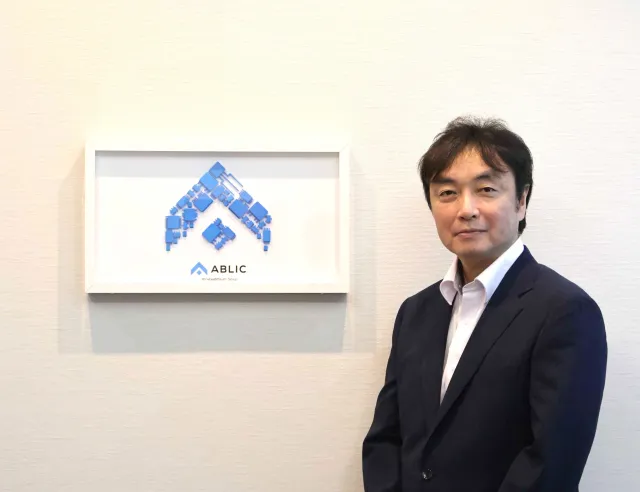
Figure: the CPO's roadmap briefing — from watch-grade low power to medical, high-voltage and harvest-powered sensing (image credit: ABLIC).
References
- ABLIC — "Battery-less Water Leak Sensor Rolled Out in U.S. & E.U. Markets" (28 October 2025): https://www.ablic.com/en/semicon/news/2025-10-28/bl_waterleaksensor_useu_market/
- ABLIC — "ABLIC Begins Sampling of viewphii-Gen 3 Handheld Ultrasound Solution" (22 October 2026): https://www.ablic.com/en/semicon/news/2026-10-22/viewphii_gen3/
- ABLIC — "ABLIC Strengthens Semiconductor Portfolio for Ultrasound Diagnostic Equipment with Socionext Medical Business Acquisition": https://www.ablic.com/en/semicon/news/2025-04-08/healthcare_content/
- EDN — "ABLIC upgrades battery-less water leak detection sensor" (11 November 2025): https://www.edn.com/ablic-upgrades-battery-less-water-leak-detection-sensor/
- WSTS — Global semiconductor market forecasts: https://www.wsts.org/76/103/WSTS-Semiconductor-Market-Forecast-Spring-2025
- MarketsandMarkets — Data Center Leak Detection Systems Market: https://www.marketsandmarkets.com/Market-Reports/data-center-leak-detection-systems-market-21001589.html
- Stratview Research — Data Center Liquid Cooling Market: https://www.stratviewresearch.com/market-reports/data-center-liquid-cooling-market.html
- Fortune Business Insights — Analog Semiconductor Market: https://www.fortunebusinessinsights.com/analog-semiconductor-market-112121
- Watts — "Choosing Data Center Leak Detection Technology": https://www.watts.com/blog/choosing-data-center-leak-detection-technology
- Teracom Systems — "Type Water Leak Sensors: Point vs. Rope": https://www.teracomsystems.com/blog/comparing-point-and-rope-type-water-leak-sensors-which-is-right-for-your-application/
- Mouser — ABLIC Battery-less Water Leak Sensors product page: https://www.mouser.ec/new/ablic/ablic-battery-less-water-leak-sensors/