
Advantech MIC-743-AT AI inference system vs Jetson Thor Dev Kits, T4000 Boards and Orin Boxes: A Semiconductors Comparison by Electronicseng
By Rachel Williams, Electronics & Engineering — Semiconductors desk · Editorial contact: info@electronicseng.com
Verdict first: choose the MIC-743-AT AI inference system when the unit that leaves your bench is the unit that ships into cabinets, AGVs and robot tethers. It packages NVIDIA Jetson Thor T4000/T5000 modules into a rugged carrier with 19V–36V DC input, 1 TB local storage and industrial I/O. The NVIDIA dev kit wins for bring-up, and the T4000-class boards win on price and power. Stocking was announced by Mouser Electronics, Inc., which shortens qualification for teams already inside that supply chain.
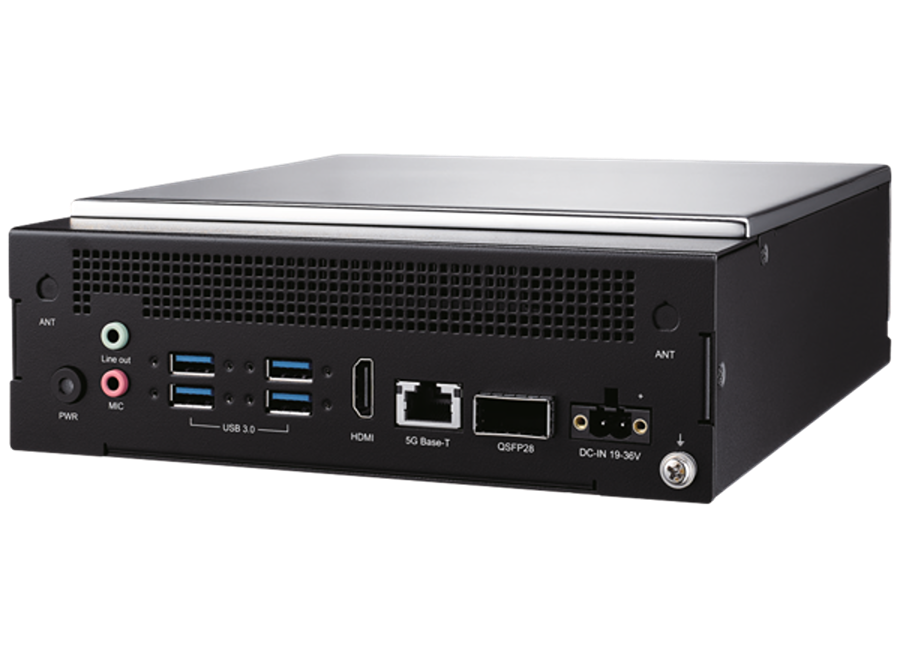 Advantech MIC-743-AT AI Inference System.
Which Jetson Thor platform should you actually buy for an industrial edge-AI build?
All four options below run on the same Blackwell-derived silicon family, so the differentiators are carrier-board ruggedness, memory envelope, sustained thermal headroom and procurement lead time — not headline FLOPS. The comparison table is organised the way a design review asks the question: what does the SKU give you on day one, and what does it force you to engineer around?
| Platform | Rated AI compute | Memory envelope | CPU / accelerator | Power & thermal | Best-fit role |
|---|---|---|---|---|---|
| Advantech MIC-743-AT AI Inference System | up to 2,070 TFLOPS (FP4) | 128 GB LPDDR5X, 1 TB pre-installed SSD | 14-core Arm Neoverse V3AE 64-bit; 2560 NVIDIA CUDA cores, 96 5th Gen Tensor cores at 1.57 GHz | 19V to 36V input; -10°C to 35°C at 0.7 m/s airflow | Production edge inference, LLM/VLM serving, multi-sensor fusion |
| Jetson AGX Thor Developer Kit (T5000) | 2070 FP4 TFLOPS | 128 GB, 273 GB/s bus (NVIDIA published figure) | Blackwell GPU + 14-core Neoverse CPU | Module power configurable 40 W to 130 W | Software bring-up, model porting, benchmarking; launch price reported at $3,499 (Aug 25, 2025) |
| Advantech Thor development boards | up to 1,200 FP4 TFLOPS | 64 GB class | 12-core CPU configuration | T4000-class window, 40 W to 70 W per NVIDIA | Cost- and power-constrained pilots, single-camera VLM workloads |
| Jetson AGX Orin 64GB carrier (legacy) | 275 TOPS (INT8, sparse) | 64 GB LPDDR5, 204.8 GB/s | 12-core Arm Cortex-A78AE; 2048 CUDA cores | Typically 15 W to 60 W | Existing designs with long qualification life; upgrade case only on model-size pressure |
The practical reading: this is a carrier-board decision, not a chip decision. The Advantech box is the only row in the table that specifies an industrial input range and a defined airflow condition, which is exactly what a control-cabinet integrator needs in a datasheet line.
What silicon and interfaces does the MIC-743-AT put on the board?
Conclusion: a full T5000-class compute payload plus the connectivity a deployed machine actually needs, with the AI stack pre-installed rather than assembled by your team.
- Compute module: powered by NVIDIA Jetson Thor modules in the T5000 / T4000 configuration, rated up to 2,070 TFLOPS.
- Memory and storage: 128 GB LPDDR5X shared between CPU and GPU, plus a 1 TB NVMe SSD as the local model and log cache.
- Processor: 14-core Arm Neoverse V3AE 64-bit SMP CPU, with 2560 NVIDIA CUDA cores and 96 5th Gen Tensor cores at 1.57 GHz MAXN.
- Host I/O: HDMI, USB 3.2 Gen 2, M.2 AEkey for Wi-Fi and M.2 Bkey for LTE, so a remote robot or line-side cabinet can stay reachable without a separate gateway.
- Software baseline: NVIDIA Jetpack 7.0 installed, giving CUDA 13.0 / Ubuntu 24.04 toolchains rather than a bare board.
- Electrical and environmental: 19V to 36V input range, operating from -10°C to 35°C with 0.7 m/s airflow.
Two numbers that are missing from the product summary but decide real system behaviour: NVIDIA's Jetson Thor page lists the module's memory bandwidth at 273 GB/s and a configurable module power window of 40 W to 130 W. Bandwidth and sustained power, not tensor-core count, are what an engineer must model before promising frame rates.
Why doesn't 2,070 TFLOPS (FP4) translate into model throughput?
Conclusion: treat the FP4 figure as an architecture ceiling, not a throughput budget. Vendor peak numbers in this class are quoted in FP4 sparse terms; production models rarely run at that density and precision simultaneously.
Three effects compress the usable number. First, sparse-vs-dense accounting: the same silicon is described as delivering 2070 FP4 TFLOPS in sparse form, so a dense-workload estimate is materially lower. Second, decode is bandwidth-bound. In autoregressive generation, each token requires a full weight pass, and the ceiling is closer to 273 GB/s divided by bytes-per-token than to the tensor-core peak; on edge parts, achieved utilisation in the 30%–50% range is common practice, which is analysis rather than vendor data and should be validated per model. Third, quantisation is a quality decision: FP4 weights and KV cache save memory, but accuracy loss must be measured on your own evaluation set before the SKU is fixed.
The 128 GB pool is the genuine differentiator here. It lets a team keep a quantised 30B-class model resident while still allocating capacity for VLM encoders, video-analytics graphs and runtime buffers on one machine. As RidgeRun's Jetson Thor feature guide puts it, the platform targets applications that "demand server-class AI performance and extensive I/O at the edge" — the multi-model resident case is precisely where the cheaper 64 GB boards stop being viable.
How does Thor compare with the Orin baseline your team already knows?
Conclusion: the upgrade case is memory capacity and multi-modal latency, not a like-for-like TOPS swap.
NVIDIA positions Jetson Thor at roughly 7.5× the AI performance and 3.5× the efficiency of AGX Orin, a vendor claim that should be re-measured on your workload before it enters a design spec. In hardware terms, the shift from an Orin 64GB design is concrete: tensor cores move from the 4th generation to 5th Gen, the CPU moves from Cortex-A78AE to the 14-core Arm Neoverse V3AE server-class core, and bandwidth rises from 204.8 GB/s to a published 273 GB/s. For perception-only pipelines already meeting latency, those gains mostly buy integration headroom — collapsing two Orin boxes and a separate x86 gateway into one chassis. For teams running LLMs, the memory jump from 64 GB to 128 GB changes which models are even deployable on-site.
Migration cost is real: the Orin stack is JetPack 5/6 era, while this box ships NVIDIA Jetpack 7.0, and Isaac ROS 4.x releases are documented as requiring JetPack 7.0 or later on Thor. Budget a toolchain port for drivers, ROS nodes and custom CUDA kernels before the first prototype build.
Which thermal, power and I/O constraints decide the enclosure?
Conclusion: the 35°C ceiling at 0.7 m/s is the tightest number in the whole spec, and it is a mechanical-engineering requirement, not a footnote.
- Airflow, not just ambient rating: the specified operating window assumes 0.7 m/s forced airflow across the heat path. Sealed, conduction-cooled cabinets that pass for lower-power modules will throttle a T5000-class board. Published Jetson thermal guidance for other platforms shows designs rated to 60°C at the same 0.7 m/s condition, so this unit's 35°C figure implies conservative derating near heat-dense neighbours.
- DC-only input: 19V to 36V means robot battery packs and 48V industrial rails need a converter stage; size that for the module's 40 W to 130 W envelope, not for the nominal 19V brick.
- Sensor fan-in: high-bandwidth camera and GMSL-class aggregation plus industrial connectivity is the reason a carrier exists at all. Related family SKUs in Advantech's April 2026 MIC-AI launch, such as the MIC-741-AT, add an SFP28 25GbE port and support for up to 8-channel GMSL aggregation — check whether you need that I/O or the MIC-743-AT's HDMI and USB mix.
- Local storage: the 1 TB SSD should be treated as a model-repository and recording buffer, with a rotation policy agreed before deployment.
What are the common misconceptions before you spec it?
- "Peak TFLOPS equals my inference speed." It does not; sparse FP4 accounting and memory bandwidth set the practical ceiling.
- "Any fanless box works." The 0.7 m/s airflow assumption is part of the rating — validate it with a hot-bench run, not only simulation.
- "128 GB of memory means a 128 GB model." Shared CPU/GPU addressing, KV cache growth and vision encoders eat the pool quickly.
- "Dev kit and production unit are interchangeable." The dev kit is a $3,499-class reference platform; the carrier board, input range and temperature window are where field failures appear.
- "Software support is automatic." Isaac ROS and robotics middleware versions are tied to JetPack 7.0; the ecosystem support matrix moves monthly.
What should design and procurement teams do next?
Conclusion: benchmark with a dev kit, qualify the carrier early, and hedge the module SKU.
- Run your own FP8 and FP4 quantised models on a Thor reference platform and record tokens/s plus accuracy delta; do not accept a datasheet number into the requirement document.
- Do a thermal dry-run in the target enclosure at the worst-case ambient, verifying the 35°C figure with the fan curve you can actually build.
- Confirm the 19V to 36V conversion stage and the total system power budget against the 40 W to 130 W module window.
- Pilot one production-grade carrier rather than a fleet of dev kits; Mouser is the announced stocking channel, and buyers there can expect traceable parts — the distributor states products are 100% certified and genuine, with design support through its Technical Resource Center.
- Hedge the silicon: the Thor family now runs from the 400 TFLOPS-class T2000 and the 865 FP4 TFLOPS T3000 (32 GB LPDDR5X, 273 GB/s) up to T5000. Designing your software layer to tolerate a step-down module protects you against single-SKU supply risk in 2027 builds.
- Freeze a JetPack version and an Isaac ROS release pair in your build system; the version coupling documented in release notes is the most common late-project blocker.
FAQ: engineers' most-searched questions about this class of edge-AI box
Is the MIC-743-AT a computer or just a carrier board?
It is a finished inference system: the carrier integrates NVIDIA Jetson Thor T4000/T5000 modules with memory, storage, HDMI, USB 3.2 Gen 2 and wireless M.2 slots, delivered with the NVIDIA Jetpack 7.0 stack installed. You supply the enclosure, power conversion and sensors.
When is 128 GB genuinely necessary?
When you need a large language model resident on-device alongside vision-language or video-analytics graphs, or when several models must be hot-swapped without loading from the 1 TB SSD. Single-camera pipelines are usually better served by a 64 GB board and its lower cost and power.
Can it run fanless in a sealed cabinet?
Not within the published rating. The -10°C to 35°C operating range is specified with 0.7 m/s airflow, so a sealed conduction path must be engineered and then verified thermally before you claim equivalence.
What is the realistic upgrade case from AGX Orin?
Model capacity first, speed second. Orin 64GB boxes at 275 TOPS and 204.8 GB/s handle perception well; Thor's 128 GB pool, 273 GB/s bus and 5th Gen Tensor path are what make on-device generative and agentic workloads tractable.
Sources consulted
- NVIDIA — Jetson Thor series specifications page: https://www.nvidia.com/en-us/autonomous-machines/embedded-systems/jetson-thor/
- NVIDIA Newsroom — Blackwell-powered Jetson Thor availability, August 25, 2025: https://nvidianews.nvidia.com/news/nvidia-blackwell-powered-jetson-thor-now-available-accelerating-the-age-of-general-robotics
- NVIDIA Developer Blog — Jetson T4000 and JetPack 7.1 inference guidance: https://developer.nvidia.com/blog/accelerate-ai-inference-for-edge-and-robotics-with-nvidia-jetson-t4000-and-nvidia-jetpack-7-1/
- NVIDIA Blog — Jetson T3000 and T2000 for mainstream robotics, July 2026: https://blogs.nvidia.com/blog/jetson-thor-robotics-edge-ai-agent/
- Advantech — MIC-AI series launch press release: https://www.advantech.com/en-us/resources/news/advantech-launches-the-mic-ai-series-powered-by-nvidia-jetson-thor-enabling-next-generation-agentic-ai-with-openclaw-and-nvidia-nemotron
- Isaac ROS release notes — JetPack 7.0 / CUDA 13.0 platform support: https://nvidia-isaac-ros.github.io/releases/index.html
- Jetson AI Lab — Jetson AGX Orin 64GB module reference data: https://www.jetson-ai-lab.com/tutorials/intro-to-jetson/
- Things Embedded — Jetson thermal design guidance: https://things-embedded.com/us/white-paper/nvidia-jetson-thermal-design-guide-unleash-peak-ai-performance/
- RidgeRun Developer Guide — Jetson Thor features overview: https://developer.ridgerun.com/wiki/index.php/NVIDIA_Jetson_Thor:_Powering_the_Future_of_Physical_AI
Prepared by the Electronicseng Semiconductors desk, Electronics & Engineering. Corrections and design-in questions: info@electronicseng.com.