
Long-Life Semiconductor Lifecycle Planning Under AI Memory Demand — Electronicseng Semiconductors
For teams whose equipment is expected to remain in service for decades, the most consequential effect of the current artificial-intelligence build-out is not in the data center at all. AI demand is redirecting memory manufacturing capacity and capital, and the devices that inherit that pressure are the ones your sustaining designs still rely on: DDR3 and DDR4 parts can encounter narrower supply, and end-of-life (EOL) notices can surface sooner than the assumptions written into a program plan. Treated purely as a purchasing event, the notice usually arrives too late to leave any good options. Treated as an engineering input, the same event is a design, qualification and lifecycle-management deliverable, and it belongs in the architecture review long before procurement is involved.
Why the Memory Roadmap Is an Engineering Signal, Not a Procurement Headline
Artificial intelligence has become a primary destination for semiconductor capacity and capital. In memory, that priority shows up as a shift toward DDR5, GDDR6, HBM3 and LPDDR5, and the corollary is uncomfortable for sustaining teams: production capacity and investment tend to follow those priorities rather than remain with earlier generations. Legacy parts do not leave service, however; DDR3, DDR4 and other mature technologies stay embedded in industrial, medical, aerospace, defense and transportation equipment whose owners have no equivalent migration path.
The first consequence is scope. Lifecycle planning that watches only processors, microcontrollers and FPGAs will miss where the exposure actually concentrates. Memory and the supporting devices around it matter just as much to long-term availability, because they are the parts most directly displaced by a reallocation of capacity.
The second consequence is the shape of the response. Once a critical device is declared EOL, a team is usually left with three imperfect options: secure enough inventory, redesign the system around a replacement device, or maintain the original design and rely on continued availability. Obsolescence cannot always be avoided; its impact can be managed far better when lifecycle considerations are built into design and program planning from the outset.
Two Clocks: Commercial Lifespan Versus Program Service Life
The semiconductor industry moves through technology cycles that are far shorter than the working lives of the systems assembled around its devices. A component can remain technically ideal for an application long after it has stopped being commercially attractive to the manufacturer that produces it. That mismatch is structural — a property of how the industry is funded, not an accident of any single product line.
Long-life sectors feel it more sharply because the cost of change compounds on top of it. Reaching into a validated design can trigger extensive testing, requalification and recertification, and the scale of that work is set by the program's certification regime rather than by the datasheet of the replacement part.
Exposure is therefore best expressed as a pair of quantities: how long the system must keep operating, and what a change to the qualified hardware or software baseline costs in verification effort. Sequencing every other decision around those two numbers is the actual planning task.
Ranking Parts by Cost of Loss Rather Than Unit Price
Credible lifecycle planning begins by separating components according to their importance to the overall system. An EOL notice against a readily replaceable device may cost a documentation cycle and a bench retest. The same notice against a highly integrated part, or one that is difficult to qualify, can ripple across the entire program.
A workable critical-parts review scores every device on:
- the role it plays in the system architecture;
- whether technically suitable alternatives exist at all;
- the qualification a replacement would demand;
- the expected lifetime of the program that consumes it;
- the consequences of changing the hardware or software built around it.
This is where engineering judgment carries the load. A supply alert tells you that something changed; it does not tell you whether the change matters to your architecture, and no external alert can make that distinction for you.
Memory Substitution: Density Parity Is Not Design Parity
Memory is the clearest demonstration that matching capacity is not a compatibility test. Interchangeability is governed additionally by data width, speed, temperature range, package, die configuration and other characteristics. When a design crosses generations, architectural and qualification questions appear on top of those parameters — and even an increase in capacity may require assessment when the original design was qualified around a particular device configuration.
| Interchangeability parameter | Question the candidate device must answer | Consequence if it does not |
|---|---|---|
| Data width | Does the part present the width the system was designed and qualified around? | Interface and architecture questions, then re-qualification |
| Speed | Does it meet the timing envelope the original design was validated at? | Retesting of the affected subsystem |
| Temperature range | Does it cover the conditions the fielded system actually sees? | Reliability exposure in high-reliability service |
| Package | Is it compatible with the board and process already validated? | Board-level change plus associated rework and verification |
| Die configuration | Does it match the die-level attributes captured at original qualification? | The substitute is not a drop-in |
| Capacity | Was the design qualified around a specific device configuration? | A higher-capacity part can still trigger a fresh assessment |
| Technology generation | Does moving between generations change the design assumptions? | Architectural plus qualification work, not just sourcing |
Capturing these attributes during the original design and keeping them in the product lifecycle record is what converts a future substitution assessment from an investigation into a checklist.
Four Ways to Answer an EOL Notice — and What Each One Costs
The reflex answer to a discontinuation is a purchase order. The realistic answer depends on the support horizon, the verification burden and the supply route available.
| Response | Why it looks attractive | Constraints and risks |
|---|---|---|
| Last-time buy and inventory | Preserves the design exactly as qualified and is the fastest answer on paper | For a program needing another 10, 15 or 20 years of support, the quantity can absorb significant capital; storage, inventory management and changing demand add complications |
| Redesign around a replacement device | Moves the product onto parts that remain in commercial supply | Triggers testing, requalification and recertification; compatible alternatives are not guaranteed |
| Maintain the original design | No architectural change, no recertification effort | Dependent entirely on continued availability; gray-market exposure grows after discontinuation |
| Authorized distribution plus licensed manufacturing | Keeps selected legacy devices in supply with traceability back to the original manufacturer | Requires early technical engagement and review at bill-of-materials and program-timeline level |
Plan Around the Program, Not Around the Notice
A longer-term approach starts with the program itself rather than with the discontinued part. Expected production volumes, service-life requirements, installed-base support obligations and the criticality of individual components all determine which strategy fits: a ten-year requirement and a twenty-year requirement are not the same problem, and a combination of inventory planning, continued authorized manufacturing and redesign may be more appropriate than either alone. The decisive variable is timing — these options should be weighed while they are still open, before schedule pressure narrows the set.
Supply-Chain Protection in Parallel with Design Control
Discontinuation creates a vacuum, and independent and gray-market sellers move into it. That introduces the risk of counterfeit, recycled or poorly stored devices into the same board slots that high-reliability and safety-critical systems depend on. For those systems, the most dependable protection is to buy from authorized sources with full traceability to the original manufacturer — fully authorized distributors such as Rochester Electronics that meet SAE AS6496 can provide that traceability.
Rochester Electronics operates across both authorized distribution and licensed manufacturing, which maps cleanly onto the two lifecycle situations above. Where authorized finished devices remain available, they support continued use of the existing design. Where they no longer are, licensed manufacturing from authorized wafer and die becomes a second route to keep selected legacy devices in supply.
Engagement is technical rather than transactional: the Rochester Electronics technical team works with local sales teams and customers to review bills of materials, understand program timelines and examine component lifetimes. That review may concern a single device or involve analysis of hundreds of line items. The earlier those conversations take place, the more options remain open, and regular communication keeps the lifecycle strategy aligned with changes in forecasts, program timelines or component status.
Common Misconceptions That Widen the Exposure
- Obsolescence is a sourcing problem. It becomes a sourcing problem only after it has already become a design, qualification and certification problem.
- A part with matching density is a substitute. Capacity parity says nothing about data width, speed, temperature range, package or die configuration.
- A last-time buy closes out the risk. For multi-decade support, capital, storage, inventory management and shifting demand remain unresolved after the purchase.
- Lifecycle planning covers processors, microcontrollers and FPGAs. Memory and supporting devices are equally exposed and equally consequential.
- The EOL notice is the starting signal. By then the option set has already contracted; the planning window opens at design time.
- Independent distribution is a harmless fallback. It is precisely the channel in which counterfeit, recycled and poorly stored devices circulate.
Action Plan: Five Practices for More Resilient Lifecycle Planning
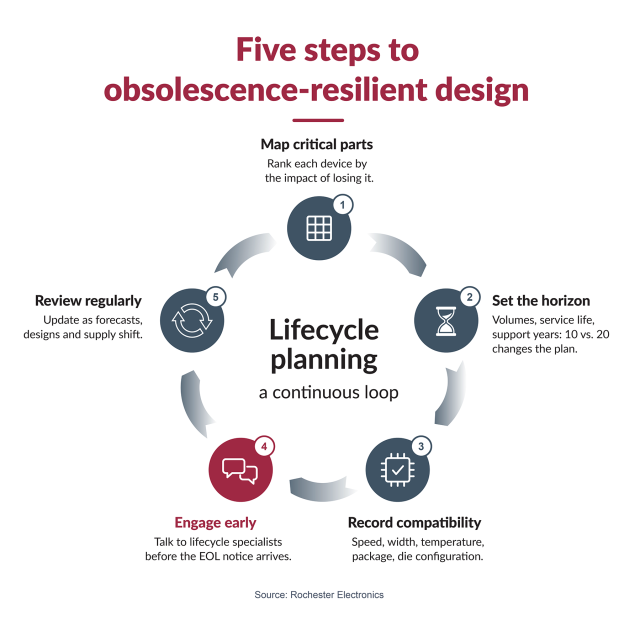
- Rank the critical parts. Build a matrix that states why each device matters and what a replacement or redesign would cost the program in qualification terms.
- Fix the program horizon. Record expected production volumes, service-life requirements and support timelines, and plan a different response for a 10-year and a 20-year case.
- Document interchangeability up front. For memory in particular, capture speed, width, temperature range, package and die configuration in the product lifecycle record while the design is still being defined.
- Open the technical dialogue early. Engage semiconductor and lifecycle specialists before an EOL notice arrives, so that options are assessed with time rather than under schedule pressure.
- Revisit the strategy on a cadence. Forecasts, design changes and supply-side developments all shift the picture; regular reviews keep the plan aligned with what the product actually requires.
FAQ: Lifecycle Risk in Long-Life Designs
Can AI demand really reach parts that never appear in an AI system?
Yes. Investment is concentrated at the leading edge, but its effects extend into older generations. As manufacturers prioritize products such as DDR5, GDDR6, HBM3 and LPDDR5, production capacity and investment can move away from earlier technology, while DDR3 and DDR4 remain part of many industrial, medical and aerospace systems.
Is a last-time buy sufficient for a program with 15 years of support left?
Not automatically. The quantity implied by another 10, 15 or 20 years of support can require significant capital, and storage, inventory management and changing demand add considerations beyond the purchase itself. Start from production volumes, service-life requirements and installed-base obligations, then decide between inventory planning, continued authorized manufacturing, redesign or a combination.
What exactly should be recorded for a memory device?
The characteristics that determine interchangeability: speed, data width, temperature range, package and die configuration, together with the device configuration the design was qualified around. Keep them in the product lifecycle record so a future assessment can be performed against evidence rather than memory.
Do only processors and FPGAs need lifecycle planning?
No. Lifecycle planning has to cover the wider semiconductor ecosystem. Memory and supporting devices matter just as much to long-term availability, and they are the category most directly affected by capacity reallocation.
Once a part is discontinued, is an independent or gray-market seller acceptable?
For high-reliability and safety-critical systems, it is the least dependable route, because counterfeit, recycled and poorly stored devices circulate in that gap. Authorized sources with full traceability to the original manufacturer are the safer path; fully authorized distributors such as Rochester Electronics that meet SAE AS6496 can provide it.
What happens if no authorized finished devices remain?
Authorized distribution is the first route, but it is not the only one. Where finished devices are no longer available, licensed manufacturing from authorized wafer and die can keep selected legacy devices in supply — Rochester Electronics operates across both authorized distribution and licensed manufacturing.
When is the right moment to start the conversation?
Before an EOL notice is received. Earlier visibility leaves more options open, and recurring dialogue ensures that changes in forecasts, program timelines or component status are reflected in the lifecycle strategy instead of discovered at the last minute.
Conclusion: Longevity Is Planned, Not Salvaged
Obsolescence is a normal condition of the semiconductor technology cycle; disruption is not an inevitable consequence of it. Long-life programs limit that disruption by asking a second question of every part — not only does it satisfy today's requirement, but what is likely to happen to it over the remaining life of the system — and then acting early on the answer. Criticality ranked, compatibility documented, program horizon defined and an authorized supply dialogue maintained turns the event into a scheduled engineering activity rather than a rescue. That discipline does not eliminate end-of-life notices. It changes who controls the timetable after one arrives.