
Electronicseng Semiconductors: Balancing CPU/GPU Paths in the AMD Helion Agentic AI Blueprint
When agentic AI infrastructure is treated as a system-level trade space, the useful questions are where cores sit, where accelerators sit, and how requests are routed. AMD Helion appears in that context as a rack-scale reference design combining open-source hardware and software; its CPU-only and CPU/GPU variants give teams a structured way to evaluate core density, accelerator capacity, and power consumption.
Open-Source Rack Architecture
21-in. rack form and Open Compute Project context
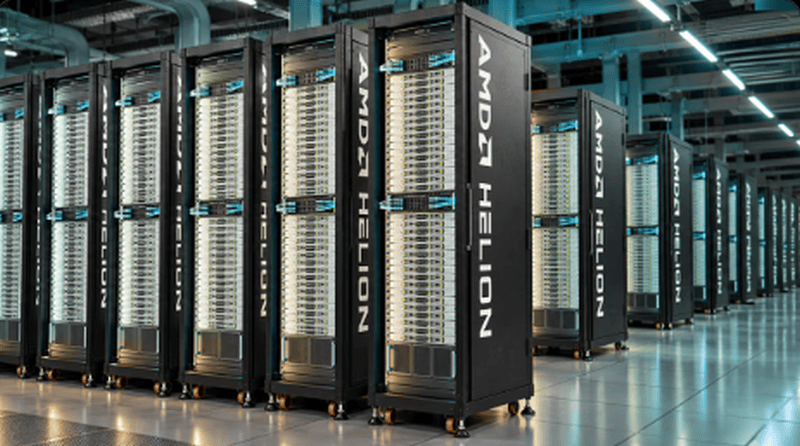
The reference architecture centers on a Helion 21-in. rack form. The description ties that form to Open Compute Project specifications and uses OCP compatibility as the context for balancing CPU and GPU performance, core density, and power consumption according to application requirements.
Because the design is a reference design, the practical value for Electronicseng readers is the set of explicit anchors: an open-source hardware and software baseline, a configurable CPU/GPU relationship, and a rack form defined against the OCP specification cited in the description.
Configuration choices
Two paths are described: a CPU-only configuration associated with hyperscale deployments, and a CPU/GPU configuration associated with enterprises. The same architectural context can therefore be examined either as a core-dense x86 system or as an integrated CPU and GPU system, depending on the deployment goal.
CPU and GPU Configuration Logic
x86 core ceiling
The CPU-only path is described as being powered by AMD EPYC processors that support up to 32,768 Zen 6 x86 CPU cores. For semiconductor infrastructure planning, that phrase converts a generic compute discussion into a concrete ceiling. The Zen 6 x86 marker and the stated core count are the parameters that should be compared against workload density assumptions.
GPU node ceiling
The all-in-one rack description integrates general-purpose compute, AMD EPYC CPU nodes, and up to 16 AMD Instinct MI350 GPU nodes. The AMD Instinct MI350 ceiling gives the CPU/GPU path an explicit accelerator boundary, while the general-purpose layer remains anchored to AMD EPYC CPU nodes.
Token router behavior
Inference requests are directed by a token router to frontier models in the cloud or to open-source models running locally in the rack. This makes the model location an architectural variable: the reference design can be understood as a system that may call external frontier models or host open-source inference inside the rack, depending on routing.
Community Contribution and Planned Availability
The stated community direction is for AMD to contribute the Helion specification to OCP, enabling community development and adoption. That plan positions the reference design as a shared specification candidate inside the Open Compute Project context, rather than only as a closed internal blueprint.
Rack configurations are under development with ecosystem partners, with planned availability in November 2026. For design and procurement teams, the date should be treated as a schedule tied to partner development, not as a statement that the configurations are currently shipping.
Comparison Table: Configuration Paths and Anchors
| Evaluation dimension | CPU-only path | CPU/GPU path |
|---|---|---|
| Deployment context | hyperscale deployments | enterprises |
| Baseline composition | open-source hardware and software | open-source hardware and software |
| Rack reference | Helion 21-in. form aligned with Open Compute Project / OCP | Helion 21-in. form aligned with Open Compute Project / OCP |
| Processor anchor | AMD EPYC with up to 32,768 Zen 6 x86 CPU cores | AMD EPYC CPU nodes |
| Accelerator anchor | not described as GPU-node-based | up to 16 AMD Instinct MI350 GPU nodes |
| Balance focus | core density and power consumption | CPU and GPU performance, core density, and power consumption |
| Time marker | planned availability in November 2026 | planned availability in November 2026 |
Selection Checklist
- State whether the target is CPU-only for hyperscale deployments or CPU/GPU for enterprises before discussing core counts or accelerator counts.
- Use the 21-in. rack form and the Open Compute Project / OCP reference as the comparison frame, not as a general marketing descriptor.
- Check CPU-density assumptions against the stated AMD EPYC ceiling: up to 32,768 Zen 6 x86 CPU cores.
- Check accelerator assumptions against the stated AMD Instinct MI350 ceiling: up to 16 AMD Instinct MI350 GPU nodes.
- Record the general-purpose compute and AMD EPYC CPU node layers as distinct from the accelerator layer when evaluating the all-in-one rack.
- Map expected inference behavior to the token router: cloud frontier models or locally running open-source models inside the rack.
- Treat November 2026 as a planned availability milestone linked to ecosystem-partner rack configuration development.
- Track the Helion specification contribution plan to OCP when evaluating whether the reference design may become a shared community artifact.
Data Citations
- Rack form: Helion 21-in.
- Specification context: Open Compute Project, OCP.
- Processor family: AMD EPYC.
- CPU core ceiling: up to 32,768 Zen 6 x86 CPU cores, using Zen 6 x86 architecture.
- Accelerator node ceiling: up to 16 AMD Instinct MI350 GPU nodes, using AMD Instinct MI350 nodes.
- Inference routing: token router to frontier models in the cloud or open-source models running locally in the rack.
- Community intent: contribution of the Helion specification to OCP for community development and adoption.
- Availability milestone: planned availability in November 2026 with ecosystem partners developing rack configurations.
Common Misconceptions
AMD Helion is only a GPU rack
The description includes both CPU-only and CPU/GPU paths, so AMD Helion should not be interpreted as an accelerator-only system. The CPU-only path is explicitly tied to AMD EPYC processors and Zen 6 x86 CPU cores.
CPU-only and CPU/GPU paths are interchangeable
They share the same reference context but differ in deployment focus. A CPU-only configuration is associated with hyperscale deployments, while the CPU/GPU configuration is associated with enterprises and includes up to 16 AMD Instinct MI350 GPU nodes.
The token router guarantees local inference
The routing split includes frontier models in the cloud as well as open-source models running locally in the rack. Local execution is one destination, not the only destination.
November 2026 confirms shipping today
The date is described as planned availability tied to rack configurations under development with ecosystem partners. It should be read as a forward-looking milestone.
OCP contribution is already complete
The wording says AMD intends to contribute the Helion specification to OCP so the community can develop and adopt it. That is a contribution plan, not a completed publication statement.
Action Recommendations for Semiconductor Infrastructure Teams
- Start with deployment intent: if the goal is CPU density for hyperscale deployments, evaluate the CPU-only anchors first; if the goal is enterprise accelerator integration, evaluate the CPU/GPU anchors first.
- Create a parameter sheet using the cited values: 21-in. rack form, Open Compute Project / OCP alignment, AMD EPYC, up to 32,768 Zen 6 x86 CPU cores, AMD Instinct MI350, up to 16 AMD Instinct MI350 GPU nodes, and November 2026.
- Separate compute, accelerator, and routing assumptions. Core density, GPU node count, and token router behavior are different decision variables in the reference design.
- Model inference routes explicitly: whether requests should reach frontier models in the cloud or open-source models running locally in the rack.
- Follow the Open Compute Project contribution path for the Helion specification, because community adoption is part of the stated plan rather than an incidental note.
- Review ecosystem-partner rack configuration development before treating the November 2026 plan as an executable procurement schedule.
FAQ
What is AMD Helion?
AMD Helion is described as a rack-scale reference design that combines open-source hardware and software. It supports CPU-only and CPU/GPU configurations for agentic AI infrastructure.
Why does the 21-in. rack form matter?
The 21-in. form gives the design a concrete rack-scale reference point. It is tied to the Open Compute Project specification context, where customers can balance CPU and GPU performance, core density, and power consumption.
What role does OCP play?
OCP is the specification context cited for the Helion rack architecture. AMD also intends to contribute the Helion specification to OCP so the community can develop and adopt it.
What CPU capacity is referenced?
The CPU-only rack is described as powered by AMD EPYC processors that support up to 32,768 Zen 6 x86 CPU cores.
What GPU capacity is referenced?
The integrated all-in-one rack description includes up to 16 AMD Instinct MI350 GPU nodes together with AMD EPYC CPU nodes and general-purpose compute.
How does inference routing work?
A token router directs inference requests to frontier models in the cloud or to open-source models running locally in the rack.
What is the availability timeline?
Rack configurations are under development with ecosystem partners, with planned availability in November 2026.
The final reading for Electronicseng Semiconductors is to treat the platform as a parameterized rack reference, not as an undifferentiated AI server claim. The decision hinges on whether the required balance is closer to core-dense CPU-only workloads or integrated CPU/GPU workloads, with the token router defining whether inference reaches cloud frontier models or locally running open-source models. Anchoring the discussion to AMD Helion, Open Compute Project, OCP, 21-in., AMD EPYC, up to 32,768 Zen 6 x86 CPU cores, Zen 6, up to 16 AMD Instinct MI350 GPU nodes, AMD Instinct MI350, AMD, and November 2026 keeps the analysis traceable to the source description.