
Apple's PROLED XDR MacBook Pro Turns OLED Notebook Competition into a Supply-Chain Test
For electronics supply-chain teams, Apple's decision to put a PROLED XDR panel into the MacBook Pro is less a single-product update than a signal that high-end notebook display architecture is moving from incremental backlight work toward tandem OLED, precise pixel engineering, and supplier-specific capacity planning. The model is the first in the MacBook product line to use a tandem OLED touch display, and TrendForce expects its 2027 shipments to reach 1.2 million to 1.5 million units.
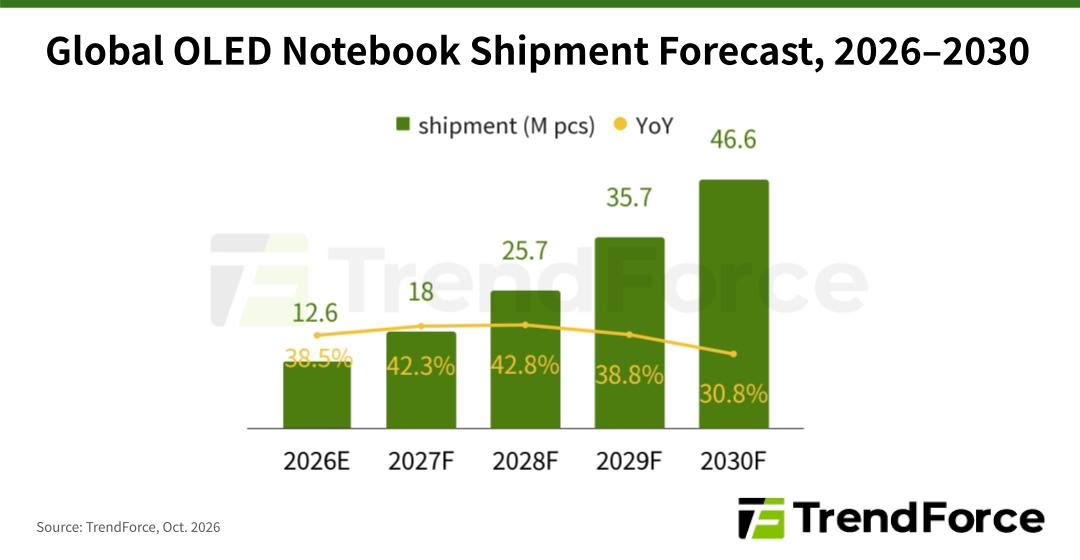
That shipment estimate gives panel makers and procurement planners a concrete data point, but it does not remove near-term ambiguity. The 14-inch version starts at $2,899, and the new OLED model is sold alongside existing Mini-LED configurations. Those two factors can slow short-term replacement demand even while the product strengthens Apple's premium positioning and shows a wider coverage strategy across price tiers.
Why the Apple move matters beyond one notebook
Before Apple entered this space, the global OLED notebook market was mainly shaped by Lenovo, HP, and Asus. Those Windows brands have gradually spread OLED displays across more product families, which is why the technology is no longer limited to a handful of flagship machines. Apple's arrival is expected to raise visibility for OLED notebooks, push more brands to treat OLED as a default planning option in future roadmaps, and improve consumer acceptance of the display type.
The market effect is not just about demand. OLED brings a different set of tradeoffs in image quality, mechanical design, and display performance. Compared with conventional LCD panels, OLED can deliver higher contrast, deeper black, and faster pixel response, and it is better suited to slim notebook construction. The limits are not abstract: panel cost, manufacturing yield, and product-specific requirements for brightness and lifetime still shape how broadly the technology can be adopted.
According to TrendForce, OLED notebook shipments can grow even if the global notebook market contracts for two consecutive years. For panel suppliers, an Apple-led transition is therefore not merely another order book; it raises demand for OLED panels while forcing faster work on high resolution, lower power consumption, and higher brightness.
Supply-chain positioning: Samsung Display's exclusive role
At the moment, Samsung Display is the exclusive OLED panel supplier for the new MacBook Pro. The company has designated the first phase of the A6 project on its Gen 6-and-above large-size OLED line at the Asan complex in Korea as an Apple-dedicated production facility. That is a clear case where display technology adoption is tightly coupled to capacity assignment, not just component availability.
The product is also strategically important for Samsung Display because it is the first item to enter mass production on the company's G8.6-generation fine metal mask (FMM) OLED line. Apple's choice of Samsung Display for the panel of its first premium OLED notebook reflects Samsung's capability in advanced display technology and strengthens Samsung's competitive position in premium OLED panels.
Engineering angle: tandem OLED and 254 PPI raise the difficulty
The new MacBook Pro uses a tandem OLED structure with pixel density of 254 pixels per inch. For manufacturing, that combination matters because tandem OLED stacks multiple emissive layers. The architecture is intended to improve the balance among brightness, power efficiency, and panel lifetime, but it also makes the process more complex. More emissive layers mean more pressure on material cost, production yield, and process control, which are exactly the parameters that determine whether a premium display can scale beyond one model.
From a selection standpoint, engineers and supply-chain managers should read 254 pixels per inch not simply as a marketing number. It is a constraint on panel capability: the mask, layer deposition, defect control, and test flow must all support a tighter pixel layout while keeping the tandem structure reliable.
Competition and second-source reality
Other panel makers are also working through qualification for related products, but entry into this supply chain is not easy. Apple's strict technical specifications, together with the supply advantage Samsung Display has already established, raise the threshold for competitors. The practical consequence is that LG Display, BOE, and TCL CSOT are directing more effort toward winning panel orders for a future OLED MacBook Air, a product expected in 2029.
This creates a split timeline. The current MacBook Pro anchor is tied to a highly specified, supplier-committed OLED panel, while later product lines may become the target for alternative suppliers once their qualification and capacity readiness are convincing enough. As Apple gradually expands OLED across notebook products, competition among display panel suppliers is expected to intensify. Over the medium term, the suppliers most likely to win major notebook-brand orders will be those that can balance cost, manufacturing yield, display performance, and large-scale delivery.
Comparison table: what changes when Apple chooses OLED
| Dimension | OLED notebook display | Current constraint from the Apple case |
|---|---|---|
| Visual performance | Higher contrast, deeper black, faster pixel response | Adoption still depends on cost and yield |
| Industrial design | Better suited to slim notebooks | Brightness and lifetime requirements vary by product |
| Panel architecture | Tandem OLED stacks multiple emissive layers | 254 pixels per inch raises process control demands |
| Supply structure | Can anchor to dedicated lines | Samsung Display is currently exclusive; competitors pursue later orders |
| Market timing | OLED growth can occur during overall notebook weakness | Two consecutive years of notebook contraction may still shape total demand |
Checklist for procurement, engineering, and analysts
- Track whether the TrendForce 2027 shipment range of 1.2 million to 1.5 million units materializes in panel order signals.
- Monitor the status of the first phase of Samsung Display's A6 project at the Asan complex in Korea, because Apple-dedicated capacity affects availability and negotiation leverage.
- Watch G8.6-generation FMM OLED mass-production milestones, since this is the line that supports the current premium OLED notebook case.
- Separate near-term MacBook Pro demand from later MacBook Air demand when evaluating supplier exposure.
- Assess LG Display, BOE, and TCL CSOT by qualification progress for a future 2029 OLED MacBook Air, not by their current exclusion from the existing panel program.
- Review whether tandem OLED's expected balance of brightness, power efficiency, and lifetime can overcome material cost, yield, and process-control limits.
Common misconceptions
- A premium Apple product does not instantly make OLED the default for every notebook segment. Mini-LED configurations remain in parallel, and price can suppress short-term switching.
- Exclusive supply today does not imply permanent lock-in. Other panel makers are pursuing qualification, but Apple's specification level and Samsung Display's established advantage make near-term entry difficult.
- Tandem OLED is not only a picture-quality upgrade. Its multiple emissive layers add complexity to material cost, yield, and process control.
FAQ
What is PROLED XDR in this MacBook context?
PROLED XDR is the display associated with the current MacBook Pro update, and the article describes the model as the first in the MacBook product line to use a tandem OLED touch display.
Why is Samsung Display central to this story?
Samsung Display is currently the exclusive OLED panel supplier for the new MacBook Pro, and the model is the first mass-production product on its G8.6-generation FMM OLED line.
Does Apple's entry mean OLED notebooks will replace LCD notebooks quickly?
No. The source analysis says OLED notebooks may grow even amid two consecutive years of overall notebook market contraction, while LCD remains difficult to fully replace in the short term because cost, yield, brightness, and lifetime constraints remain.
Which future Apple OLED notebook may give other panel makers a path?
A future OLED MacBook Air, expected in 2029, is the target where LG Display, BOE, and TCL CSOT are putting more effort.
Action recommendations
- For hardware procurement teams, build scenarios around the 14-inch $2,899 price point and Mini-LED parallel sales rather than assuming an immediate OLED transition.
- For engineering teams, evaluate tandem OLED architecture by its combined constraints: 254 pixels per inch, multiple emissive layers, brightness, power efficiency, lifetime, and process control.
- For supply-chain analysts, monitor Samsung Display's A6 first-phase Apple-dedicated facility and G8.6-generation FMM line as the earliest evidence of whether the current exclusivity is durable or transitional.
- For display-panel strategy reviews, treat the 2029 OLED MacBook Air window as the likely first serious opening for LG Display, BOE, and TCL CSOT.
- For product-roadmap discussions, use the TrendForce 2027 shipment range as a data anchor for premium OLED demand, while still tracking overall notebook contraction for two consecutive years.
Closing perspective
From an Electronicseng perspective, the MacBook Pro's PROLED XDR shift is most useful not as consumer technology news, but as a compact case study in how a single premium device can move an entire OLED notebook supply chain. The facts are narrow but consequential: a new product line entry, a dedicated supplier arrangement, a demanding tandem OLED structure, and a future 2029 opening for other panel makers. Companies that track these variables will be better placed to judge whether OLED in notebooks is a premium experiment or the beginning of a broader structural transition.