
Electronicseng Semiconductors: Sequencing Multi-Rail Startup, Supervision, and Shutdown
When semiconductor systems depend on several converter outputs, design work becomes sequence management: core rails, I/O rails, memory rails, and reset deassertion each carry dependencies. A modern processor, FPGA, memory module, sensor, or high-speed interface rarely operates from a single supply. If the startup, supervision, and shutdown choreography is wrong, excessive inrush current, back-powering, latch-up, corrupted initialization, or, in some cases, device damage can follow.
This article, prepared for Electronicseng Semiconductors, focuses on how configurable mixed-signal control replaces sprawling RC networks and firmware-dependent control with deterministic, compact sequencing. GreenPAK™ devices are used here as the technical example because they combine fixed timing, power-good qualification, voltage sensing, and I²C acknowledgement in hardware.
Why discrete timing and firmware-first approaches strain out
At the low end, a sequencer can shift regulator-enable signals through RC delays and logic gates. That solution may be adequate for a small, fixed design. As rail counts and supervision requirements grow, however, each extra stage adds passives, tolerance stack-up, and possible failure points. Capacitor and resistor variation, temperature, leakage, and aging can move the effective delay. A late timing change may then require component substitutions, schematic edits, new layout work, and another board spin.
A microcontroller adds configurability, but it inserts software into a function that may need to operate before the main processor is ready. The firmware must boot, execute correctly, and react to faults quickly enough. Dedicated power-sequencer ICs can provide strong supervision, yet they may be costly, over-specified, or too rigid for mid-range systems. The semiconductor-side challenge is to keep hardware determinism while allowing configuration, without the board-area or power penalties of either extreme.
Configurable building blocks: one programmable device in place of scattered logic
GreenPAK configurable mixed-signal ICs combine lookup tables, counters, oscillators, analog comparators, asynchronous state machines, and flexible GPIO routing in one small device. In a power-sequencing implementation, those blocks can generate regulator-enable signals, qualify power-good inputs, compare rails against thresholds, insert blanking times, latch faults, and enforce a controlled shutdown. Because the logic runs in hardware, the sequence is not dependent on code execution or a real-time operating system.
Instead of a chain of discrete logic and RC timing stages, the implementation can use one programmable device. Timing changes are made in a graphical design environment, not by swapping components. Depending on the selected part, the same architecture can support a few rails or larger state-machine-controlled systems, add analog supervision, or expose selected parameters over I²C. An industrial controller, a basic consumer product, or an FPGA-based system with stricter startup rules can therefore be approached from one device family.
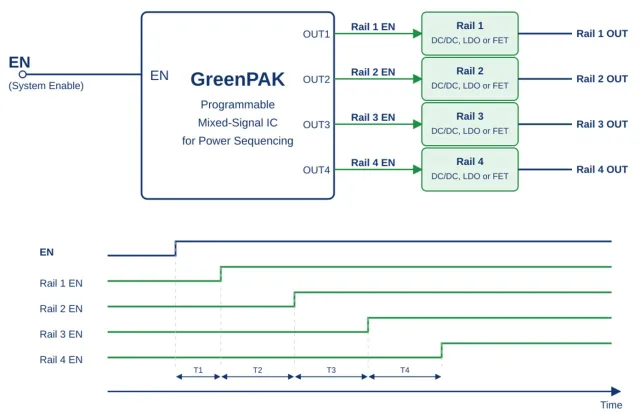 Figure 1. Using configurable delays and logic, a basic GreenPAK implementation enables four rails in sequence.
Four ways to decide when a rail is qualified
Readiness decisions can be made in open-loop, closed-loop, analog, or digital ways. The following comparison summarizes the mechanisms described in the reference material.
| Readiness method | How it works | When it helps | Design note |
|---|---|---|---|
| Fixed timing | Oscillators and counter/delay blocks create a defined interval between stages, while lookup tables set the active polarity. | Regulators have predictable startup behavior and no power-good output. | The approach is easy to simulate and tune, but delays need margin for worst-case ramp time. |
| Power-good qualification | The sequence advances only after the preceding regulator asserts its status signal. | It accommodates variable startup time better than an open-loop delay and allows signal polarity configuration. | Useful when the preceding regulator provides a status output. |
| Voltage sensing | Integrated analog comparators verify that each rail crosses a defined threshold before the next rail is released. | Noise and startup glitches can be rejected by programmable hysteresis and blanking delays. | Suitable when the next stage should depend on measured voltage rather than elapsed time alone. |
| I²C acknowledgement | A controlled device can confirm that it is initialized over I²C. | Useful when a digital readiness signal is needed. | Can be combined with other methods, such as a voltage threshold followed by a short settling delay. |
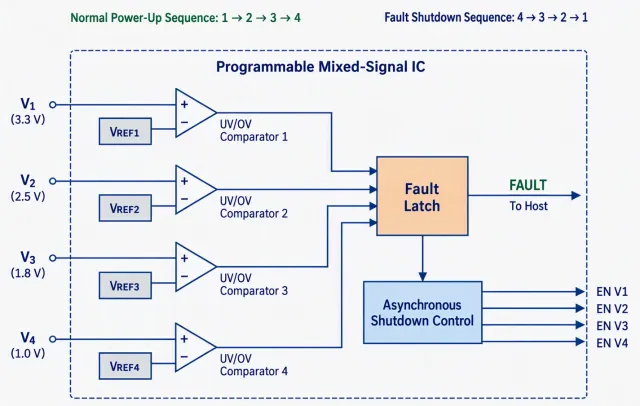 Figure 2. Each rail can be qualified by analog comparators, which trigger a controlled response when a voltage falls out of range.
Supervision and reverse-order shutdown keep the power tree safe
A robust sequencer continues to watch after startup. A short circuit, a failed regulator, or an overcurrent event reported by a load switch can cause a monitored rail to drop. GreenPAK logic can combine comparator and power-good results into a fault latch; downstream rails can be prevented from enabling; a host-visible FAULT output can be asserted; and an orderly shutdown can be initiated. The asynchronous hardware path makes the response deterministic, without reliance on firmware polling or software execution latency.
Power-down sequencing requires similar attention. Many devices require disabling in reverse order of power-up to avoid back-powering through signal pins, latch-up, or data corruption. A defined delay can be inserted at each transition as an asynchronous state machine moves forward through startup states and backward through shutdown states. Six-rail examples demonstrate this bidirectional approach in a single device; the same architecture can be extended or combined with external load switches.
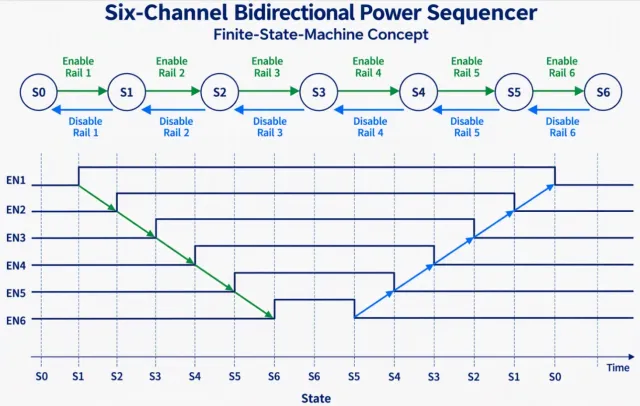 Figure 3. Ordered startup and reverse-order shutdown are supported by a six-channel asynchronous state machine.
Runtime tuning without a board spin
I²C-enabled GreenPAK devices add another layer of flexibility. During board bring-up or at runtime, selected delays, thresholds, and rail enables can be adjusted, allowing one PCB to support multiple product variants. Fault information can be latched for host readback; this helps engineers identify the rail that failed instead of reproducing a transient event with external probes. That capability is especially valuable when final timing depends on regulator behavior, board loading, components startup characteristics, or late changes to component selection or loading.
Selection checklist for semiconductor power sequencing designs
- Start with rail count: a four-channel design may fit in a very small device, while monitored eight- or ten-channel systems benefit from devices with additional comparators and routing resources.
- Expand the device selection to GPIO availability, analog comparator count, delay resources, state-machine depth, package size, and the need for I²C.
- For larger rail trees, daisy-chaining several GreenPAK ICs can also control 16 or more power rails.
- Choose direct control of regulator-enable inputs or, when rail isolation and switching are needed, use GreenFET load switches.
- Do not count only enable outputs; reserve inputs for power-good signals, overcurrent indicators, and reset dependencies.
AMD and Renesas implementation references
A practical example is provided by AMD documentation. In AMD’s XAPP1375, “Simplified Power Sequencing,” Renesas configurable mixed-signal ICs are included as a digital sequencing option for AMD Versal™ adaptive SoCs and other AMD SoCs and FPGAs. The guidance highlights how software-customizable ICs can integrate multiple functions and move from GreenPAK-based prototyping to production. These examples can be opened and explored in the Go Configure™ Software Hub, where timer, comparator, and state-machine behavior can be changed without rewriting firmware or reworking the PCB.
Reference data used in this article comes from application notes that can be opened from the Go Configure Software Hub:
- AN-1067, Power Sequencer Using GPAK, presents four-channel power-up, power-down, and power-good-controlled designs.
- AN-1074, 6-Channel Power Lines Sequencer, uses LUT and flip-flop cells for ordered switching.
- AN-1105, A State Machine Linear Sequencer, demonstrates a seven-line asynchronous-state-machine implementation.
- AN-CM-356, SLG51000, SLG51001 and SLG51002 Power Sequencer, covers power sequencing implementations using the SLG51000, SLG51001, and SLG51002 PMIC families.
Designers can adapt these downloadable examples to their own rail count, timing, and supervision requirements.
FAQ for semiconductor power-tree teams
Can fixed timing and voltage sensing be combined?
Yes. In practical systems, these methods can be combined – for example, a voltage threshold followed by a short settling delay.
Why not always place sequencing in firmware?
Because firmware must boot, execute correctly, and react to faults quickly enough, and it may be needed before the main processor is ready.
What should hardware verification include beyond normal startup?
Slow and fast ramps, brownouts, repeated enable cycles, missing power-good signals, and shutdown under load should be included.
Can one solution scale beyond a very small device?
Yes. Depending on the selected GreenPAK part, designs can range from a few rails to larger systems, and daisy-chaining several ICs can control 16 or more power rails.
Common misconceptions in multi-rail sequencing
- “Startup timing is the only requirement.” The reference material treats supervision and shutdown as equally important, because fault handling and reverse-order disabling protect devices after rails are enabled.
- “Discrete RC delays remain stable as rail counts grow.” Component variation, temperature, leakage, and aging can move the effective delay, increasing late-change pressure.
- “Firmware is always the safest flexible option.” If software must operate before the main processor is ready, boot and fault-response latency become concerns.
- “Sequencing is only auxiliary logic.” Its behavior determines whether a system starts reliably, survives a fault, and shuts down safely.
Action plan before the next power-tree review
Map rail dependencies, define nominal and worst-case startup and shutdown timing, select open-loop, power-good, voltage-sensing, or acknowledgement-based transitions, allocate resources, and simulate both normal and fault paths.
Then include hardware cases such as slow and fast ramps, brownouts, repeated enable cycles, missing power-good signals, and shutdown under load. Start from ready examples in the Go Configure Software Hub and progress from simple to more advanced implementations, adapting them to the board’s rail count, timing, and supervision rules.
The engineering payoff
For many multi-rail designs, the key advantage lies not in a single specification but in the balance of integration, power, speed, and adaptability. BOM lines and routing complexity are reduced by consolidating timers, glue logic, supervisor functions, and fault handling. Boot dependencies are avoided by hardware execution, and response time becomes predictable. Programmability preserves the ability to tune delays and thresholds as the system evolves; small packages and microamp-class operation suit space- and power-constrained products.
For the Electronicseng Semiconductors audience, power sequencing should be treated as a compact hardware subsystem. A configurable mixed-signal sequencer can coordinate rails, validate voltages, record failures, and adapt without a redesign. As rail counts and dependency rules continue to grow, this approach provides a practical middle ground between fragile discrete timing, firmware-centric control, and costly fixed-function supervision.