
Intel Earnings Reset: Foundry Timeline, PC Pressure and Packaging Constraints for Electronicseng Semiconductors
A few hours ago, the opening question on the call was not about the beat; it was about Intel’s external foundry line. BofA pressed when customer engagements would move from evaluation to formal tape-out—final design release to a wafer fab—and when external revenue could enter a financial model. CEO Lip-Bu Tan said customer details would not be disclosed. On packaging, he said “In the next two quarters there will be someone ready to announce.” For 18A and 14A, the answer was again “later.” The schedule remained absent, and no modelable revenue figure was provided.
That missing schedule is why the shares fell nearly 30%. This quarter’s operating results were acceptable, but next quarter’s guidance was not: revenue and non-GAAP EPS came in well below consensus, while PC demand was squeezed by rising memory prices. An earlier this month explosion at the Israeli fab, Fab 28 in Kiryat Gat, also weighed on sales. The facility had carried Intel’s early 10-nanometer production push and still supports some server 10-nanometer products; it shut for about two weeks.
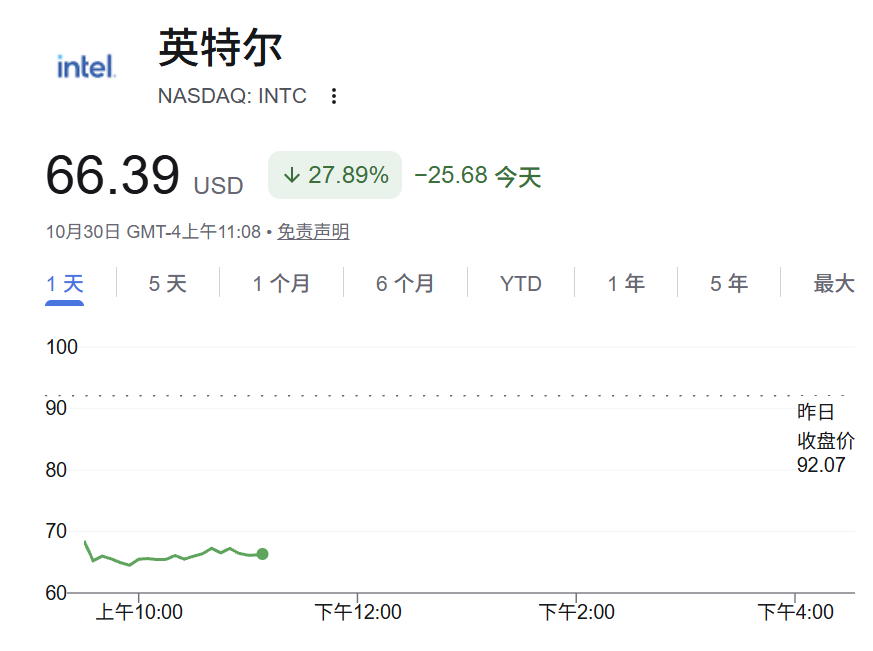
Valuation was built on a foundry recovery script that has no clock
Historically, Intel revenue leaned heavily on PCs. After its process position slipped, former CEO Pat Gelsinger bet on IDM 2.0, using fabs for internal supply and external orders while funding plant construction and advanced node catch-up. About a year and a half into Lip-Bu Tan’s tenure, some investors thought foundry might be scaled back to clean up reporting. Instead, foundry priority rose. Around August, the company raised roughly $23B, making the cash reserve thicker. The market became more willing to price the thesis: “shortages ease, 18A ramps, external customers pay.”
What broke this quarter was the client segment. CCPG, which sells CPUs for PCs and notebooks, generated $8.097B, down 5% YoY and down 9% QoQ, below company expectations. Operating profit was $2.285B, a margin near 28%. It remains the largest revenue block, but volume is falling first. For Q4 QoQ, the company expects another decline of more than 20%. CFO Dave Zinsner warned: “Looking ahead, we expect the PC slowdown to continue at least into the first half of next year,” with destocking lasting into Q1.
Intel’s own industry framing is colder: the PC unit TAM in 2026 is expected to fall about 12%, with a second-half decline exceeding 20%; 2027 is expected to fall about 10% more. Memory price increases raise system bills and suppress replacement demand. The same memory modules can still command a premium in data centers, while PC OEMs hesitate when cost rises—leaving the CPU vendor exposed first.
Morgan Stanley’s estimate provides the data citation here: continued deterioration in the client business could trim revenue consensus by about $3B to $4B.
The quarter was solid; the guide was weak
This quarter Intel posted revenue of $16.513B, up 21% year over year and almost in line with relative consensus of about $16.5B. Non-GAAP EPS was $0.52, compared with relative consensus of about $0.40 and company guidance of about $0.38. Zinsner opened: “We delivered another solid quarter … including the strongest data center revenue growth in 15 years.”
The next-quarter guide was where expectations cracked. Fourth-quarter revenue guidance was $15B to $16B against relative consensus of about $17.1B; non-GAAP EPS was $0.25 against relative consensus of about $0.43. Before earnings, optimistic analysts had pushed the Q4 revenue midpoint to $17.1B–$17.5B, so the guide invalidated that projection. On the call, an analyst asked how much of the roughly $1.8B guide gap was attributable to the Israeli fab and how much to PC weakness.
Zinsner said preliminary assessment put the Israeli fab accident at about $0.3B of Q4 revenue, nearly all on 10-nanometer server products, and about 200 basis points of gross margin impact. The Q1 revenue impact may be similar, with most scrapped wafers booked in Q4; the larger driver remains PC sales.
Data center demand is real, but foundry timing is still absent
DCAI, which sells server CPUs and AI accelerators, generated $7.318B this quarter, up 78% YoY and up 17% QoQ. Operating profit was $3.039B, a margin near 42%; the profit amount already exceeded CCPG. Lip-Bu Tan said: “Despite near-term PC industry headwinds, our demand for CPUs remains strong … the immediate priority is to open additional supply to satisfy the exceptional demand for the Xeon family.”
Constraints are not only wafer fabs. Management noted Intel 3 output is ramping, but the industry is short of advanced organic substrates, which also limits EMIB advanced packaging. Wafers are produced, but packaging materials cannot keep pace, so server CPUs still do not ship.
The company expects industry server CPU shipments to grow more than 30% annually in 2026 and 2027, with tightness possibly extending into end of 2027 or even 2028. For full-year DCAI, management said it may come in about $10B above expectations set at the beginning of the year.
Morgan Stanley treats this server strength as good but skeptical: the numbers rely heavily on a shortage environment, and Intel’s flagship products remain weaker than peers. The comparison with rivals is stark. An analyst pointed out that AMD’s server-related revenue guide was about 70% higher, and Arm architecture is also taking server sockets. Peers talk slope and share; Intel says share depends on whether supply can catch up. During substrate and packaging shortages, scarcity creates delivery pressure. Demand is rising, but no specific share point is given.
Foundry revenue is still mostly internal
The foundry segment carries internal and external wafer manufacturing and packaging. It contributed $6.697B this quarter, almost entirely internal orders. External foundry revenue was $0.411B, up $0.118B QoQ, mainly from one-time customer projects. Operating loss was $1.853B.
TSMC remains the external foundry benchmark: only when customers keep paying for advanced nodes does a foundry story hold. SemiAnalysis notes that although Intel’s 18A has shipped, transistor density does not lead TSMC’s equivalent process, and high-end GPUs and I/O chips still mix in TSMC capacity. Morgan Stanley says market confidence is largely bet on 14A landing in 2028 or 2029. External high-volume commitments remain small. Its deeper concern is structural capability: if Intel cannot meet its own demand, that will be the worst possible advertisement.
How to read the earnings facts: a semiconductor analyst checklist
For Electronicseng Semiconductors readers, the useful question is not whether Intel beat a quarter, but which lines can be modeled.
- Do not model external foundry revenue from packaging hints alone; the call repeated “later” for 18A and 14A.
- Track formal tape-out language separately from customer evaluation.
- Separate internal transfer revenue from external foundry revenue; this-quarter external foundry revenue is $0.411B.
- Watch advanced organic substrates and EMIB packaging constraints, not just wafer output.
- Use memory-price pass-through, PC TAM declines, and server CPU shipment growth as supply-chain inputs, not sentiment markers.
Segment comparison that matters
| Line | Current reading | Modelable detail | Next watch item |
|---|---|---|---|
| CCPG | $8.097B, down 5% YoY, down 9% QoQ | $2.285B operating profit, margin about 28% | Q4 decline of more than 20%; PC slowdown into first half next year |
| DCAI | $7.318B, up 78% YoY, up 17% QoQ | $3.039B operating profit, margin about 42% | Supply openings for Xeon and substrate/EMIB constraints |
| Foundry | $6.697B total, mostly internal | External $0.411B, up $0.118B; loss $1.853B | Formal tape-out, packaging announcements, 18A/14A timing |
| Balance sheet | Cash plus short-term investments about $54B at quarter end | Diluted shares about 5.3B; Q4 guide diluted about 5.44B; debt about $50.1B | Free cash flow, capex, external foundry conversion |
Cash, capex and the foundry gap
Intel raised about $23B in August. At quarter end, cash and short-term investments were about $54B. Diluted shares outstanding were about 5.3B, while Q4 guidance assumed about 5.44B fully diluted. Interest-bearing debt totaled about $50.1B. Cash is not the shortage; the shortage is whether external foundry becomes modelable revenue.
BofA’s question kept returning to the same point. The statement said customer details would not be disclosed. The Q&A asked again about formal tape-out and modelable timing, and the answer was “later.” Gross capex in 2026 remains about $20B, and 2027 is described as “significantly higher.” No absolute number was locked. Dave Zinsner said next year is an investment year and “there probably will not be positive free cash flow.”
Single-quarter adjusted free cash flow was still $1.6B—operating cash flow about $5.1B, minus gross capex about $4.2B, plus adjustments such as government incentives and partner contributions. That positive number will not sustain next year. Money enters from operating collections and the August raise, then flows into wafer lines, packaging lines and the loss-making foundry division. Morgan Stanley’s judgment is that even if later numbers move higher, the stock is already roughly fully priced.
Common misconceptions in reading Intel’s quarter
- Confusing a strong DCAI quarter with a strong server market position. Morgan Stanley sees the strength as shortage-dependent and still questions flagship competitiveness.
- Assuming packaging announcements equal foundry commitments. The packaging answer pointed to “In the next two quarters there will be someone ready to announce,” but 18A and 14A remained “later.”
- Reading external foundry revenue as repeatable volume. The $0.411B external figure rose $0.118B QoQ, but was mainly one-time customer projects.
- Treating PC weakness as cyclical noise. Intel’s own TAM view points to about 12% unit decline in 2026, a second-half decline over 20%, and about 10% more in 2027.
FAQ for engineers and supply-chain readers
What is blocking Intel’s server CPU shipments?
Management said Intel 3 output is ramping, but advanced organic substrates are scarce, limiting EMIB packaging. Wafers may exist, yet packaging materials and assembly capacity can delay server CPUs.
Why did shares fall nearly 30% after earnings?
The drop reflected PC softness, lower gross margin guidance, and the missing external foundry timetable. The Israeli fab accident contributed about $0.3B of Q4 revenue and about 200 basis points of margin, but the larger issue remained PC sales and unmodeled foundry.
Can engineers treat 18A as production-ready?
SemiAnalysis says 18A has shipped, but density does not lead TSMC’s same-generation node, and high-end GPU and I/O chips still need TSMC capacity. Morgan Stanley says confidence is mostly on 14A in 2028 or 2029.
Action recommendations
For design teams, keep tape-out assumptions conservative. If you rely on Intel foundry timing, separate packaging announcements, internal ramp and external customer tape-out.
For hardware procurement, monitor memory cost pass-through, PC TAM reduction and server CPU shipment growth above 30% annually in 2026 and 2027. Treat the about two-week Israeli fab downtime as a scenario variable.
For analysts, model only facts in guidance: this quarter revenue $16.513B, next-quarter guide $15B to $16B, non-GAAP EPS $0.25; treat foundry upside as optional until formal tape-out.
Bottom line for Electronicseng Semiconductors
Server orders are still in line; AI demand has not collapsed. What changed is pricing: memory cost pressures PCs, gross margin guidance is lower, external foundry still cannot be written into models, and next-year free cash flow likely turns negative. The market is less willing to pay for an unproven foundry schedule and an unproven PC recovery slope. For semiconductor readers, the next signal is not a slogan, but a dated customer tape-out.