
Electronicseng Semiconductors: Intel Moon Lake May Go All-Efficiency While Wildcat Lake Refresh Adds Performance Cores
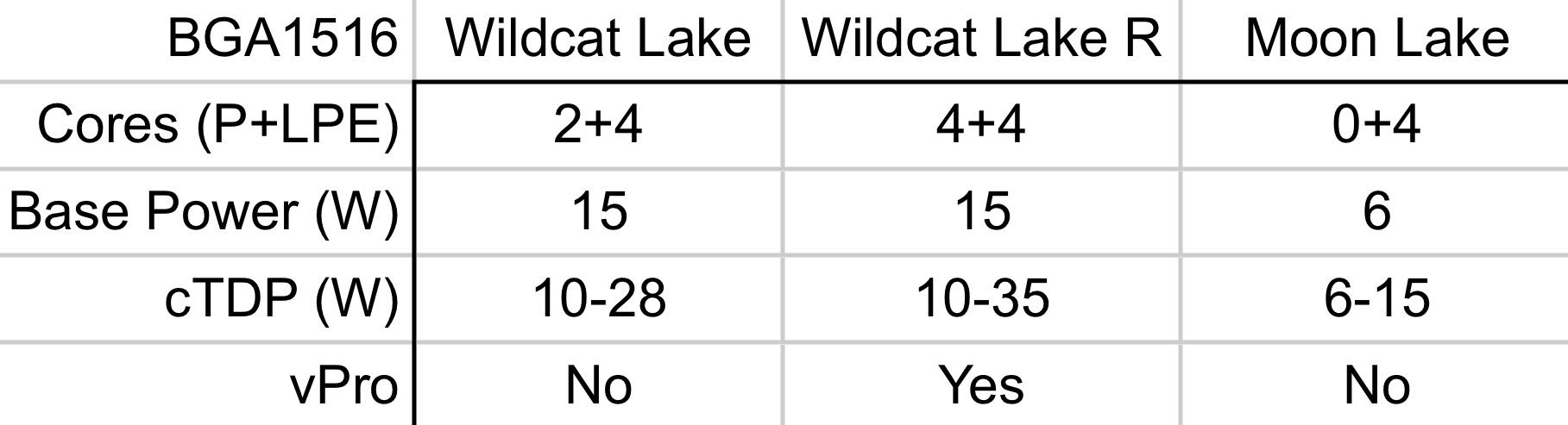
Intel’s lower-tier client silicon may be moving away from a single one-size-fits-all model. The October 29 information released by Jaykihn describes two different entry-level paths: Moon Lake, a package-level direction built around very low power and minimal active thermal mass, and Wildcat Lake Refresh, a more conventional uplift that adds performance cores and enterprise platform support. For Electronicseng Semiconductors readers, the value of the leak is not the naming alone, but the signal about how Intel 18A process technology, disaggregated chip design, and core mix can be repackaged for price-sensitive systems.
Reported technical framing
Moon Lake is reported to reuse the BGA 1516 package associated with Wildcat Lake, while using a disaggregated chip design. The compute chip is based on Intel 18A process technology. Its core configuration is described as up to 4 Darkmont low-power efficiency cores, with no traditional performance core. The base power figure is about 6 W, and the configurable ceiling is up to 15 W. If this configuration becomes official, it would be a notable product in recent years because it appears to prioritize silicon area, power, and platform cost rather than burst-heavy single-thread work.
Wildcat Lake Refresh is described differently. The reported core mix is up to 4 Cougar Cove performance cores plus 4 Darkmont low-power efficiency cores. The existing Wildcat Lake is said to reach up to 2 performance cores and 4 low-power efficiency cores. The Refresh therefore looks like a capacity increase on the high-end side of the entry segment, rather than a new microarchitecture story. Its base power range is expected to move from the existing 10 to 28 W to 10 to 35 W. In other words, the processor may be allowed to sustain more performance when the laptop chassis can manage the heat.
The graphics path is still less firm. Moon Lake may use Xe3 integrated graphics, but core count has not been confirmed. Wildcat Lake Refresh is expected to continue using Xe3 integrated graphics, and the reported materials do not point to a major graphics-core expansion. For thin-and-light designs that rely on iGPU performance, that distinction matters: CPU core count can improve office responsiveness, but actual rendering, gaming, and media work can remain limited by graphics execution units, memory bandwidth, and the chosen power limit.
vPro, chiplets, and cost control
Wildcat Lake Refresh is also expected to add vPro platform support. vPro is associated with enterprise fleet management, security features, and remote management capabilities for business devices. This change could move the product from purely consumer entry-level notebooks into procurement channels that require managed PCs and standardized corporate images. It does not transform a low-power part into a workstation, but it does change its addressable market.
The two processors are expected to use disaggregated chip design. Compared with a conventional monolithic die, a disaggregated approach splits compute, input/output, and other functions into separate dies, then connects them through chip-to-chip interconnects. This can let product teams choose different silicon for different functions. Wildcat Lake already reflects the approach: a compute chip on Intel 18A process technology is combined with an I/O chip produced on a less advanced node. That process-mix strategy helps control the overall cost of low-priced client products without forcing every block onto the 18A advanced process.
Where the 18A story stops helping
Intel 18A is positioned as a key advanced node for Intel’s manufacturing roadmap, and it introduces RibbonFET gate-all-around transistors and PowerVia backside power delivery. Those technologies are intended to improve transistor density, power delivery, and performance headroom. For Electronicseng Semiconductors readers, the important nuance is that node name alone is not a benchmark. Moon Lake may sit on Intel 18A process technology, yet still be designed around about 6 W base power, up to 15 W configurable power, and only 4 Darkmont low-power efficiency cores. In absolute performance, it could be below premium products with more cores, larger caches, higher clocks, wider memory, or stronger thermal design.
The reported Moon Lake direction fits systems where web browsing, document work, video playback, light productivity, and long battery life are primary. Chromebook-class devices and basic notebook platforms are the clearest categories. A complex software build, large image batch, sustained virtualization, or heavy single-thread workload may expose the missing performance core. The final result will depend on frequency, cache, memory bandwidth, operating-system scheduling, and the laptop’s thermal policy. In other words, two systems using the same processor family can behave differently if one is passively cooled and the other has a higher sustained power target.
Data snapshot from the reported information
- Source date: October 29, attributed to Jaykihn.
- Package: BGA 1516 package, described as consistent with Wildcat Lake.
- Moon Lake compute silicon: Intel 18A process, disaggregated chip design.
- Moon Lake core target: up to 4 Darkmont low-power efficiency cores, no traditional performance core.
- Moon Lake power target: about 6 W base power, up to 15 W configurable power.
- Wildcat Lake core target: up to 2 performance cores and 4 low-power efficiency cores.
- Wildcat Lake Refresh core target: up to 4 Cougar Cove performance cores and 4 Darkmont low-power efficiency cores.
- Power ranges: existing Wildcat Lake 10 to 28 W; Wildcat Lake Refresh 10 to 35 W.
- Graphics: Xe3 integrated graphics expected, but core counts remain unconfirmed for Moon Lake; Refresh graphics expansion is not indicated.
- Enterprise: Wildcat Lake Refresh may support vPro.
- Manufacturing: Intel 18A process includes RibbonFET and PowerVia; disaggregated design uses different process nodes for different dies.
- Timing: Wildcat Lake Refresh may arrive in the first half of 2027, but this is not official.
Comparison of reported segment roles
| Product direction | Reported core mix | Power profile | Most plausible system focus | Key decision signal |
|---|---|---|---|---|
| Moon Lake | up to 4 Darkmont low-power efficiency cores, no performance core | about 6 W base, up to 15 W configurable | Chromebook, ultra-entry notebooks, low-power lightweight devices | Cost, area, battery life, low thermal demand |
| Existing Wildcat Lake | up to 2 performance cores and 4 low-power efficiency cores | 10 to 28 W base range | Budget notebooks, student systems, light commercial use | Entry balance with some performance cores |
| Wildcat Lake Refresh | up to 4 Cougar Cove performance cores and 4 Darkmont low-power efficiency cores | 10 to 35 W base range | Stronger entry notebooks, managed business devices if vPro is adopted | More headroom for multitasking and complex office work |
Competitive pressure in low-price PC silicon
These reports appear while the low-cost notebook segment is changing. Apple MacBook Neo, Windows laptops using Qualcomm processors, and other low-cost computing devices have made entry-level PCs less dependent on old parts and mature low-cost manufacturing. The reported Intel direction is therefore not just a product refresh; it is an attempt to segment the market more finely. Moon Lake can chase ultra-low power and low bill-of-materials cost. Wildcat Lake Refresh can target users who need more performance cores. Existing Wildcat Lake can serve budget commercial and education channels.
For buyers, the strategic point is that “entry-level” is becoming a family of different engineering trade-offs. A Chromebook-class part with 4 Darkmont low-power efficiency cores should not be judged like a part that offers up to 4 Cougar Cove performance cores. Conversely, a product using Intel 18A process technology may still have fewer cores, less cache, lower clocks, and weaker sustained performance than a higher-tier processor.
Common misconceptions
- “18A automatically makes a laptop fast.” The node helps density, power delivery, and potential efficiency, but final user performance depends on core count, frequency, cache, memory bandwidth, graphics configuration, and thermal design.
- “All-efficiency cores are only for very old office tasks.” That is too narrow. The design could still be relevant for lightweight devices that need long battery life, low heat, and lower cost, but sustained high-load work is the likely boundary.
- “vPro means the platform is high end.” vPro mainly adds manageability and security features. It can help commercial fleets, but it does not remove the power and core-count limits of an entry-level processor.
- “A bigger TDP number alone guarantees better laptop performance.” The 10 to 35 W figure creates headroom; the actual result depends on the laptop chassis, cooling, BIOS power policy, and battery-life target.
Checklist for engineering and procurement review
- Confirm whether the SKU is Moon Lake, existing Wildcat Lake, or Wildcat Lake Refresh before writing a comparison sheet.
- Record performance-core count: no traditional performance core, up to 2 performance cores, or up to 4 Cougar Cove performance cores.
- Record efficiency-core count: 4 Darkmont low-power efficiency cores or 4 low-power efficiency cores, depending on the reported product.
- Record base and configurable power: about 6 W to up to 15 W, 10 to 28 W, or 10 to 35 W.
- Check package and board reuse: BGA 1516 package is the reported continuity point.
- Check graphics assumptions: Xe3 integrated graphics does not guarantee the same EU count or media capability across products.
- Check commercial requirements: vPro support changes enterprise procurement fit, not necessarily raw compute.
- Check thermal design: low-power and lightweight laptops may favor efficiency, while thicker designs may extract more from the 10 to 35 W envelope.
- Check memory and cache details: they can shift the user-visible difference between similar core counts.
- Treat timing as tentative: the first half of 2027 date for Wildcat Lake Refresh has not been confirmed.
FAQ: what the leak changes and what it does not
Does Moon Lake have performance cores?
The reported configuration says no traditional performance core and focuses on up to 4 Darkmont low-power efficiency cores.
What is the main Wildcat Lake Refresh upgrade?
The reported upgrade is core count: up to 4 Cougar Cove performance cores and 4 Darkmont low-power efficiency cores, compared with up to 2 performance cores and 4 low-power efficiency cores for existing Wildcat Lake.
Will graphics be the same?
Not necessarily in practice. Both directions are connected to Xe3 integrated graphics, but Moon Lake’s core count is unconfirmed, and Wildcat Lake Refresh is not reported to have a clear graphics-core expansion. CPU headroom may improve before iGPU headroom.
Does Intel 18A mean these are premium products?
No. Intel 18A is a manufacturing node, but these are still entry-level designs. The package, core mix, power limits, cache, memory, and thermal envelope define the final product tier.
When will we know?
Intel has not officially confirmed full specifications, final naming, pricing, or release dates. Wildcat Lake Refresh may arrive in the first half of 2027, according to the current information, but that remains a report rather than an official date.
Action recommendations
For platform engineers: do not plan around the chip name alone. Define the workload as either light interactive computing, mixed productivity, or managed business computing. If the design targets Chromebook-class use, compare Moon Lake against existing low-power options and verify whether 4 Darkmont low-power efficiency cores can meet latency and multimedia expectations. If the design targets office notebooks with occasional heavier multitasking, prioritize the reported 4 Cougar Cove performance cores and evaluate whether the laptop can sustain 10 to 35 W without thermal or battery penalties.
For purchasing managers: use the reported core mix and power envelope as first-order screening criteria. Wildcat Lake Refresh with vPro may fit managed fleets, but only after confirming official SKU availability, memory options, graphics configuration, and actual OEM thermal limits. For low-cost devices, Moon Lake could be attractive if the workload is clearly bounded by browsing, document editing, video playback, and light productivity.
For market watchers: the more useful signal is segmentation. Intel appears to be splitting the entry market by power and core type rather than relying on a single low-cost CPU family. The comparison set should therefore include Apple MacBook Neo, Windows laptops with Qualcomm processors, and existing entry PC platforms, while remembering that the Moon Lake and Wildcat Lake Refresh parameters are still based on Jaykihn’s October 29 leak.