
Intel Q4 Guidance Miss Triggers a 23.43% After-Hours Slide: A Semiconductor Supply-Chain Read on Memory, PC Demand and Capacity
Investors saw a guidance cut; a design or sourcing desk should see a set of readings from the upstream chain. On Thursday, Intel published its fourth-quarter outlook — revenue of $15 billion to $16 billion against a Bloomberg-compiled analyst average of $17 billion, with some forecasts above $18 billion, and adjusted earnings per share of 25 cents against the 43 cents modeled by Wall Street. The market re-priced that gap immediately: shares were down 3.6% in Thursday's close, then fell 23.43% in Thursday after-hours trading.
The engineering value in the release is the attribution. Intel tied the shortfall to manufacturing supply shortfalls, an unprecedented tightness in memory chips, and the fallout from a fatal explosion at its Israeli plant, while management projected that the PC market slump will last at least through the first half of 2027.
Where Intel's Numbers Diverged From the Street's
Consensus figures and company guidance describe different things. The Street's model assumes a supply-constrained quarter resolves; Intel's own outlook assumes it does not.
| Reference point | What Intel guided on Thursday | What the market had modeled | Why it matters to semiconductor teams |
|---|---|---|---|
| Fourth-quarter revenue | $15 billion to $16 billion | $17 billion average; some above $18 billion (Bloomberg compilation) | The gap is roughly $1 billion to $3 billion of deferred or unfillable shipments |
| Fourth-quarter adjusted EPS | 25 cents | 43 cents (Wall Street) | Mix and absorption pressure when fabs run below plan |
| Share price, Thursday's close | — | Down 3.6% | Positioning before the call |
| Share price, Thursday after-hours trading | — | Down 23.43% | The full outlook, not the quarter, was the surprise |
| PC market size, this year | Down 12% | — | Baseline already contracted before 2027 pressure |
| PC market size, next year | An additional 10% decline | — | Two consecutive down years for client platforms |
| Duration of the PC slump | At least through the first half of 2027 | — | Planning horizon, not a one-quarter blip |
| Israel plant incident | About $600 million in revenue impact within two quarters | — | A named, quantified single-site dependency risk |
Two Failure Modes Behind One Guidance Cut
The first failure mode is supply-side. Intel's CEO Lip-Bu Tan said that, absent shortages of some raw materials and the shutdown of a plant in Israel, the company's data-center division would have performed better, and that Intel is working to resolve these supply-chain problems. The company had previously stated that the fatal explosion at the Israeli facility would cost roughly $600 million in revenue within two quarters.
For procurement, that is the more instructive half of the release. A single site outage carried a dollar figure and a two-quarter duration, which means qualification and inventory policies tied to that supply line need to be evaluated on the same timescale rather than on a normal reorder cycle.
The second failure mode is demand-side, and it is where memory sits. Laptop and desktop makers — Intel's main customers — are being squeezed by memory chip shortages and surging component prices, which has cut PC shipments and suppressed user demand.
"I'm somewhat disappointed, because this quarter we failed to meet strong customer demand. We are facing short-term challenges, including manufacturing supply shortages, an unprecedented tightness in memory chips, and the resulting softness in PC demand." — Lip-Bu Tan
"One of the main challenges is essentially memory chips. Memory prices have risen sharply. I expect that by 2027 this will become a very severe problem for all of us. We are not the only company affected; the entire market has been hit." — Lip-Bu Tan
Read together, the two statements describe a chain in which the same constraint — memory availability and price — first suppresses sell-in to OEMs and then feeds back as unfulfilled orders at the CPU supplier.
The Memory Variable: Client Platforms Into 2027
Memory is the parameter that converts a component price event into a platform volume event. When device bill-of-materials costs rise sharply on a commodity line item, OEMs either raise prices, cut configurations, or defer builds — and every one of those responses lowers attach rates for the processor socket beside it.
Intel's own arithmetic frames the window: the PC market shrinks 12% this year, then contracts a further 10% next year, with the slump lasting at least through the first half of 2027. Anyone whose roadmap assumes a client refresh rebound inside four quarters is planning against the supplier's stated expectation.
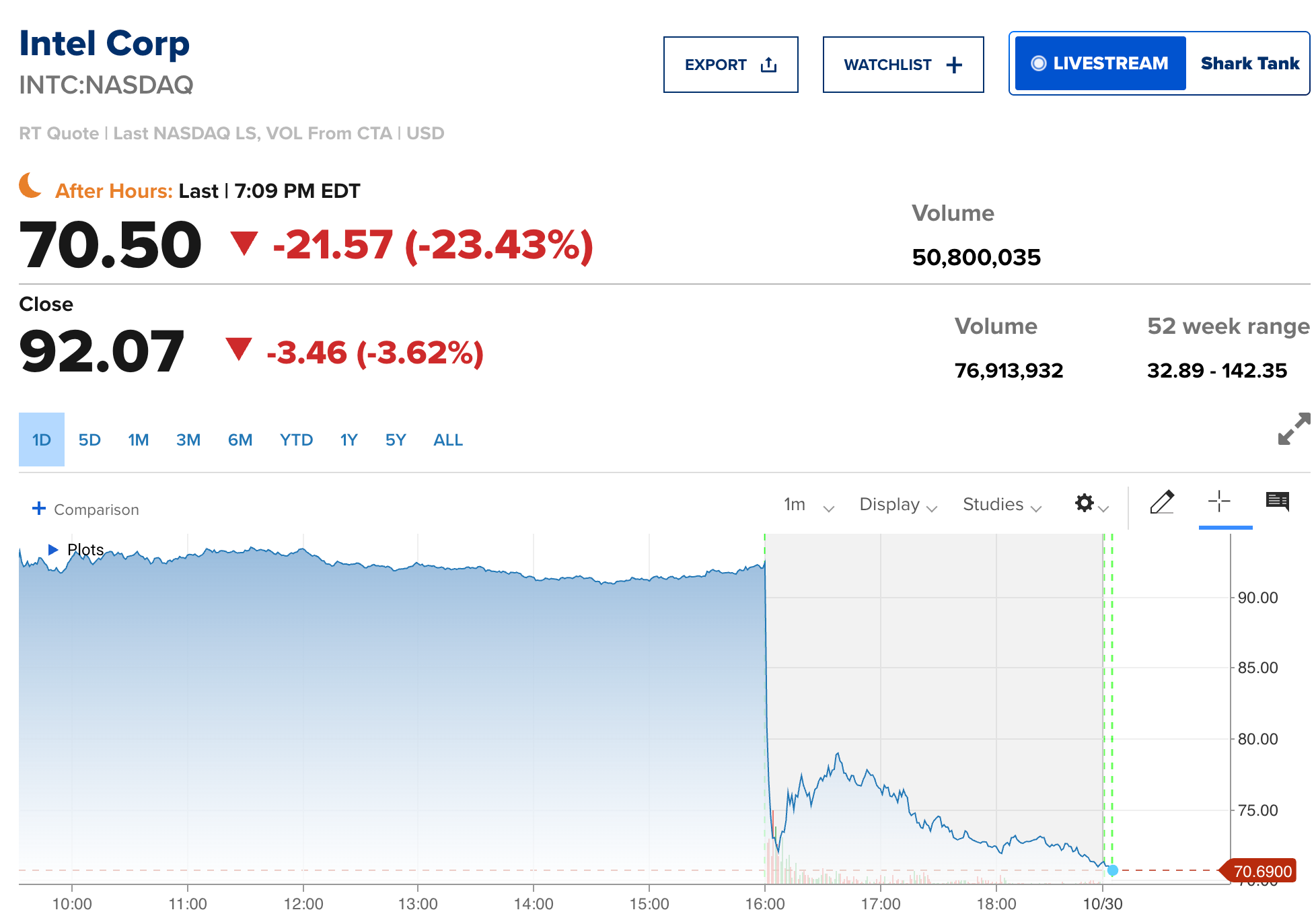
Charted in a single line: Intel shares fell 23.43% in Thursday after-hours trading.
The Long Side: Capacity Spend and Foundry Ambition
Despite the near-term guidance, Intel's long-term view on demand for its products is still positive, and the company is increasing investment in new equipment to lift capacity. Tan also said the company is growing more confident that it can attract other chipmakers to place orders and have their chips manufactured at Intel's fabs.
That distinction — weak current shipments, unchanged capex intent — is the signal most often lost in a headline about a 23.43% after-hours drop. A supplier adding equipment while its client channel contracts is signalling that it is not writing down the structural demand case; it is absorbing a cyclical supply and price shock.
Checklist for Design, Sourcing and Program Teams
- Re-baseline fourth-quarter and next-year client-platform forecasts against Intel's guided range of $15 billion to $16 billion, not the $17 billion analyst average.
- Treat memory price as a live variable in platform cost models, and stress-test configurations for the 2027 window flagged by Intel.
- Map single-site dependencies in your supply chain; the Israeli plant outage alone carries about $600 million in revenue impact within two quarters.
- Extend inventory buffers on components whose suppliers cite raw-material shortages.
- Track the data-center line separately: Intel stated that unit would have performed better without those two constraints.
- Watch capacity signals — equipment investment and external chipmaker orders — as leading indicators of future wafer availability.
- Confirm with OEM partners whether price increases, configuration cuts or build deferrals are being used to absorb memory cost.
Common Misreadings
- "This is purely an execution failure." Intel's stated causes were manufacturing supply shortfalls, unprecedented memory tightness and an Israeli plant outage — external constraints as much as internal ones.
- "Data center is collapsing too." The company said the data-center division would have posted better results without the raw-material shortages and the plant shutdown.
- "The stock move prices in the quarter." Thursday's close showed only a 3.6% decline; the 23.43% drop came in Thursday after-hours trading, once the outlook and the 2027 framing were visible.
- "Only Intel is exposed." Per Tan: "We are not the only company affected; the entire market has been hit."
- "Guidance cut means capacity retreat." Intel is adding new equipment spend to raise capacity and says it is increasingly confident of winning foundry orders from other chipmakers.
Action Recommendations
- Reset the planning horizon to two years. A 12% decline this year and a further 10% next year, with weakness at least through the first half of 2027, makes short-cycle refresh assumptions unsafe.
- Decouple client and data-center forecasts. The two lines are responding to different constraints, so a single demand multiplier across the roadmap will misprice both.
- Put memory sourcing on a formal risk register. The supplier calls it unprecedented and expects it to be a severe problem for the whole market by 2027.
- Diversify where single-site risk is quantified. Use the roughly $600 million, two-quarter impact of the Israeli plant explosion as the benchmark for how you value site concentration elsewhere.
- Convert the after-hours move into an internal signal, not noise. A 23.43% repricing reflects changed expectations for outlook, and any counterparty depending on that supplier's shipments inherits the same revision.
- Revisit long-term supply agreements with capacity visibility in mind. Rising equipment investment and external foundry orders will shape how much wafer capacity is available to each customer over the next cycle.
FAQ
What exactly missed?
Intel's fourth-quarter revenue outlook of $15 billion to $16 billion fell short of the $17 billion Bloomberg-compiled average, and adjusted EPS of 25 cents came in below the 43 cents Wall Street expected.
How did the market respond?
Shares were down 3.6% in Thursday's close and then dropped 23.43% in Thursday after-hours trading.
What is the quantified cost of the Israeli plant incident?
Intel previously said the fatal explosion at the facility would cause about $600 million in revenue loss within two quarters.
How long does Intel expect the PC downturn to run?
At least through the first half of 2027, following a 12% decline this year and an expected further 10% decline next year.
Is Intel retrenching?
No. Management said it remains optimistic about long-term demand, is increasing investment in new equipment to raise capacity, and is increasingly confident it can attract orders from other chipmakers to use its fabs.
Why does one CPU vendor's outlook matter to a board designer?
Because the stated causes — memory chip shortages, soaring component prices, raw-material gaps and a fab outage — are chain-wide inputs. Intel itself framed memory as a problem for the entire market, not a company-specific one.
Data Cited
- Intel's Thursday statement: fourth-quarter revenue outlook of $15 billion to $16 billion; adjusted EPS of 25 cents.
- Bloomberg compilation of analyst estimates: $17 billion average, some forecasts above $18 billion.
- Wall Street consensus: adjusted EPS of 43 cents.
- Share price: down 3.6% in Thursday's close; down 23.43% in Thursday after-hours trading.
- PC market: down 12% this year, an expected 10% decline next year, slump at least through the first half of 2027.
- Israel plant explosion: about $600 million in revenue impact within two quarters.
- Source of the outlook and quotations: Intel's earnings statement and conference call, as reported.
For additional context on semiconductor supply-chain developments, contact Electronics & Engineering at info@electronicseng.com.