
QLC Density in a 1U Envelope: Reading Kioxia's E1.L LD4 Series as a Semiconductor Decision
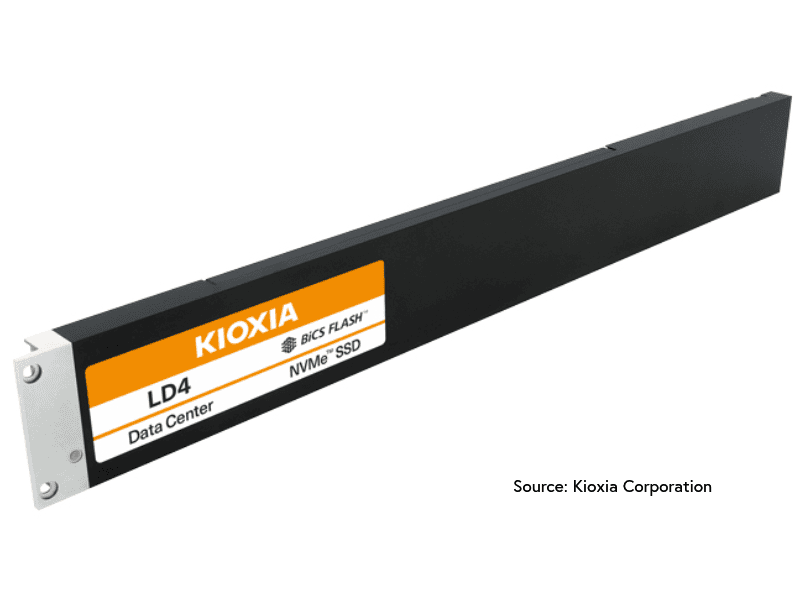
Long before a controller addresses a single terabyte, the height of a rack unit decides how much flash can physically be deployed. That constraint, rather than raw interface bandwidth, is what makes the announcement covered in detail by eeNews Europe worth a closer engineering look: Kioxia has committed its eighth-generation BiCS FLASH QLC NAND to the E1.L form factor and pointed the resulting LD4 Series squarely at 1U servers. For anyone qualifying storage on the Electronicseng beat, the interesting part is not the product name but the cell-level and platform-level trade-offs behind it.
Where the Product Sits in the Semiconductor Value Chain
The LD4 Series is the first Kioxia SSD family to couple the E1.L form factor with eighth-generation BiCS FLASH QLC NAND, which places it at the junction of three linkages in the chain: NAND cell architecture at the device level, E1.L module and controller integration at the component level, and hyperscale server platforms at the system level.
Kioxia positions the family for hyperscale data centres, where escalating storage demand has to be balanced against server space and infrastructure costs. The same announcement also underlines an AI-adjacent angle: the target infrastructure is the kind that supports AI workloads and read-intensive applications, where capacity per slot matters more than sustained write throughput.
Cell-Level Arithmetic: Why four bits per Cell Reshapes the Rack
Quad-level cell technology stores four bits in each memory cell. The direct consequence is capacity: a given die and package footprint yields more gigabytes than lower-density NAND technologies, which is precisely the lever needed inside a shallow E1.L bay mounted in 1U servers.
The trade-off is endurance. Higher bits-per-cell designs usually bring lower write endurance, so the family is best matched to workloads dominated by reads. That single sentence explains both why hyperscale operators are the launch audience and why this is a workload-fit decision, not a pure spec-sheet comparison.
Capacity Headroom: Launch SKUs Versus Validated Architecture
Two numbers describe the shipping reality; a third describes the design ceiling. Initial capacities are 15.36 TB and 30.72 TB, while an architecture validated for up to 122.88 TB has been confirmed — with no commercial drive at that capacity announced.
| Attribute | Announced position | Engineering implication |
|---|---|---|
| NAND platform | eighth-generation BiCS FLASH QLC NAND | Latest-generation QLC density is the capacity driver |
| Cell scheme | four bits per memory cell | Capacity per cell over write endurance |
| Form factor | E1.L | High-capacity module in a front-facing, dense bay layout |
| Target platform | 1U servers | Density gain comes from the slot, not the chassis count |
| Launch capacities | 15.36 TB and 30.72 TB | The two SKUs that can actually be planned into a design today |
| Architecture ceiling | validated for up to 122.88 TB | Headroom signal only; no commercial part at that size |
| Host interface | PCIe 5.0 over a four-lane link at up to 16 GT/s per lane | Generational bandwidth headroom for read-dominant traffic |
| Protocol | NVMe 2.0e | Current-spec driver and firmware assumptions apply |
| Platform spec | Open Compute Project (OCP) Datacenter NVMe SSD Specification v2.6 | Aligns with hyperscale fleet requirements |
| Port design | Single-port architecture | Standardised integration path into dense storage systems |
| Availability status | Sampling to selected customers | Pre-mass-production; specifications may change |
| Public debut | OCP Global Summit 2026, 12 to 15 October, San Jose, California | Shown in a data-centre-spec audience, not a consumer venue |
Interface and Specification Compliance
According to Kioxia, the LD4 Series provides PCIe 5.0 connectivity over a four-lane interface and reaches transfer rates of up to 16 GT/s per lane. The drives comply with the NVMe 2.0e specification and support the Open Compute Project (OCP) Datacenter NVMe SSD Specification v2.6.
- PCIe 5.0 host link, four-lane, up to 16 GT/s per lane
- NVMe 2.0e protocol compliance
- OCP Datacenter NVMe SSD Specification v2.6 support
- Single-port architecture designed for hyperscale and data centre-class servers
- Standardised interface intended for integration into high-density storage systems
Qualification Checklist Before You Put E1.L QLC in a 1U Design
- Confirm the chassis and backplane actually expose an E1.L bay with adequate service access in the 1U servers in question.
- Verify a PCIe 5.0 four-lane path is available per slot, and that the switch or root complex can sustain up to 16 GT/s per lane in the real topology.
- Characterise the workload read/write ratio first; QLC's lower write endurance makes read-dominant hyperscale traffic the natural fit.
- Validate NVMe 2.0e assumptions in the host driver stack, not just the firmware on the drive.
- If the fleet follows Open Compute Project requirements, test against OCP Datacenter NVMe SSD Specification v2.6 rather than assuming compliance from the datasheet.
- Decide whether 15.36 TB or 30.72 TB is the planning unit, and re-run the capacity model at both to see which one changes rack count.
- Book re-qualification time for the pre-production window: samples are for functional evaluation and specifications may change before mass production.
Common Misconceptions
- "A 122.88 TB drive is on the price list." No. The architecture has been validated for up to 122.88 TB, but Kioxia has announced no commercial drive at that capacity. Plan against 15.36 TB and 30.72 TB.
- "QLC means enterprise-unfit." The endurance penalty is real, which is why the family is aimed at read-dominated hyperscale workloads rather than write-heavy tiers.
- "The form factor is just a mechanical detail." The density story only closes when the E1.L envelope and the eighth-generation QLC cell architecture are considered together.
- "Sampling means shipping." Early samples exist for functional evaluation; treat all published figures as provisional until mass production.
- "PCIe 5.0 alone delivers the performance." Link width and per-lane rate are stated as four-lane and up to 16 GT/s per lane; platform design still determines realised throughput.
Sampling Status and Event Context
The E1.L QLC SSD family is now sampling to selected customers, with the initial samples intended for functional evaluation. Kioxia notes that specifications may change before mass production.
The LD4 Series was showcased at OCP Global Summit 2026, held from 12 to 15 October in San Jose, California — a venue choice that reinforces the product's audience of hyperscale infrastructure teams rather than enterprise generalists.
Action Recommendations
- Run a density-versus-endurance simulation using 30.72 TB as the upper current SKU, then stress-test the same model at up to 122.88 TB to see how much future headroom your rack layout can absorb.
- Reserve evaluation slots with the supplier channel now if the fleet is E1.L-ready; sampling access is limited to selected customers.
- Freeze a workload profile before evaluation, so functional samples are judged against read-heavy behaviour rather than synthetic write benchmarks.
- Track the pre-mass-production spec changes and re-validate driver, firmware and OCP v2.6 conformance at each revision.
- Keep procurement timing tied to the architecture's announcement year, 2026, and avoid committing downstream capacity claims on the validated ceiling alone.
FAQ
What exactly did Kioxia announce?
The LD4 Series: an E1.L solid-state drive family built on eighth-generation BiCS FLASH QLC NAND, designed for 1U servers and aimed at hyperscale data centres.
Which capacities can be designed in today?
15.36 TB and 30.72 TB are the initial drive capacities.
Does a 122.88 TB part exist?
No commercial drive has been announced at that size. Kioxia states the architecture has been validated for up to 122.88 TB, which is a design-capability signal, not a shipping SKU.
Why is QLC the right cell choice here?
Because four bits are stored in each memory cell, capacity per die and per slot rises versus lower-density NAND. The trade-off is lower write endurance, which suits read-intensive hyperscale workloads.
What host and firmware standards apply?
PCIe 5.0 over a four-lane interface reaching up to 16 GT/s per lane, NVMe 2.0e compliance, and support for the Open Compute Project (OCP) Datacenter NVMe SSD Specification v2.6.
Is the product available?
It is sampling to selected customers for functional evaluation. Specifications may change before mass production; the family was shown at OCP Global Summit 2026, held 12 to 15 October in San Jose, California.
Bottom Line
The useful takeaway for design teams is not headline terabytes but the pairing itself: cell-level density from eighth-generation QLC, packaged into an E1.L envelope that fits the only dimension hyperscale operators can no longer grow — the height of a 1U servers bay. Treat the 15.36 TB and 30.72 TB SKUs as qualification targets, the validated ceiling of up to 122.88 TB as roadmap evidence, and the read/write ratio of your own workloads as the deciding factor before any E1.L QLC deployment is committed.