
Semiconductor Timing for Low Earth Orbit: A Design and Procurement Read on the Microchip Technology LX-820 | Electronicseng Semiconductors
By Rachel Williams · Electronicseng Semiconductors
Payload engineers rarely spend as much time on the reference oscillator as they do on the processor that reads it, yet in orbit that device sets the cadence for every data sample, every navigation timestamp and every command window. The real question on a Low Earth Orbit (LEO) programme is not whether quartz timing works off-world; it is whether the timing chain must be bought as a bespoke, high-reliability build, or whether a production-standard component can be specified against the same radiation, thermal and mechanical envelope. The LX-820 Radiation-Tolerant Quartz Oscillator, the newest entry in the L-Series from Microchip Technology, is written for that second answer — and it rewards being read as a semiconductor supply decision as much as a datasheet choice.
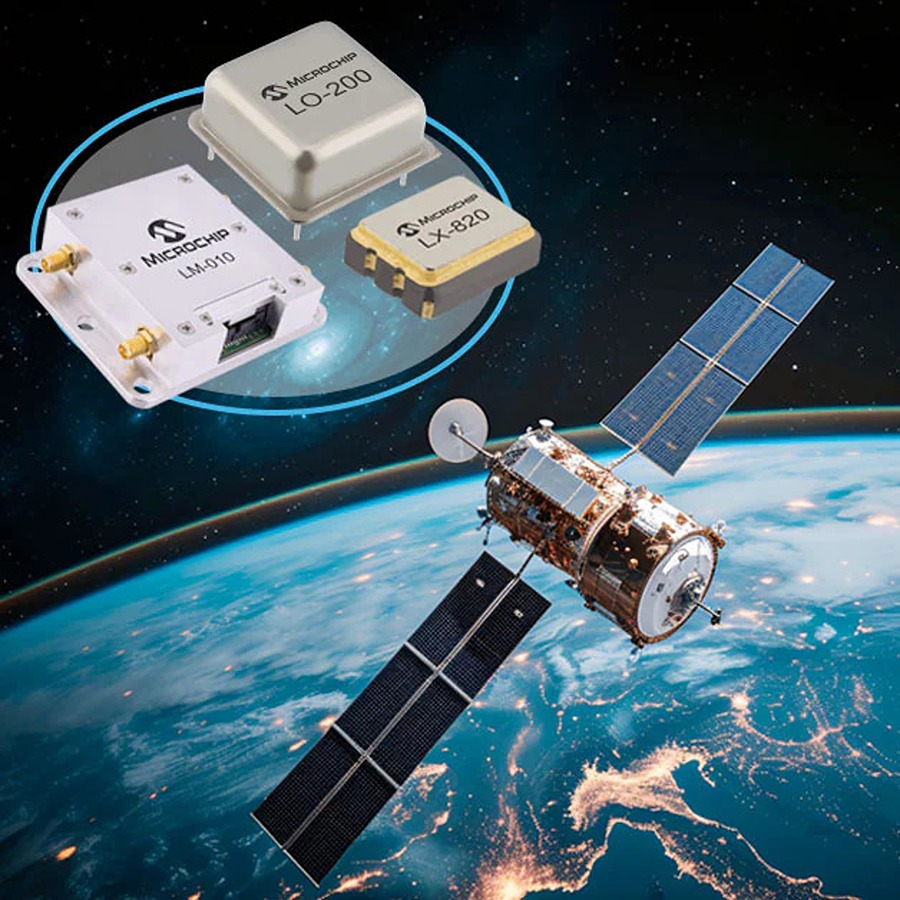
Positioning: between commercial quartz and a full space pedigree
The L-Series label describes a manufacturing route more than a frequency plan. The family is deliberately placed between commercial off-the-shelf (COTS) oscillators and traditional high-reliability space products, blending commercial- or military-grade components with production inspection, electrical and thermal analysis and hybrid manufacturing. For a bill of materials built on quartz and silicon, that hybrid route shifts where the qualification burden sits: the evidence is carried by the finished, screened assembly rather than by a bespoke component lineage.
Because these parts are submitted as complete, functioning devices, Total Ionizing Dose (TID) and Single-Event Latchup (SEL) results are reported at oscillator level, with radiation tolerance up to 50 krad and SEL testing to 40 MeV·cm²/mg. Most L-Series products also use swept quartz, a material choice aimed at the mechanism designers fear most in orbit, namely radiation-induced frequency drift. Ruggedized construction and four-point crystal mounts in L-Series OCXOs address the other half of the environment: launch loads and the intended mission profile.
Data reference: the specification lines a design review will ask for
The LX-820 is defined by frequency, temperature, performance class, package and radiation margin at the same time, so the stated values are collected below in one place for board-level scoping.
| Specification line | Stated value | Engineering read-through |
|---|---|---|
| Device | LX-820 Radiation-Tolerant Quartz Oscillator (L-Series) | Timing reference specified for Low Earth Orbit (LEO) and other space applications |
| CMOS output frequency | 1.25 MHz to 135 MHz — single-ended outputs up to 135 MHz | Reference loads that accept a single-ended clock |
| LVDS output frequency | 100 MHz to 250 MHz — differential outputs up to 250 MHz | Low-voltage differential signaling where a paired clock is required |
| Operating temperature | -55°C to 125°C | Wide thermal envelope covering orbital swing and ground handling |
| Performance class | MIL-PRF-55310 Level B with ±100 ppm | Military-grade oscillator performance level rather than an open commercial tolerance |
| Package | 3.2 mm × 2.5 mm surface-mount | Compact footprint for density-constrained boards |
| Radiation tolerance (TID) | up to 50 krad | Dose margin to compare against the mission dose estimate |
| Single-Event Latchup | 40 MeV·cm²/mg | Latchup test level reported across the family |
| Crystal material | Most L-Series products use swept quartz | Reduces radiation-induced frequency drift |
| Supply profile | Many configurations from stock, or lead times of less than 20 weeks | Contrasts with the extended lead times typical of space-qualified timing |
The two frequency bands are separate output paths rather than one sliding scale: CMOS runs 1.25 MHz to 135 MHz, while low-voltage differential signaling (LVDS) runs 100 MHz to 250 MHz. That split is where most early scoping errors appear, because a board that needs a high-frequency differential reference cannot borrow headroom from the single-ended side.
The two programme pressures the family is written against
Satellite timing procurement normally collides with two persistent challenges: supply chain constraints and budget pressure. Space-qualified timing solutions often carry extended lead times and significant procurement costs, and the paperwork around them adds to both. L-Series is positioned as a more accessible alternative — many configurations are available from stock or with lead times of less than 20 weeks — and it is also intended to lower overall programme cost by reducing the need for component pedigree, documentation requirements and inspection overhead typically associated with traditional high-reliability space-grade timing products.
For planners the consequence is schedule arithmetic rather than marketing: a timing line that can be pulled from stock or delivered in less than 20 weeks changes how design freezes, long-lead ordering and second-source decisions are sequenced, without altering the electrical envelope described above.
Architecture comparison inside one portfolio
These applications impose different timing requirements, so the L-Series encompasses crystal oscillators (XOs), temperature-compensated crystal oscillators (TCXOs), oven-controlled crystal oscillators (OCXOs) and a pulse-per-second (PPS) disciplined oscillator. The choice is a stability-versus-power-versus-size trade, not a preference ranking.
| Architecture | What the portfolio positions it for | Selection trigger |
|---|---|---|
| XO (crystal oscillator) | Compact devices with broad frequency coverage | Size and frequency range lead the requirement — the case the LX-820 makes in a 3.2 mm × 2.5 mm package |
| TCXO | Tighter temperature stability at lower power | Thermal drift matters more than board area |
| OCXO | More demanding stability and phase-noise performance | The link or measurement budget needs the tighter column; ruggedized construction and four-point crystal mounts apply here |
| PPS-disciplined oscillator | Pulse-per-second synchronization with holdovers | Time-tag continuity is the governing requirement |
Read as a flow, the entry point is the compact XO when size and broad frequency coverage are priorities; TCXOs move in when tighter temperature stability and lower power are needed; OCXOs move in when stability and phase-noise demands rise again; and a disciplined oscillator enters the design when PPS synchronization and holdovers are required.
Mission context: where an accurate reference is consumed
Highly accurate timing references support communications, navigation, Earth observation, mapping and emerging lunar missions in modern satellite systems. Each of those consumers pulls on a different combination of the four variables the portfolio is differentiated by — frequency stability, phase noise, power and size — which is exactly why a single oscillator family has to offer several architectures to meet different mission requirements.
Common misconceptions
- A dose rating is not a stability rating. Radiation tolerance up to 50 krad and SEL to 40 MeV·cm²/mg describe the environment the device survives; ±100 ppm under MIL-PRF-55310 Level B describes how far the frequency may move. They must be budgeted separately, and swept quartz exists precisely to limit radiation-induced frequency drift as a distinct effect.
- Every L-Series oscillator uses swept quartz. The stated position is that most L-Series products do, so the material choice needs confirming per configuration whenever drift matters.
- CMOS headroom extends to the differential output. CMOS is specified from 1.25 MHz to 135 MHz and LVDS from 100 MHz to 250 MHz; the two bands overlap only in the middle of the range.
- OCXO mechanical features transfer to the small part. Ruggedized construction and four-point crystal mounts are described for L-Series OCXOs, while the LX-820 is a compact 3.2 mm × 2.5 mm surface-mount device — mount detail belongs to the architecture actually selected.
- Space-qualified always means slow. The L-Series premise is the opposite for many configurations: from stock, or lead times of less than 20 weeks.
- COTS-adjacent means untested. The family sits above COTS, with production inspection, electrical and thermal analysis and hybrid manufacturing applied to complete, functioning devices.
Selection and qualification checklist
- Fix the output type before the frequency: CMOS up to 135 MHz or LVDS up to 250 MHz.
- Check the requested frequency against the correct band — 1.25 MHz to 135 MHz for CMOS, 100 MHz to 250 MHz for LVDS.
- Map the orbital dose estimate against the up to 50 krad figure, and record the latchup requirement alongside 40 MeV·cm²/mg.
- Verify the thermal environment at the mounting location against -55°C to 125°C, including ground test and handling extremes.
- Confirm ±100 ppm against the link, navigation or sampling budget, and confirm MIL-PRF-55310 Level B conformance in the documentation set you will actually receive.
- Confirm the 3.2 mm × 2.5 mm surface-mount footprint against land pattern, adjacent components and rework constraints.
- Ask explicitly whether the configuration uses swept quartz when radiation-induced frequency drift is on the critical path.
- Escalate architecture if the budget demands it: TCXO for tighter temperature stability at lower power, OCXO for demanding stability and phase noise, a disciplined oscillator for PPS synchronization and holdovers.
- Test the supply assumption early: stock position, or the less than 20 weeks lead-time profile, before the build schedule is committed.
- Re-price the programme overhead — component pedigree, documentation and inspection effort are where the savings are claimed.
FAQ
What is the LX-820 and where does it fit?
The LX-820 Radiation-Tolerant Quartz Oscillator extends the L-Series of timing devices for Low Earth Orbit (LEO) and other space applications. The series sits between commercial off-the-shelf oscillators and traditional high-reliability space products, so the part is best read as a production-scale option for missions that need radiation and thermal margins without a fully bespoke pedigree.
Which output frequencies and interfaces are supported?
CMOS output frequencies run from 1.25 MHz to 135 MHz, that is CMOS outputs up to 135 MHz, and LVDS output frequencies run from 100 MHz to 250 MHz, that is differential outputs up to 250 MHz.
What are the environmental and performance limits?
The device is designed to operate from -55°C to 125°C, is engineered to meet MIL-PRF-55310 Level B with ±100 ppm performance, and is supplied in a compact 3.2 mm × 2.5 mm surface-mount package.
What radiation evidence supports the family?
As complete, functioning devices, L-Series oscillators have passed Total Ionizing Dose (TID) and Single-Event Latchup (SEL) testing, reaching radiation tolerance up to 50 krad and SEL testing to 40 MeV·cm²/mg. Frequency drift is handled at material level, since most L-Series products use swept quartz.
Is a fixed-frequency oscillator the only building block?
No. Within the portfolio, developers can choose among XOs, TCXOs, OCXOs and a PPS-disciplined oscillator, each offering different frequency stability, phase noise, power and size to meet different mission requirements.
How quickly can hardware be obtained?
Many configurations are available from stock or with lead times of less than 20 weeks, and production quantities are now available for the LX-820 Crystal Oscillator and other L-Series oscillators.
The wider timing stack around the device
An oscillator never ships alone in a system design, and the surrounding portfolio is worth mapping during architecture selection: it runs from miniature component oscillators and small plug-in timing server cards to atomic clocks and multi-rack time scale systems, with Microchip presenting those clock and timing systems as trusted, reliable and resilient contributions to the world's time. For programme teams the relevant point is that a compact board-level reference and a system-level time scale are chosen against very different cost and schedule budgets, even when they share the same supplier and interface vocabulary.
Action recommendations
- Re-run the timing budget for any LEO board currently specified with a bespoke space-grade oscillator, and test whether ±100 ppm over -55°C to 125°C closes the requirement.
- If the design needs a differential reference above the single-ended ceiling, standardize the LVDS option in the 100 MHz to 250 MHz band early, because that band is where CMOS stops.
- Treat the radiation column as a comparison against your dose estimate rather than a pass badge: up to 50 krad and 40 MeV·cm²/mg are the family's stated limits.
- Ask for swept quartz in writing when drift is mission-critical, since most, not all, L-Series products use it.
- Use the less than 20 weeks lead-time profile to renegotiate design freeze and second-source sequencing, and quantify the pedigree, documentation and inspection overhead you avoid.
The headline for our Semiconductors desk is that nothing about the orbit environment got easier: dose, latchup, launch loads, thermal swing and drift all remain on the table. What changed is the shape of the buy, since satellite developers can now select from a wide range of oscillator architectures in one L-Series portfolio that carries those margins without importing the procurement penalty usually attached to them.