
Semiconductors Practice Guide: Designing with Nordic nRF71 series Wi-Fi SoCs for Low-Power Edge AI
For product teams, the practical interpretation is simple: Nordic nRF71 series Wi-Fi SoCs can replace the usual host-MCU-plus-Wi-Fi-companion split when connectivity, application logic, and a bounded inference workload all fit in one device. Nordic Semiconductor reports that the nRF71 series delivers up to 20 times lower standby power consumption than the nRF70 series of Wi-Fi companion ICs. At DTIM 10, the relevant baseline currents are 14 µA at 2.4 GHz and 8 µA at 5 GHz, not the final product current.
What does the one-chip architecture remove from the design?
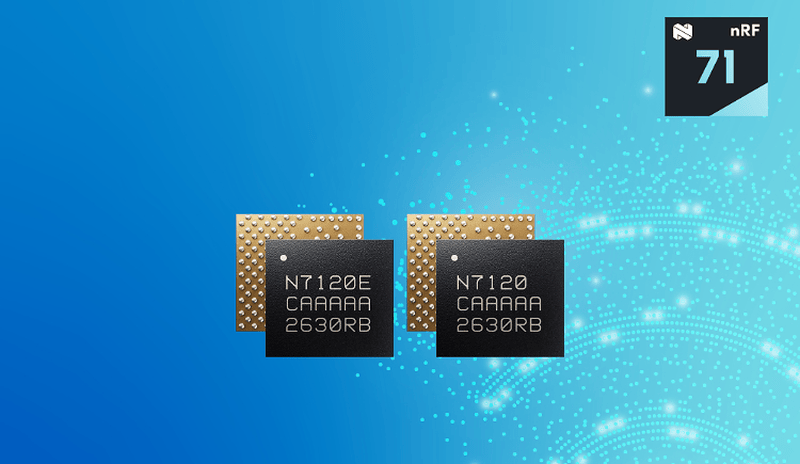
The main architectural saving is control-path simplification. The Nordic nRF7120 product page states that developers can build secure, battery-powered, Wi-Fi connected devices “without external memory or a separate host MCU”. In a typical sensor-to-cloud node, that changes both BOM and timing: one device owns the radio policy, application state, and local inference.
The first two SKUs are the nRF7120 and the nRF7120E. The nRF7120 provides dual-band Wi-Fi 6, while nRF7120E adds tri-band Wi-Fi 6E and an Axon NPU for hardware-accelerated edge AI. Both include 4 MB of on-chip non-volatile memory and 1 MB of user-accessible RAM, and both support Bluetooth LE, Thread, and Matter. Nordic Semiconductor announced the nRF71 series on 3 November 2026 and states that it is sampling with selected customers.
Questions that decide whether a companion IC is still needed
- Do the GPIO, timer, analog, and peripheral needs exceed what a Cortex-M33 application can host?
- Is 1 MB of user-accessible RAM enough for the stack, buffers, OTA strategy, and model activation memory?
- Can the product tolerate a radio policy managed by the same firmware team that owns the application?
- Is Matter commissioning over Bluetooth LE, Thread, and Wi-Fi part of the product requirement?
How should engineers read the DTIM 10 current figures?
Conclusion first: the nRF71 series numbers are connected-standby floors under a specific beacon-listening policy, not product-level average consumption. DTIM 10 means the client may skip most traffic-indication beacons and wake on the DTIM beacon to receive buffered broadcast or multicast frames. Nordic's Wi-Fi fundamentals lesson describes power save modes as essential for low-power IoT devices, while third-party radio configuration guidance warns that DTIM=1 forces every-beacon wakeups and can erase power savings.
- Set the assumption: the connected state still has a beacon-listening cost; it is not a sleep current of a closed radio.
- Test multiple AP profiles: different routers may use different DTIM multipliers, causing latency and current spread.
- Separate event energy: TX/RX bursts, sensor wake, flash writes, and inference consume millijoule-scale energy that must be added to the 14 µA at 2.4 GHz baseline.
- Include the PMIC: regulator quiescent current and battery chemistry self-discharge may dominate the measured system current.
A practical rule is to model energy as: idle baseline + connection policy + radio event duty cycle + host processing + storage writes + regulator overhead. The 8 µA at 5 GHz figure is a reference point for a higher band that often has higher path loss, so retry rate should be measured in the actual enclosure.
When does the Axon NPU earn its place, and when is Neuton software enough?
The Axon NPU earns its place when the model workload is too frequent or too compute-heavy for the 256-MHz Cortex-M33 to meet latency and energy targets. Nordic Semiconductor cites keyword spotting, anomaly detection, and image classification as practical edge AI applications for battery-powered devices based on the nRF71 series. Nordic Semiconductor states that, with the Axon NPU, machine-learning models run 10× to 17× faster than on the 256-MHz Cortex-M33 alone.
The CPU-only path is also part of the system design. Ultra-small models trained on developers' own data can run with Neuton software directly on the Cortex-M33, without using the Axon NPU. Nordic's Edge AI documentation adds an important framing: the Axon NPU is described as a dedicated accelerator core for improving speed and efficiency of TensorFlow Lite models. This suggests a two-tier decision for Electronicseng Semiconductors readers: use Neuton-style lightweight models when feature extraction and decision logic are simple; move the hot path to hardware acceleration only when CPU latency or energy becomes a measurable failure mode.
Integration checklist for battery-powered Wi-Fi products
- Write the radio scope: nRF7120 for dual-band Wi-Fi 6 or nRF7120E for tri-band Wi-Fi 6E; confirm regional 6 GHz operation before a global SKU claim.
- Draw the power-event ledger: idle, connected standby at DTIM 10, scan, association, data TX/RX, Matter commissioning, sensor sampling, inference, OTA, and NVM writes.
- Choose the AI target early: Cortex-M33 only with Neuton software, or Axon NPU for accelerator-friendly TensorFlow Lite models; benchmark accuracy, inference latency, and current during inference.
- Map the software stack: use nRF Connect SDK, which Nordic states is built around Zephyr RTOS and integrates drivers, protocol stacks, and samples for nRF wireless devices.
- Validate bring-up hardware: the nRF7120 development-kit documentation shows the board exposing Cortex-M33 CPU support, GPIO headers, and MSPI resources, useful for sensor, memory, and debug experiments.
- Check memory pressure: 4 MB of on-chip non-volatile memory is attractive for eliminating external flash, but OTA slots, file systems, logs, and model weights must fit with margin.
- Plan RF coexistence: Bluetooth LE, Thread, and Matter all use spectrum and network interactions; test antenna isolation, enclosure loss, and retry behavior with a live AP and a Thread border router.
- Run current profiling on firmware not on a dev kit average: replace USB power with battery path, use a current probe, and capture peak currents during commissioning and NVM erase/write.
- Verify regulatory and interoperability: Wi-Fi Alliance programs, regional approvals, and Matter certification are separate gates; a working demo does not prove a shipping product.
- Freeze supply risk: sampling status means second-source modules, alternate package options, and distributor checks should happen before mechanical lock.
Comparison table: nRF7120 vs nRF7120E for design selection
| Design factor | nRF7120 | nRF7120E | Engineering implication |
|---|---|---|---|
| Wi-Fi band plan | dual-band Wi-Fi 6 | tri-band Wi-Fi 6E | 6 GHz may reduce congestion where legal and infrastructure exists, but it increases certification scope. |
| Edge AI | CPU-only edge AI path with Neuton software | Axon NPU plus CPU path | Use the NPU for repeated sensor fusion or model inference that cannot meet power targets on the CPU. |
| On-chip memory | 4 MB of on-chip non-volatile memory and 1 MB of user-accessible RAM | 4 MB of on-chip non-volatile memory and 1 MB of user-accessible RAM | Simplifies BOM, but model size and OTA strategy become firmware design constraints. |
| Protocol set | Bluetooth LE, Thread, Matter | Bluetooth LE, Thread, Matter | Multi-protocol support helps commissioning and local control, but still requires test vectors for failure paths. |
| Power reference | 14 µA at 2.4 GHz and 8 µA at 5 GHz at DTIM 10 | 14 µA at 2.4 GHz and 8 µA at 5 GHz at DTIM 10 | Use these as lab baselines, not promises, until the device's event profile is measured. |
Common pitfalls that can erase the low-power advantage
- Misreading DTIM: connected standby depends on network policy; APs or multicast traffic can cause frequent wakeups.
- Assuming the NPU is always better: tiny CPU models may already meet latency and battery targets; moving them to an accelerator can add integration overhead without system-level savings.
- Forgetting 5 GHz and 6 GHz path loss: higher bands can increase retries, changing average current and user latency.
- Using a dev kit current number: debug interfaces, regulators, LEDs, and sensors inflate consumption.
- Overcommitting to 1 MB of user-accessible RAM: audio, image classification, and large feature pipelines can exhaust activation memory, requiring quantization and shorter windows.
- Treating sampling as production: errata, package availability, and firmware support can evolve.
FAQ: practical questions before selecting Nordic nRF71 series parts
Are the nRF7120 and nRF7120E Wi-Fi companion ICs or application SoCs?
They are presented as Wi-Fi SoCs that can carry the application and radio role, unlike the nRF70 series of companion ICs. Whether they replace the host MCU in your product still depends on peripheral count, software complexity, and memory margin.
Does DTIM 10 guarantee a certain battery life?
No. DTIM 10 is one connected-state measurement condition. The real average current depends on AP beacon policy, multicast traffic, report frequency, retry behavior, sensor power, inference duration, and PMIC overhead.
Should all edge AI workloads be placed on the Axon NPU?
No. Nordic Semiconductor positions ultra-small models using Neuton software on the Cortex-M33, while the Axon NPU is described for TensorFlow Lite-class acceleration. Teams should benchmark accuracy, latency, and energy before selecting the target.
Does Matter support make a product ready to ship?
No. Supporting Matter requires protocol implementation, security, commissioning tests, ecosystem compatibility, and certification. The silicon capability is only the first layer.
Can a design be finalized now?
Nordic Semiconductor states that the nRF71 series is sampling with selected customers, so a production SKU should not be frozen until the correct revision, package, support policy, and supply position are confirmed.
Action recommendations
Start with a narrow battery-powered prototype that proves the three hardest loops: connection policy, current during real events, and model inference in the final enclosure. If the application is simple enough to fit within 4 MB of on-chip non-volatile memory and 1 MB of user-accessible RAM, test the one-chip architecture before adding a companion or external memory.
- For 2.4 GHz-focused products, benchmark nRF7120 first; reserve Wi-Fi 6E mainly where the product truly needs 6 GHz capacity or reduced congestion.
- For keyword spotting, anomaly detection, or image classification, create a power budget that separates CPU inference from Axon NPU inference; use the 10× to 17× statement as an accelerator benchmark target, not a product claim.
- For supply-chain planning, treat the 3 November 2026 sampling announcement as the start of early engagement: request design files, qualification status, and distributor stock before committing tooling.
- For software teams, standardize on nRF Connect SDK and Zephyr bring-up practices early, because radio policy, Matter commissioning, and inference scheduling interact.
References and sources checked
- Nordic Semiconductor news release for nRF71 series
- Nordic Semiconductor nRF7120 product page
- Nordic Semiconductor Edge AI materials
- Nordic Semiconductor nRF Connect SDK
- Zephyr documentation for the nRF7120 DK
- Nordic Developer Academy: beacon frames, TIM and DTIM
- IoT For All: Wi-Fi radio configuration settings
- Regulatory test guidance for Wi-Fi 6E devices