
Nova Lake-S 28-Core PassMark Entries: Reading the Single-Thread Lead, and the Columns That Contradict It
Turn the recently surfaced Intel Nova Lake-S benchmark records around and they become far more informative. Instead of asking whether a 28-core sample beats today's flagships, the more useful question for a semiconductor audience is why the answer flips depending on which PassMark column you read. Two early entries place the unlabelled part just ahead on single thread, behind on CPU Mark, and well behind on Memory Mark — a spread that says as much about how engineering silicon gets sampled in public databases as it does about the retail platform it may one day become.
Provenance first: how the records reached the database
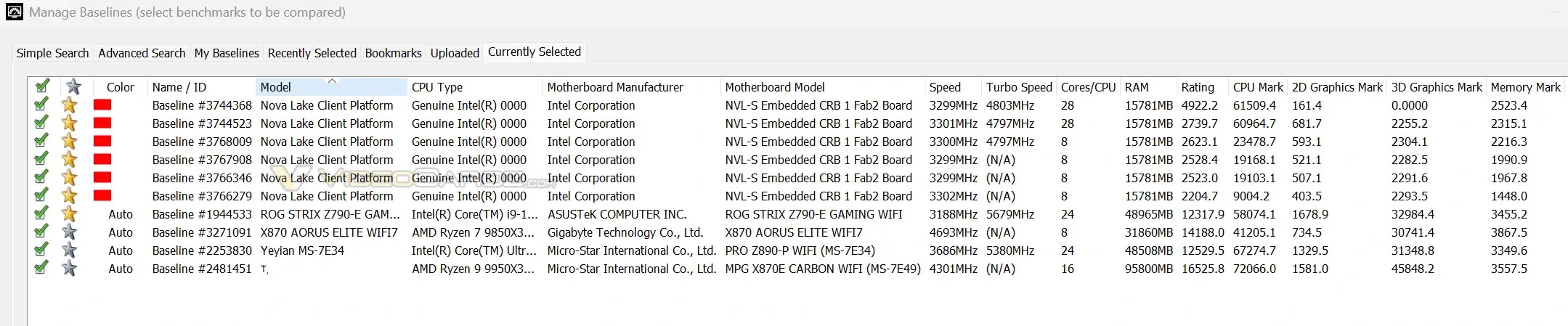
According to a reader report carried by VideoCardz, the listings were located inside the "Manage Baselines" function of PerformanceTest 11.1 and are registered under the identifier "Intel 0000" — an unidentified device, with record history traceable to September this year. The two 28-core entries report single-thread scores of 5210 points and 5191 points. For anyone doing component qualification, that identifier is the central caveat: baseline uploads carry no control over thermal configuration, memory topology or microcode revision, so a score is a sampling event, not a specification.
Single-thread standing against current top parts
| Reference processor | Single-thread score | Sample advantage |
|---|---|---|
| Core Ultra 9 285K | 5059 points | about 3% |
| Ryzen 9 9950X3D | 4805 points | 8.4% |
| Core i9-14900KF | 4635 points | 12.4% |
Using the comparison set selected in media coverage, the sample leads by about 3%, 8.4% and 12.4% respectively. Headroom of that size on the single-thread axis is relevant for serialised and latency-sensitive code paths, but it rests on one column of one benchmark run on a part whose retail identity is still unknown.
Where the same sample falls behind
- CPU Mark (multi-thread): the sample tops out at 61509 points, below Core Ultra 9 285K at 67274 points and below Ryzen 9 9950X3D at 72066 points; only Core i9-14900KF at 58074 points sits underneath it.
- Memory Mark: 2523.4 for the sample against 3349.6 for the comparison system.
- Platform clues visible in the screenshot: about 16GB of memory, an about 3.3GHz reported frequency and a boost reading close to 4.8GHz.
The Memory Mark gap cannot be pinned on the processor alone, because it is a whole-system result and the reference machine may simply carry a faster memory configuration. The multi-thread shortfall points in the same direction: test environment, clocking or firmware state on a sample marked "Intel 0000" is unlikely to mirror shipping hardware, which is exactly why the single-thread lead should not be extrapolated on its own.
The 8-core entries are the noisier data set
The same database also holds 8-core records. Their best single-thread score is 5085 points, about 0.5% above the Core Ultra 9 285K reference figure, while CPU Mark results swing from 9004 to 23478 points. A spread that wide across identically labelled parts usually indicates inconsistent test conditions or differing development configurations rather than silicon variance — a second reminder to weight provenance over peak numbers.
Product stack, cache variants and packaging signals
Earlier leaked Nova Lake-S product tables list SKUs such as Core Ultra 9 4970K BFC. High-end models are said to combine 8 performance cores, 16 efficiency cores and 4 low-power efficiency cores, with "BFC" read as a large last-level cache variant. Other leaks suggest the standard 4950K may also carry those 4 low-power efficiency cores. The current benchmark entries identify no retail model, so there is no way to confirm whether the sample includes the extra cache at all.
Socket, chipset and schedule — the parts that touch procurement
Nova Lake-S is rumoured to move to an LGA 1954 socket paired with a 900-series chipset, which implies a platform transition rather than a drop-in upgrade path for existing boards. Intel has previously confirmed that Nova Lake is planned for introduction before the end of 2026, and media expectations place the first desktop products in early 2027; a 52-core version built on a dual compute tile design is said to follow later. Model names, core configurations and launch timing all remain pending official confirmation from Intel.
Checklist: verification points before these numbers reach a design decision
- Re-check any board-reuse assumption against the rumoured LGA 1954 socket and 900-series chipset pairing.
- Flag records labelled "Intel 0000" in PerformanceTest 11.1 as unsigned engineering samples until a retail SKU appears.
- Cite the source path — PassMark database, PerformanceTest 11.1, records dating to September this year — next to every figure circulated internally.
- Only re-baseline the single-thread gain once CPU Mark and Memory Mark results come from matched platform configurations.
- Track confirmation on core configuration, the BFC large-cache variant and the 52-core dual compute tile part before sizing thermal and power delivery.
Common misconceptions
- "A single-thread win proves a generational leap." One 5210-point entry from an unidentified part, with CPU Mark trailing two current flagships, does not support that reading.
- "A lower Memory Mark means a weaker memory subsystem on-chip." Memory Mark is system-level; the 2523.4 versus 3349.6 delta is not attributable to the processor alone.
- "The 8-core entries characterise a smaller product tier." Scores from 9004 to 23478 signal inconsistent configurations, not usable product behaviour.
- "BFC is a confirmed SKU with confirmed cache." It is a suffix in a leaked table, with large-cache intent inferred rather than published.
Action guidance for engineers, buyers and analysts
Treat this leak as a platform-risk signal rather than a performance verdict. Design and sourcing teams should keep current-generation costings on Core Ultra 9 285K, Ryzen 9 9950X3D and Core i9-14900KF baselines until matched CPU Mark and Memory Mark results exist for Nova Lake-S, while analysts should record the single-thread lead as an upper-bound sample observation, not a roadmap commitment. The decisive variables remain the ones Intel has not yet published: which SKU the sample corresponds to, whether it carries the BFC cache configuration, and how the LGA 1954 socket and 900-series chipset transition lands against the stated window before the end of 2026.
FAQ
Is the 28-core record a shipping Nova Lake-S product?
No. It appears in the PassMark database as "Intel 0000", and neither the retail model nor its cache configuration has been confirmed by Intel.
Does the sample actually beat today's flagships?
Only on the single-thread column: about 3% over Core Ultra 9 285K, 8.4% over Ryzen 9 9950X3D and 12.4% over Core i9-14900KF. On CPU Mark it lands below the 285K and the 9950X3D, above only the Core i9-14900KF.
Why do the 8-core figures vary so widely?
Their CPU Mark results range from 9004 to 23478 points, which most plausibly reflects differing test conditions or development configurations rather than a stable product data point.
When should platform planning account for Nova Lake-S?
Intel's stated plan puts Nova Lake before the end of 2026, with media expecting first desktop parts in early 2027 and the 52-core dual compute tile version later. Because the LGA 1954 socket and 900-series chipset imply a new platform, schedules that assume socket reuse need revisiting.
Data sources and reliability note
All scores above originate from PassMark database entries located through the "Manage Baselines" view of PerformanceTest 11.1, reported by a VideoCardz reader, with comparison values as selected in media coverage; the product-stack, socket and timing details come from leaked Nova Lake-S tables plus Intel's own confirmation of a pre-2027 introduction window. None of these figures has been verified against retail silicon, and every number should be re-read after official specifications are published.