
Electronicseng Semiconductors Field Guide: Bench-Validating Nuvoton's Gerda IC and Qt for MCUs With No External DRAM
On the bench this week, a 480×272 panel tore mid-scroll because its second framebuffer would not fit in on-chip SRAM — the exact failure mode Nuvoton's Gerda IC and Qt for MCUs are designed to remove. Direct answer: yes, this pairing renders automotive and appliance graphics without external memory, provided you budget the framebuffer, confirm the texture-compression ratio, and size the OTA image before PCB layout. The rest of this guide is the bring-up sequence we use, with the numbers that decide pass or fail.

The Gerda-and-Qt stack targets premium HMI on cost-sensitive products with no external memory (image from the original announcement).
What does "no external memory" actually remove from the BOM?
Conclusion first: deleting the external DRAM or PSRAM removes more than one chip. It removes the high-speed routing, the extra PCB layer, the signal-integrity and EMC debug loop, the memory-timing bring-up, and one more part in the supply chain — costs that rarely appear in a line-item comparison. Nuvoton's Gerda HMI controller platform supplies large built-in RAM together with display, connectivity and control interfaces, so a standalone HMI no longer needs a framebuffer hanging off a parallel or QSPI bus.
On the software side, Qt for MCUs contributes the graphics engine, a component library and the development environment; its optimised renderer works with Gerda's texture compression so graphics and animation occupy a smaller memory footprint. Fewer components, fewer lanes to route, lower system cost — the effect is strongest in high-volume appliances and two-wheeler clusters where every cent and every square millimetre is counted.
Here is the arithmetic that usually forces a design to add external RAM. At 16 bits per pixel, a single framebuffer is width × height × 2 bytes:
| Panel | Single buffer | Double buffer | Where it lands |
|---|---|---|---|
| 480×272 (16 bpp) | ≈260 KB | ≈520 KB | On-chip RAM feasible |
| 800×480 (16 bpp) | ≈750 KB | ≈1.5 MB | Needs multi-MB on-chip RAM or partial refresh |
Asset storage is the other consumer. In a production Qt for MCUs project, the Ducati Scrambler cluster shipped in roughly 1.5 MB of total program space using RLE-compressed 32-bit backgrounds — a useful reality check that rich graphics fit in single-digit megabytes when compression is applied from day one.
Which Gerda device and toolchain should you shortlist?
Conclusion: match the RAM ceiling and the safety features to the panel, not to the marketing headline. Public Nuvoton documentation describes Gerda-4L with an Arm Cortex-M7, a 2.5D graphics engine, built-in RAM of 5 MB or 6 MB and image compression at 25% or 50%; the Gerda-4UL pairs a Cortex-M33 with a 2.5D engine and a hardware security module. Pick the larger-RAM part when you must hold two full framebuffers, and the security-heavy part when OTA and key storage dominate.
This is where the organisational detail matters: Nuvoton Technology Corporation Japan (NTCJ) and Qt Group jointly brought Nuvoton's Gerda HMI controller platform to Qt for MCUs as supported target hardware, so the board-support path is vendor-maintained rather than a community port. Typical targets are motorcycle dashboards, head-up displays and washing-machine interfaces — cases where a touch screen must react quickly without pushing hardware cost up.
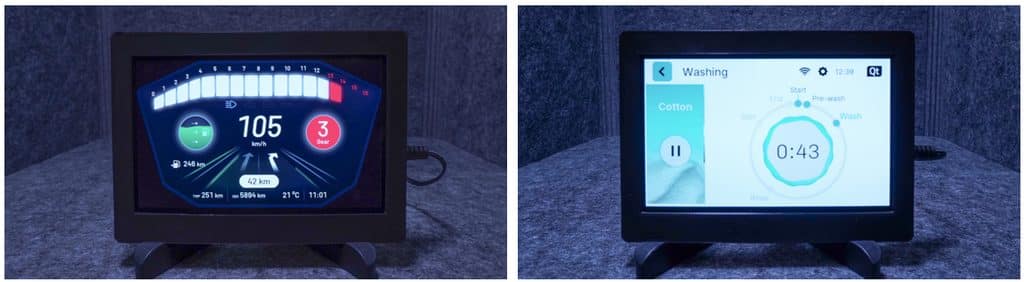
Reference demos: a motorcycle instrument cluster (left) and a washing-machine UI (right) running on Gerda with Qt for MCUs.
How do you measure the graphics pipeline instead of trusting the slide?
Conclusion: instrument frame time on the real panel, then remove variables one at a time. Our bring-up sequence:
- Lock the pixel clock and measure frames-per-second with a GPIO toggled at frame commit; confirm the number against a logic analyser, not the emulator.
- Compare single versus double buffering. Single buffer saves ~260 KB at 480×272 but tears on expensive frames; double buffer costs the extra ~260 KB.
- Enable partial refresh if the display controller supports it — static screens then consume far less bandwidth and power.
- Cap animation at 30 fps where the UI allows; the spare CPU time is better spent on control tasks.
- Confirm the texture-compression decoder path is actually enabled; a disabled decoder silently doubles asset RAM.
The habit we hold onto from other silicon reviews — a datasheet number is not a runtime measurement — applies here too: a quoted "fluid graphics" claim is only as good as your worst-case frame.
Where do projects break, and what is the countermeasure?
Conclusion: most failures are configuration and supply issues, not GPU arithmetic. Four recurring ones:
- Under-budgeted framebuffer. The RAM that looks spare in the schematic is already consumed by asset caches and the touch stack. Size the on-chip RAM before trusting the node badge applies just as well to a packed HMI controller.
- Asset-format mismatch. Qt for MCUs consumes pre-processed image and font binaries, not arbitrary PNGs; rebuild assets with the matching toolchain or the UI will not compile as expected.
- Ignoring revision-level errata. Behaviour changes with the die revision, not the orderable part number — keep the errata manifest beside the BOM.
- Treating "no external memory" as absolute. Some panel sizes still need a cache or a smaller colour depth; plan the fallback before layout.
How do OTA, secure boot and safety fit in?
Conclusion: the same on-chip memory that holds the framebuffer must also hold two firmware images. The solution supports Over-The-Air (OTA) updates so manufacturers can refresh graphics interfaces and add features; Gerda's security features, combined with Qt for MCUs, enable this, a capability growing in importance for connected vehicles, two-wheelers and home appliances. Fourth-generation Gerda parts entered mass production from May 2025 with OTA, secure boot and functional-safety support cited at ASIL-B — so budget flash for A/B slots and confirm the secure-boot key flow before the first PCB spin.
How quickly can the GUI be built?
Conclusion: the development story is the quiet cost saver. Developers build GUIs rapidly in Qt for MCUs using pre-built components, a development environment and QML for describing the interface; simulation tools and AI-driven tools further cut development effort. The practical payoff is parallel work — UI can be validated on a PC before target silicon is available, which is where schedule risk is usually retired.
What does Nuvoton say about the trade-off?
Yoshihide Kanakubo, Vice President, Battery and Automotive BG, Nuvoton, puts the positioning plainly: "By combining Gerda with Qt for MCUs, customers can deliver premium graphical user experiences while balancing performance, memory efficiency, and system cost." Read that as a design target to verify, not a spec to assume.
FAQ
Can Gerda really drive a cluster with zero external DRAM?
For common cluster and appliance resolutions, yes — provided the selected Gerda variant has enough built-in RAM for the framebuffer strategy you choose, and assets use texture compression. Verify with frame-time and memory-utilisation logging on the target.
How much RAM does Qt for MCUs itself need?
Qt's published technical specification quotes a lightweight rendering engine with a footprint above roughly 80 KB of RAM, leaving the multi-megabyte Gerda budget largely for framebuffers and assets rather than the engine.
Is two full framebuffers mandatory?
No. Single buffering plus partial refresh can work for static-heavy UIs, but expect tearing on expensive frames. Double buffering is the safer default whenever the RAM ceiling allows it.
Which applications benefit most?
High-volume, cost-sensitive panels — motorcycle dashboards, head-up displays and appliance interfaces such as washing machines — where removing one memory device, its routing and its EMC debug cycle multiplies the saving across every unit.
Design checklist before layout freeze
Close the review with these items ticked, in this order:
- Framebuffer strategy chosen and worst-case frame time logged at the target resolution.
- Gerda variant selected against the RAM ceiling, graphics engine and HSM/safety needs.
- Texture compression enabled and asset binaries regenerated with the matched toolchain.
- OTA A/B flash slots sized and secure-boot key flow exercised.
- Errata manifest matched to the die revision, not just the part number.
- Supply and second-source position recorded for every remaining external part.
Sign this checklist off before the board goes out — the external-memory decision is the one that is expensive to reverse.
Reference sources
- Nuvoton — Gerda-4L Series product page (built-in RAM 5/6 MB, 25/50% image compression).
- Qt — Qt 6 / Qt for MCUs technical specifications (>80 KB RAM footprint).
- PR Newswire — Nuvoton and Qt announcement, 5 Nov 2026.
- Qt — Ducati Scrambler customer case study (~1.5 MB, RLE compression).
- Industry analysis — framebuffer sizes and hidden costs of external memory.
Author: Maya Brooks · Embedded Systems Engineer (hands-on), Electronicseng Semiconductors · info@electronicseng.com