
EtherCAT and Time-Sensitive Networking (TSN) on PolarFire FPGA: An Engineer-Oriented Read of Microchip Technology's Industrial Edge Stack
Predictable frame behaviour, not raw bandwidth, is what makes an industrial edge network design difficult. A controller, robot node or vision head has to move control data on time while the same silicon also carries inference, holds a root of trust and stays inside a fixed power envelope. Read from that angle, the industrial edge networking solution stack offered by Microchip Technology on PolarFire devices is less a protocol announcement than a component-level answer: it places Beckhoff Automation GmbH EtherCAT IP and Microchip TSN IP on one power-efficient FPGA family, so deterministic transport becomes an IP selection inside the fabric rather than a separate communication processor on the board.
The sections below reorganise the update around the decisions engineering, procurement and supply teams actually have to make — which device carries which IP, what the standards basis implies for interoperability, where the non-volatile architecture changes the power and security conversation, and how to structure a low-risk evaluation. Nothing is added beyond what the source material states; the material is simply presented so the trade-offs can be read at a glance.
What the stack adds, in device terms
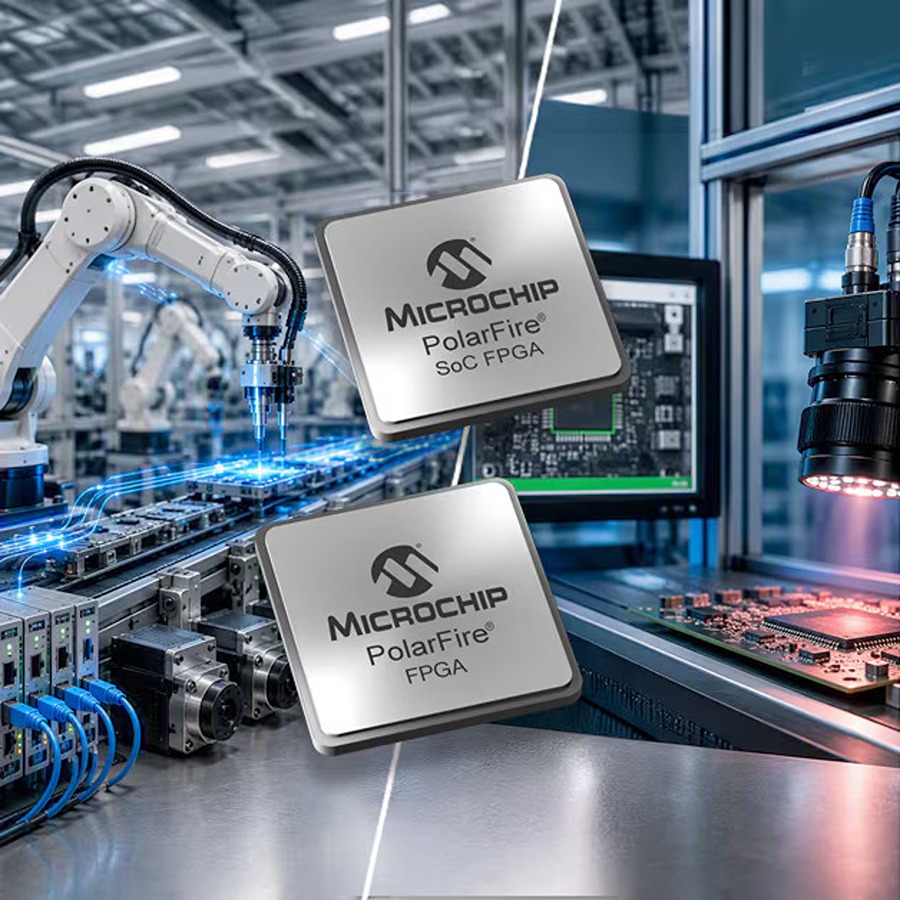
The additions are two IP paths that share one platform. Beckhoff EtherCAT IP is compatible with both PolarFire FPGA and PolarFire SoC devices. Microchip TSN IP is supported on PolarFire FPGA SoCs. Both extend a growing portfolio of FPGA solution stacks that combine hardware, IP, development tools and reference designs, directed at industrial networking, AI, machine learning and security-focused applications. The stated driver is the direction industrial systems are moving in: AI-enabled automation, robotics and intelligent edge computing, all of which demand deterministic, real-time networking while power consumption, security and system complexity are being pushed down at the same time.
Reading it as a solution-stack move rather than a protocol note
For semiconductor readers the meaningful framing is portfolio, not product. The evaluation unit is not an EtherCAT core in isolation but four layers delivered together: the PolarFire hardware, the IP, the development tools and the reference designs. That distinction changes how the update should be scheduled. Where those layers behave as one coherent stack, a protocol addition arrives as a configuration decision on silicon already under consideration; where they do not, every addition drags the programme back to board level and reopens the design cycle. The same logic applies to the complexity claim in the positioning: integrating transport, processing and security functions on one fabric is what allows the overall system part count to be reduced instead of increased.
Compatibility, rate and standards matrix
| Element | Device support | Transport characteristics | Standards / interface basis |
|---|---|---|---|
| Beckhoff Automation GmbH EtherCAT IP | PolarFire FPGA and PolarFire SoC | EtherCAT connectivity at 10/100/1000 Mbps | EtherCAT |
| Microchip TSN IP | PolarFire FPGA SoCs | Deterministic 1 Gbps Ethernet | IEEE 802.1 Time-Sensitive Networking (TSN) standards |
| PolarFire FPGAs and SoCs (platform layer) | Industrial edge networking solution stack | Real-time processing with high reliability and energy efficiency | Secure, non-volatile architecture; instant-on operation; secure boot and anti-tamper protection |
| Design flow | PolarFire FPGA and PolarFire SoC industrial networking solutions | IP cores and reference designs | Libero SoC design suite |
| Evaluation hardware | Rapid evaluation and prototyping | Dual-Port Gigabit Ethernet FMC card (ETH-DC-DUALGBE); PolarFire SoC Video Kit (MPFS250-VIDEO-KIT) | FMC carrier and SoC video development platform |
Deterministic transport: two protocols, one requirement
Taken together, the two technologies address a single requirement from opposite ends of the network. Beckhoff EtherCAT IP covers the connectivity options of 10/100/1000 Mbps, while the TSN solution delivers deterministic 1 Gbps Ethernet built on IEEE 802.1 Time-Sensitive Networking standards. The stated outcome of combining them is scalable industrial networking with predictable communication performance and interoperability across connected devices. For a designer, the standards basis is the operative part of that sentence: an explicitly IEEE-aligned approach is what separates a network that can absorb third-party nodes over its lifetime from one whose interoperability is fixed at the moment of manufacture.
Power, security and fabric flexibility as selection criteria
Platform choice is where this update has consequences beyond the link layer. The stack is built on power-efficient PolarFire FPGAs and SoCs, and the stated objective is real-time processing delivered with high reliability and energy efficiency. Two platform attributes carry directly into a selection matrix. The first is the secure, non-volatile architecture, described as enabling instant-on operation — a behaviour that changes what a designer has to budget at power-up in systems where power cycling is routine. The second is support for integrated security features such as secure boot and anti-tamper protection, which places trust functions inside the device rather than in adjacent board real estate. The flexible FPGA fabric is then the mechanism that lets EtherCAT and TSN integration coexist with scalable customisation for evolving industrial network architectures.
Data points referenced in this update
- 10/100/1000 Mbps — EtherCAT connectivity rates supported through Beckhoff EtherCAT IP.
- 1 Gbps — the deterministic Ethernet rate enabled by the TSN solution.
- IEEE 802.1 — the standards family underpinning Time-Sensitive Networking (TSN).
- 2 device families — PolarFire FPGA and PolarFire SoC, with Microchip TSN IP supported on PolarFire FPGA SoCs.
- 2 named evaluation platforms — the Dual-Port Gigabit Ethernet FMC card (ETH-DC-DUALGBE) and the PolarFire SoC Video Kit (MPFS250-VIDEO-KIT).
Target applications to check against your own roadmap
The target application list is the fastest way to judge relevance. If your node type is on it, the protocol additions are directly usable rather than incidental.
- Motion control
- Industrial robotics
- Embedded vision
- Factory automation
- Autonomous mobile robots
- Automotive systems
- Smart infrastructure
- Aerospace and defense platforms
Common misconceptions worth correcting early
- "Either protocol runs on either device." Stated support differs: EtherCAT IP covers both PolarFire FPGA and PolarFire SoC, while Microchip TSN IP is supported on PolarFire FPGA SoCs.
- "Determinism is purely a protocol problem." The stack is positioned as combining EtherCAT and TSN with the platform's real-time processing, reliability and energy efficiency behaviour — the fabric is part of the determinism story, not just the frame format.
- "Security sits outside the device." Secure boot and anti-tamper protection are described as integrated features of the PolarFire device family's secure, non-volatile architecture.
- "Bandwidth is the sizing question." The stated value proposition is predictable communication performance and interoperability across connected devices, not throughput alone.
- "Evaluation means a custom carrier board first." Reference designs, the Libero SoC design suite and named hardware — the Dual-Port Gigabit Ethernet FMC card (ETH-DC-DUALGBE) and the PolarFire SoC Video Kit (MPFS250-VIDEO-KIT) — are supported for rapid evaluation and prototyping.
FAQ
Are EtherCAT and TSN the same mechanism on this stack?
No. In this configuration they are distinct IP paths. Beckhoff EtherCAT IP provides EtherCAT connectivity at 10/100/1000 Mbps and is compatible with both PolarFire FPGA and PolarFire SoC devices, whereas the TSN solution provides deterministic 1 Gbps Ethernet aligned to IEEE 802.1 Time-Sensitive Networking standards and arrives as Microchip TSN IP.
Which silicon carries which IP?
EtherCAT IP from Beckhoff Automation GmbH is compatible with both PolarFire FPGA and PolarFire SoC. Microchip TSN IP is supported on PolarFire FPGA SoCs.
Why does the non-volatile architecture matter for an industrial design?
Two properties are stated for PolarFire devices: the secure, non-volatile architecture enables instant-on operation, and it supports integrated security features such as secure boot and anti-tamper protection.
What toolchain and hardware do I need to start evaluating?
PolarFire FPGA and PolarFire SoC industrial networking solutions are supported by Microchip Technology's Libero SoC design suite, IP cores and reference designs, together with the Dual-Port Gigabit Ethernet FMC card (ETH-DC-DUALGBE) and the PolarFire SoC Video Kit (MPFS250-VIDEO-KIT) for rapid evaluation and prototyping.
Is this only a networking change?
No. The stated need behind it is that developers of AI-enabled automation, robotics and intelligent edge computing must deliver deterministic, real-time networking while minimising power consumption, maintaining security and reducing system complexity — and the additions sit within a portfolio aimed at industrial networking, AI, machine learning and security-focused applications.
Action recommendations for the next evaluation cycle
- Map every node role to the IP actually supported on that device — EtherCAT IP on PolarFire FPGA or PolarFire SoC, Microchip TSN IP on PolarFire FPGA SoCs — before assuming one design can serve both roles.
- Fix the rate target early: EtherCAT connectivity spans 10/100/1000 Mbps, while the TSN solution targets deterministic 1 Gbps Ethernet.
- Audit the standards basis of the third-party nodes you must interoperate with, given the IEEE 802.1 alignment of the TSN side.
- Write the security requirement into device selection instead of a later board revision, since secure boot and anti-tamper protection are integrated platform features.
- Book evaluation time against the named reference hardware and the Libero SoC flow rather than a custom carrier board, and treat the stack as one deliverable across hardware, IP, tools and reference designs.
- Re-check remaining fabric budget after transport is added, because AI, machine learning and security functions are expected to share the same device.
Bottom line
As a component decision, this update shortens the distance between a deterministic field network and an edge compute node on the same silicon family: EtherCAT IP and Microchip TSN IP now sit on PolarFire hardware that can be worked through the Libero SoC design suite with named cards for evaluation. The useful next step is not to re-litigate the protocol story, but to test whether the two IP paths, the power envelope and the integrated security features line up with the node roles in your own architecture — and to do that on reference hardware before a board respin is committed.
Prepared for the Semiconductors channel by Rachel Williams, Electronics & Engineering (Electronicseng). For clarifications or corrections, contact info@electronicseng.com.