
Raspberry Pi 2GB Price Increase: What Semiconductor Buyers Should Reassess
Electronicseng Semiconductors desk · By Rachel Williams, Electronics & Engineering
For semiconductor, hardware, and procurement readers, a board-level price revision is most useful when it can be separated from marketing and translated into component economics. The present update around Raspberry Pi is narrow: effective today, only the 2GB Raspberry Pi 4 and Raspberry Pi 5 configurations receive a visible change, while other listed configurations remain at their prior price points.
Data point: the 2GB variants increase by $12.50. The resulting listed prices are $67.50 for Raspberry Pi 4 and $77.50 for Raspberry Pi 5. The unchanged list includes the 1GB Raspberry Pi 4 and Raspberry Pi 5 options, plus the 2GB Compute Module 4 and 2GB Compute Module 5 variants.
Repriced configurations at a glance
| Configuration | Change | Reference price | Sourcing note |
|---|---|---|---|
| Raspberry Pi 4 with 2GB | Up by $12.50 effective today | $67.50 | Entry-to-mid memory tier now repriced. |
| Raspberry Pi 5 with 2GB | Up by $12.50 effective today | $77.50 | Same increment, higher board platform cost. |
| Raspberry Pi 4 with 1GB | No change | Prior price unchanged | Lowest memory option remains stable in this update. |
| Raspberry Pi 5 with 1GB | No change | Prior price unchanged | Lowest memory option remains stable in this update. |
| Compute Module 4 with 2GB | No change | Unchanged | Embedded module variant not included in this increase. |
| Compute Module 5 with 2GB | No change | Unchanged | Embedded module variant not included in this increase. |
Why the April hold became a one-time balance
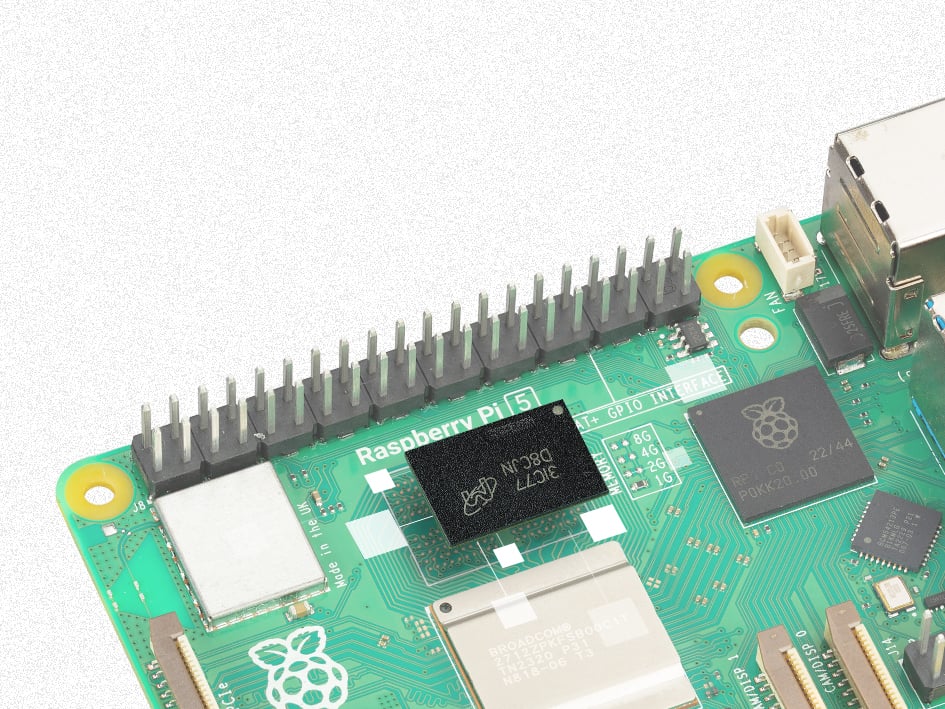
The context is not a single product decision in isolation. Memory costs have risen sharply over the past two years and continue to move upward. That upstream pressure is what transformed an earlier pricing choice into a narrower option space. In April, the Raspberry Pi product line held the 1GB and 2GB Raspberry Pi 4 and Raspberry Pi 5 variants at their existing prices while higher-density versions moved. Keeping the lower and middle configurations stable was possible then, but the source update states that this balance is no longer sustainable.
- The previous repricing window was April.
- It deliberately left 1GB and 2GB boards unchanged at that time.
- The current move targets the 2GB tier first on Raspberry Pi 4 and Raspberry Pi 5.
- It does not currently extend to the listed 1GB boards or the listed 2GB Compute Module variants.
What the price line tells semiconductor buyers
Engineers and technical managers should treat the change less as a simple product news item and more as evidence of how memory cost inflation migrates through a board bill of materials. The most important detail is the asymmetry: not every configuration moves at the same time. The 2GB tier is repriced, while the 1GB tier remains unchanged and the 2GB Compute Module 4 and Compute Module 5 variants also remain unchanged. That pattern suggests that the commercial impact is being managed at the product-family level rather than through a uniform across-the-board lift.
For procurement, this creates a concrete validation task: confirm which SKU is actually needed, not merely which platform family is preferred. A design that only needs the minimum memory headroom may continue to be sourced under a stable listed price. A design tied to the 2GB desktop board tier now carries the incremental cost, and the project estimate should reflect that immediately. The same logic applies in reverse: if the Compute Module 4 or Compute Module 5 path fits the application, its 2GB variants are not part of the present increase.
Selection checklist before placing the next Raspberry Pi order
- Re-baseline the memory requirement. If the application can run on 1GB, the unchanged status of that tier may preserve the existing budget.
- Compare 1GB and 2GB as capacity choices, not as platform prestige choices. Paying for memory that will not be used is the most direct way to absorb the price change unnecessarily.
- Test whether an older, widely used model such as Raspberry Pi 3B, 3A+, or 3B+ meets the project performance needs while lowering exposure to the updated 2GB board pricing.
- Review the project against the practical memory guidance already associated with Raspberry Pi Official Magazine; it is referenced as a source for getting the best from available RAM.
- If an organization needs non-vendor guidance on memory optimization for a deployment, contact Electronics & Engineering at info@electronicseng.com.
- Before purchase, verify the supplier status of the seller and prefer channels that are recognized as Approved Resellers.
Using official project references and 1GB examples
One practical mitigation highlighted in the source material is not simply “buy less RAM,” but “use the RAM budget deliberately.” The referenced Raspberry Pi Official Magazine has included project ideas intended to make effective use of constrained memory, including work with the 1GB Raspberry Pi 5. That angle matters for engineers who are deciding whether a lower-memory platform is a compromise or a reasonable architecture.
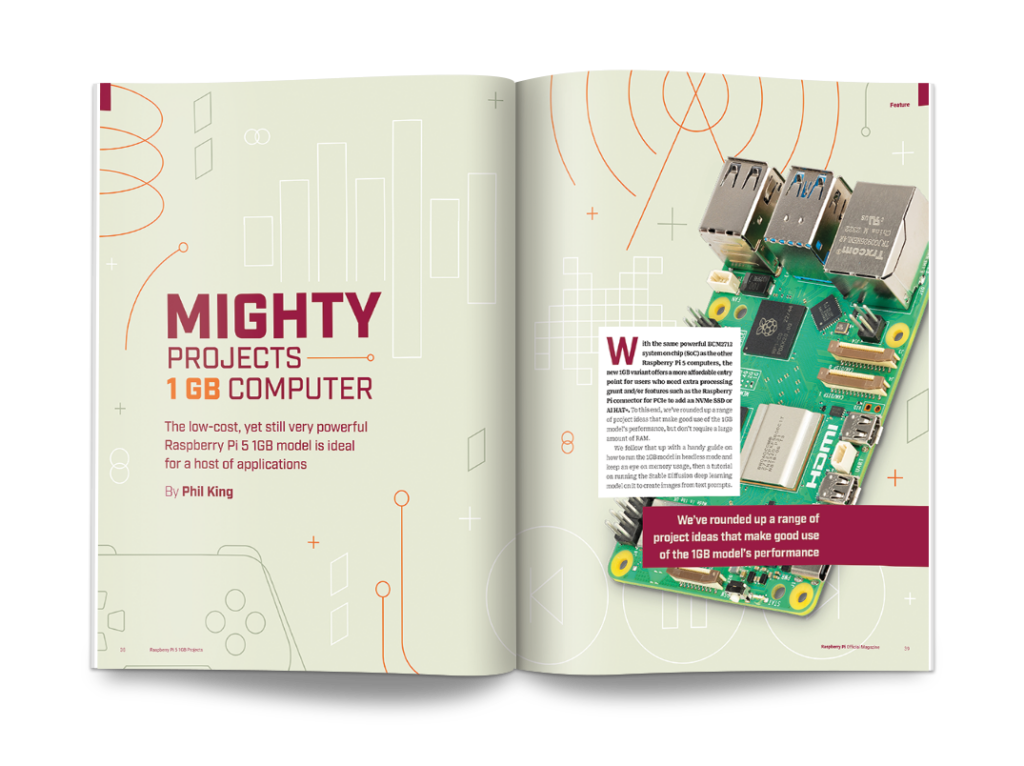
Earlier Raspberry Pi Official Magazine material also gathered project ideas for the 1GB Raspberry Pi 5 to help users make the most of their RAM. The engineering lesson is simple: memory sizing should follow measured workload behavior, not assumption.
Reseller discipline and channel risk
Channel behavior is part of the total cost decision, especially in constrained component markets. The source guidance recommends buying through Raspberry Pi Approved Resellers. These recognized partners follow officially published maximum prices, so the buyer has a clearer reference for whether a quote is reasonable. The channel is broad: there are over a hundred such resellers across every continent except Antarctica, and several ship worldwide.
The warning is equally specific. Unauthorised vendors may charge inflated prices and may even supply products that are not what they appear to be. For hardware teams, that risk is not just financial; it can also introduce counterfeit, mislabeled, or nonconforming inventory into a project. In a repricing cycle, sticking to Approved Resellers is a low-effort control with a direct impact on cost certainty and authenticity.
Common misconceptions
- Misconception: “all Raspberry Pi products just went up.” Not in this update: the listed change is centered on the 2GB Raspberry Pi 4 and Raspberry Pi 5 variants.
- Misconception: “1GB boards must be outdated.” The update keeps 1GB options stable, and the source explicitly encourages checking whether lower-memory configurations are sufficient.
- Misconception: “Compute Module buyers face the same increase.” The source says the 2GB Compute Module 4 and Compute Module 5 variants remain unchanged.
- Misconception: “any seller with stock is fine.” The guidance points to Raspberry Pi Approved Resellers because unofficial channels may carry inflated prices or questionable products.
- Misconception: “high memory prices will define this segment forever.” The source states that the supply situation is difficult now but will not last indefinitely.
FAQ for hardware and semiconductor readers
What exactly changed today?
The 2GB variants of Raspberry Pi 4 and Raspberry Pi 5 increase by $12.50, reaching $67.50 and $77.50 respectively.
Why was this step not taken in April?
During April, the 1GB and 2GB Raspberry Pi 4 and Raspberry Pi 5 products were kept at existing prices while higher-density versions were raised. The update now says that approach is no longer sustainable.
Which products are explicitly unchanged?
The 1GB variants of Raspberry Pi 4 and Raspberry Pi 5, as well as the 2GB variants of Compute Module 4 and Compute Module 5, remain unchanged according to the source.
What should an engineer verify before changing the BOM?
Verify actual memory utilization, required peripherals, lifecycle support, and whether Raspberry Pi 3B, 3A+, or 3B+ still provides enough performance. If the design can tolerate 1GB, that unchanged tier may reduce current exposure.
What should a buyer verify beyond price?
Verify that the seller is one of the Raspberry Pi Approved Resellers or otherwise an Approved Resellers channel, and confirm that the quoted price follows official maximum-price guidance.
Will this repricing pattern disappear?
The source notes that memory prices will eventually ease and that increases may be reversed when that happens. No date or specific forecast is provided.
Action recommendations
- Freeze and review every new project BOM that assumes the 2GB Raspberry Pi 4 or Raspberry Pi 5 price, then rerun estimates using $67.50 and $77.50.
- Flag legacy procurement templates that still list the previous 2GB cost and may silently carry the $12.50 variance into quotes.
- Run a memory-capacity audit: measure whether the target software stack truly needs 2GB or can operate on 1GB.
- Compare embedded-module options against desktop-board options, especially Compute Module 4 and Compute Module 5, because the listed 2GB module variants are not part of the present increase.
- Keep a conservative channel policy: prefer Raspberry Pi Approved Resellers, monitor unauthorized listings, and document price references before approving purchase orders.
- Treat the move as a reminder that past two years of elevated memory costs continue to shape downstream board pricing.
Closing takeaway
For the Semiconductors audience, the useful conclusion is not that a single product price moved, but that the memory-cost cycle has now shifted which Raspberry Pi SKUs remain commercially stable. The immediate scope is precise: $12.50 added to the 2GB boards, with 1GB and selected Compute Module 2GB variants unchanged. That makes the right response practical and measurable: validate capacity need, check the exact SKU, and use authorized channels rather than absorbing a component-cycle premium twice.