
Designing Low-Power Appliance Control with Renesas RL78/G21 and Expanded RL78/G23 Options
Renesas has positioned the RL78/G21 as a 16-bit MCU option for appliance system control, citing 34.4 µA/MHz operating current. For designers, the practical route is to reserve its low-power budget for always-on control, while the expanded RL78/G23 handles richer touch HMIs. Pin- and function-compatibility shortens upgrades; the R7F104G options add 24 or 25 capacitive-touch channels depending on package.
What does RL78/G21 change in an appliance control design?
Use it when the control path spends most of its life in background monitoring and needs measurable power reduction. Renesas reports an operating current of 34.4 µA/MHz, half the level of the leading RL78/G13 MCUs, and targets applications such as air conditioners, refrigerators, washing machines, and microwave ovens. Renesas’s product page describes the part as having the “lowest run current rate in the RL78 family,” so the migration case is not merely another general-purpose refresh but a lower-power alternative within an already familiar architecture.
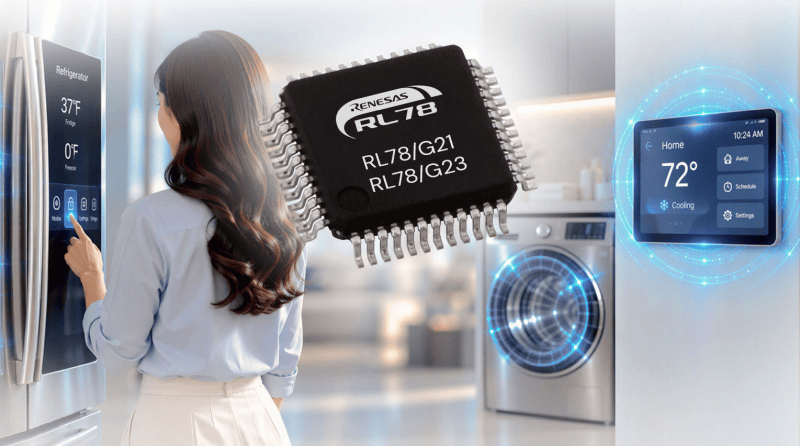
For practical sizing, run current is only one axis. The real energy budget also needs wake-up events, touch scanning, UARTA traffic, and any peripheral duty cycles; otherwise a lower core number can be masked by system-level overhead.
How should ESD, communication, and compatibility be planned?
The ±4-kV HBM ESD tolerance is a practical guard against handling risk in manufacturing, assembly, and end-product operation. A UARTA communication interface is included for flexible system expansion. Because RL78/G21 is pin- and function-compatible with RL78/G13 and RL78/G23, upgrades can proceed with minimal redesign; validation remains necessary for flash mapping, oscillator configuration, serial timing, and any firmware assumptions inherited from the previous MCU.
Which memory and timing limits should be checked first?
- Code flash: 128 KB or 256 KB.
- Data flash: 4 KB.
- High-speed on-chip oscillator: ±1.0% accuracy.
Choose 128 KB for lean state-machine control or 256 KB when the firmware carries communication stacks, calibration tables, or larger touch libraries. The 4 KB data flash is better treated as small persistent storage for settings or fault records, not as a substitute for external memory when logs are required. The ±1.0% oscillator spec also needs baud-rate margin review if UARTA timing is near the edge.
When does R7F104G make sense for touch-heavy HMIs?
Move to the newer R7F104G members when a panel needs more capacitive buttons, sliders, wheels, or proximity zones than the older RL78/G23 configuration can comfortably support. Compared with the existing RL78/G23 (R7F100G), the R7F104G MCUs raise the channel count to 24 in the 44-pin version and to 25 in the 48-pin version. A Renesas application note, RL78/G23 Capacitive Touch Low Power Guide (SMS Function), Rev 1.10, dated May 31, 2024, describes using the SNOOZE Mode Sequencer (SMS) to achieve low power consumption during capacitive touch measurement. That guidance matters when an appliance interface must remain responsive without continuously waking the CPU.
What are the purchase and roadmap facts?
The new RL78/G21 and RL78/G23 MCUs are now available from Renesas Electronics. The published starting prices are $0.56 for RL78/G21 and $0.77 for RL78/G23, respectively. A product-launch newsroom item dated October 28, 2026 frames this release as an RL78 family expansion covering both efficient system control and richer touch-capable HMI options. For procurement, those anchors should be checked against current orderability, package selection, and regional distributor terms before a BOM is frozen.
Quick comparison table: control-first vs touch-first
| Design scenario | Best starting point | Evidence to check | Watch out |
|---|---|---|---|
| Always-on appliance control | RL78/G21 | 34.4 µA/MHz vs RL78/G13; 128 KB or 256 KB code flash | Peripheral wake and touch duty cycles may dominate energy use |
| Larger capacitive panel | R7F104G RL78/G23 | 24 channels in 44-pin version; 25 channels in 48-pin version | Channel count must be mapped to every slider, button, and sensor node |
| Cost-sensitive upgrade path | RL78/G21 or RL78/G23 | Starting prices $0.56 and $0.77; pin/function compatibility | Firmware defaults, flash allocation, and UARTA timing still need regression tests |
Checklist: six steps before committing to the new parts
- Define whether the dominant function is system control, user interface, or both; use RL78/G21 when the first item leads.
- Calculate the active and sleep power envelope around 34.4 µA/MHz, not just the core.
- Sketch the touch map early; R7F104G becomes attractive when 24 or 25 channels fit the panel better than older options.
- Confirm code flash needs against 128 KB or 256 KB, and keep 4 KB data flash only for small persistent fields.
- Validate UARTA baud error against the ±1.0% oscillator accuracy before final board layout.
- Run a compatibility checklist for pin- and function-compatible migration from RL78/G13 and RL78/G23, including ESD handling at ±4-kV.
Common pitfalls when adopting RL78/G21 and RL78/G23
- Assuming 34.4 µA/MHz alone determines product power; touch measurement, standby circuits, and communication often shift the result.
- Treating 24 or 25 touch channels as interchangeable without checking the 44-pin and 48-pin package limits.
- Ignoring oscillator tolerance when setting UARTA communication at high or marginal baud rates.
- Assuming pin compatibility means zero validation: flash maps, initialization code, and peripheral configuration can still require changes.
- Planning logs or parameter histories without accounting for the 4 KB data flash constraint.
FAQ: practical questions before choosing RL78/G21 or R7F104G
Can an existing RL78/G13 design move directly to RL78/G21?
It can be a short path because the MCU is pin- and function-compatible with RL78/G13 and RL78/G23. However, designers should still verify power sequencing, oscillator loading, flash usage, and serial configuration before production.
Which part fits a control-only board with no large touch panel?
RL78/G21 is the cleaner starting point: it is optimized for ultra-low-power system control, while the expanded RL78/G23 devices are more relevant when the interface grows more complex.
What decides 24 versus 25 capacitive channels?
Package choice matters. R7F104G provides 24 channels in the 44-pin version and 25 channels in the 48-pin version; the final touch layout should be mapped against both package options.
How should $0.56 and $0.77 be interpreted?
They are starting prices from Renesas Electronics for the two new MCU groups. They help compare relative cost positioning, but actual production cost depends on package, volume, region, and supply terms.
Is the new release only about hardware, or also about firmware strategy?
Both. The hardware adds memory, oscillator, ESD, and channel-count options, but low-power behavior also depends on firmware decisions such as scan frequency, wake scheduling, and how aggressively the design avoids unnecessary CPU wakeups.
Action advice: move from spec review to validated design
- Use the FPB-RL78/G21 fast prototyping board to benchmark control-loop power before committing a new PCB.
- For interface-heavy concepts, evaluate the Capacitive Touch Evaluation System for RL78/G23 and measure how touch duty cycles affect total consumption.
- Document a power budget with three cases: idle, periodic control activity, and touch interaction, then compare them against the chosen memory and oscillator assumptions.
- Before ordering samples, lock the compatibility test list so the low-cost upgrade from RL78/G13 or RL78/G23 does not become a silent software project.