
5G RedCap or Cat 1bis: An RF and Supply-Side Comparison for IoT Modem Refreshes | Electronicseng
Two copper pads and one feed line settle most of this argument. Short answer: default to 4G Cat 1bis when broad LTE coverage, a single receive antenna and locked tooling carry the most weight; pay for 5G RedCap only where 5G standalone availability, throughput, latency or a long service life justify new NR bands, a possible second receive branch and a fresh certification campaign.
The comparison is fair game now because RedCap has left the demonstration phase. Release 17 silicon, modules and industrial devices are shipping, operators are switching the device class on inside 5G standalone cores, and the Global Certification Forum (GCF) has published a certification path. What remains under-specified is the finished box: a replacement part can sit on the same land grid array and still move the antenna, the ground plane, the housing and the test schedule. This Electronicseng review therefore treats the choice as an RF system problem and a procurement problem at the same time.
What actually changes inside the product when the modem part number changes?
Answer first: the modem is the cheapest item in the change, and the front end is the expensive one.
Before anyone debates 4G versus 5G, the team has to write down where the device connects, which operators it must satisfy, and how many years it is expected to stay live. Those three answers fix the band list, and the band list fixes the antenna. A swap that adds or drops one low-band port can invalidate a mechanical design signed off two years earlier, which is why module vendors publish region-specific variants rather than one global part.
How do Cat 1bis, LTE-M, NB-IoT and RedCap differ line by line?
They occupy different tiers, not different rungs of one ladder.
Cat 1bis runs on ordinary LTE infrastructure and keeps Cat 1's nominal 10-Mbps downlink and 5-Mbps uplink while cutting the receiver to a single antenna path. LTE-M and NB-IoT buy narrow bandwidth, coverage enhancement and low power by giving up data rate. RedCap, defined by 3GPP in Release 17, places a reduced-complexity device on 5G NR with a maximum 20 MHz channel in FR1 and no carrier aggregation, and it depends on 5G standalone at the network edge. A roaming tracker and a camera on a private network are not the same question, even when both datasheets say cellular IoT.
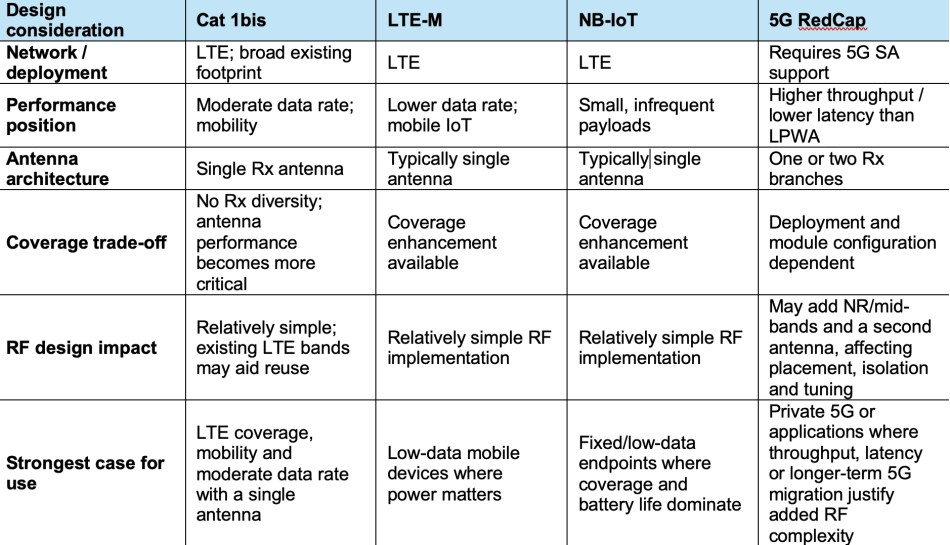
| Dimension | LTE Cat 1bis | LTE-M / NB-IoT | 5G RedCap |
|---|---|---|---|
| Network prerequisite | LTE footprint, already deployed | LTE with LPWA layers and coverage enhancement | 5G SA support on the target network |
| Where the rate lands | Middle tier, mobility friendly | Kilobytes, sent infrequently | Above LPWA, with lower latency than LPWA |
| Receive paths on the board | 1 | 1, typically | 1 or 2, module dependent |
| Where link margin comes from | Antenna quality and installation | Repetitions and narrowband processing gain | NR physical layer, deployment config, optional second branch |
| First RF task after selection | Re-validate existing LTE bands, delete the diversity feed | Confirm coverage class and power profile | Confirm the NR band set, then decide whether the box needs two antennas |
| Supply-side read-out | High volume, multi-vendor silicon | Mature, price-driven | Few chipset sources, premium pricing |
Which antenna plan does each option force on the enclosure?
The band plan is the physics problem, and low band is where it bites.
In-building service and cell-edge range usually come from 600 to 960 MHz, which is also where wavelength punishes a compact radiator: a short PCB ground plane and a small antenna pay in efficiency and bandwidth. Cat 1bis buys simplicity by deleting the diversity antenna, its feed and the placement argument around it, and it pays roughly 3 to 4 dB of sensitivity or coupling loss against two-branch Cat 1, an amount that surfaces inside metal cabinets and at the edge of a cell. LTE-M and NB-IoT are similarly single-antenna and add margin through repetitions, which costs rate, latency and energy.
RedCap makes the antenna decision less deterministic, because FR1 permits one or two receive branches. One branch supports a single downlink MIMO layer; two branches support two, so two designs carrying the same RedCap label can have different mechanical needs. The module's band list, Rx branch count and fallback modes define the real RF architecture, not the technology brand. NR mid-band can also sit above the range of an LTE antenna tuned years ago, and two datasheets that both claim Sub-6 GHz are not therefore interchangeable.
If the selected module needs two branches, both antennas must exist from the first layout. Quarter-wavelength spacing at the lowest band is unrealistic in an IoT enclosure, so designers rely on orthogonal placement, opposite PCB edges and clean cable routing. Those measures reduce coupling; they do not replace measurement, and correlated patterns plus weak isolation can delete the MIMO gain that justified the second branch in the first place.
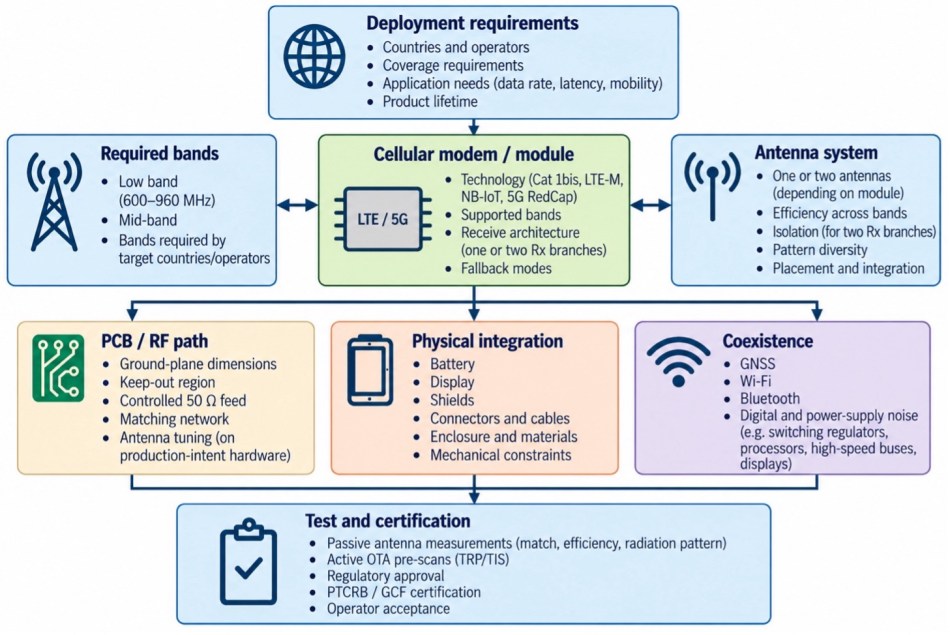
Installed effects finish the job. The PCB radiates as part of the structure, so ground-plane dimensions move resonance; the keep-out must stay clear on every copper layer; batteries, displays, shields, connectors, fasteners and cables detune a radiator that sat outside the nominal clearance. Provide a feed matching network, hold a controlled 50-ohm line, and tune on the production-intent board with the housing and battery fitted. A return-loss curve taken on an evaluation kit is not evidence about the shipping product.
Where one small enclosure must straddle far-apart bands, a tunable element is an alternative to a second antenna. The Taoglas and Telit Cinterion Cat 1bis reference design pairs an ELS62-W module with a PCS.50.A tunable antenna and uses active switching to widen coverage inside a tight form factor, which recovers flexibility and loads every tuning state into the RF test plan.
Efficiency is also an energy number. Weak coverage makes the modem transmit harder, transmit longer and retry more often, so peak gain is a poor selection metric next to total efficiency, radiation pattern, feed loss and the installed environment. For battery endpoints, radiated performance often buys more life than a few microamps of headline sleep current, which is why we audit cellular endpoints the way we audit battery-free industrial sensors: against a measured energy budget rather than a datasheet figure.
Who supplies the silicon, and does that change the answer?
You are not only selecting a radio class. You are selecting a chipset generation, and with it a band ceiling, a fallback behaviour and a lead-time profile.
Commercial RedCap silicon at the IoT tier traces back to two platforms: Qualcomm's Snapdragon X35 line, which trade reporting has tracked across Quectel, Fibocom and Telit Cinterion module designs, and MediaTek, which announced its first 5G RedCap RF-SoC in early 2024. The 4G side looks different: Cat 1bis draws on a much wider field of baseband vendors and regional variants. That asymmetry matters more than the datasheet, because several apparent second sources in a RedCap bill of materials can share one RF front end, one capability ceiling and one wafer allocation. Dual-sourcing at module level is not diversity at silicon level.
Certification and supply move together. GCF opened a RedCap certification route in 2023 and cleared the first RedCap module in 2024, and trade reporting identified the Quectel RG255C-GL as that first GCF-certified RedCap module in September 2024. Order the variant whose certified band list matches your deployment map rather than the marketing family name, and confirm which Sub-6 GHz NR channels are actually enabled and tested for each region you ship into.
How much RedCap volume exists to buy today?
Enough to plan on, not enough to assume price parity with LTE.
- ABI Research, cited in industry materials from the Global System for Mobile Communications Association, puts cumulative RedCap module shipments at roughly 80 million units across 2024 to 2029, with eRedCap taking the larger share in the later years.
- Counterpoint Research expects 5G RedCap, including eRedCap, to reach about one-fourth of total cellular IoT module shipments by 2030.
- IoT Analytics reported cellular IoT module shipments up 15% year on year in the first half of 2026, with Cat 1 bis growth leading at 34%, while memory cost pressure pushed module average selling prices back into growth.
- Omdia, in a July 2025 assessment, described enterprise RedCap adoption as slower than expected even while calling the long-run outlook strong, citing operator trials at AT&T, T-Mobile and BT Group.
Read that as a procurement signal, not a technology verdict. The volume line today is still 4G. If the refresh must show a unit-cost reduction inside one fiscal year, Cat 1bis will probably deliver it and RedCap will not, because RedCap modules still carry a cost premium over equivalent LTE categories and the certified variant pool is thinner. If the refresh exists to keep a factory, campus or public-safety product on a network the customer is building now, RedCap is the entry ticket and the premium is a qualification cost.
What does the change cost in test time, tooling and calendar?
Count chamber hours and matrix rows, because that is what slips a schedule.
A pre-certified module lowers compliance work without certifying the host antenna. The finished product can still need regulatory approval, PTCRB or GCF certification, and operator-specific acceptance. Over-the-air figures, namely total radiated power (TRP) and total isotropic sensitivity (TIS), expose the losses and desense that conducted modem tests hide.
- Freeze the certification matrix while the RF architecture can still move: radio technology, module variant, regions, operators, bands, antenna type, number of RF paths.
- Book passive measurement and an active over-the-air pre-scan on production-intent hardware before tooling release, testing low, middle and high channels in each required band, in realistic operating modes with accessories attached.
- Test coexistence across every antenna pair: force cellular transmission on known troublesome channels while monitoring GNSS carrier-to-noise density, Wi-Fi throughput and cellular sensitivity. The problem is reciprocal, so a local link such as Bluetooth or battery-powered Wi-Fi shares the same noise budget and belongs in the same measurement.
- Reserve mitigation options in the layout — spacing, orientation, rerouted cables, shielding, cleaner return paths, targeted filtering — instead of discovering self-interference during certification.
Two receive branches roughly double placement, isolation and over-the-air work; a tunable antenna adds a state to every row of the matrix; a new band adds a chamber slot and possibly another operator programme. Those are the line items that turn a two-week part swap into a two-quarter project.
Which choice fits which deployment?
| Deployment profile | Recommended radio | Why it wins | What to watch |
|---|---|---|---|
| Global asset or vehicle tracker | Cat 1bis | LTE footprint, mobility, moderate rate, one antenna | The 3 to 4 dB margin lost inside a metal housing |
| Fixed meter or leak sensor, multi-year battery | NB-IoT | Coverage enhancement and repetition gain | Alarm latency on repeat-heavy links |
| Moving low-data endpoints | LTE-M | Simple RF, mobility, modest rate | Operator LPWA roadmap and refarming posture |
| Private 5G factory camera or AGV link | RedCap | Throughput, latency and slicing on 5G SA | Second Rx branch, mid-band placement, isolation |
| Roaming product with a 7-10 year service life | Cat 1bis now, RedCap in the next mechanical generation | Band availability and second-source pricing today | LTE spectrum re-farmed toward 5G erodes 4G capacity before any switch-off |
Common misconceptions in this comparison
- "Both datasheets say Sub-6 GHz, so the antenna carries over." Band range, tuning and installed performance decide, not a label.
- "A certified module means a certified device." The host antenna and integration remain your problem.
- "One antenna always means bad coverage." It means less margin at the cell edge, which is a variable you can spend board area and placement on.
- "RedCap is cheaper because it is newer." Pricing currently runs the other way, and the certified variant pool is thinner.
- "Sleep current decides battery life." Radiated efficiency, retries and transmit duty usually weigh more.
- "Waiting for eRedCap costs nothing." Waiting costs a mechanical generation if your enclosure cannot host two antennas later.
FAQ: questions RF leads actually ask
Is RedCap just a slower 5G modem?
No. It is a narrower device class: a maximum 20 MHz channel in FR1, no carrier aggregation, and one or two receive branches. That reduction is what lets it reach NR mid-band throughput with less RF hardware than a full 5G modem.
Can we keep the existing antenna when moving to RedCap?
Only if the chosen module's band list and Rx branch count fit the current layout and a re-tune on the production board proves it. Treat the answer as no until measured, and price the tooling change before the module quote arrives.
Should a refresh starting now wait for Release 18 eRedCap?
Not as a purchase option. Release 18 targets further complexity reduction, but with commercial chipsets and devices expected in early 2027 it belongs in the roadmap review, not the current bill of materials. Designs wanting Cat 1bis-class throughput with a longer path onto 5G standalone should track it as the successor to that tier.
Is 4G a dying platform for a long-life product?
There is no announced industry-wide 4G sunset, and public shutdown trackers still show LTE as the workhorse for years. The real exposure is refarming: operators moving LTE spectrum toward 5G can reduce 4G capacity in specific markets before any switch-off date exists.
Which one wins on power?
For small, infrequent payloads, LTE-M or NB-IoT. For a link that must stay active or carry video, RedCap's NR efficiency can beat an LTE Cat 4-era design, but the antenna installation and retry behaviour usually dominate the difference. Measure the whole energy budget before comparing sleep numbers.
How the decision closes
Pick Cat 1bis where ordinary LTE coverage, mobility, a moderate data rate and a single antenna are the binding constraints, and where a multi-vendor bill of materials with defensible pricing matters this budget cycle. Pick RedCap where 5G SA availability, higher throughput, lower latency, private-network integration or product lifetime justify new bands, a possible second receive path and a fresh certification campaign. Keep LTE-M or NB-IoT for small, infrequent payloads where coverage enhancement and battery life dominate.
The capacity read is the less comfortable part: the RF work is the schedule and the module is only the part number, so book chamber time, lock the band list and make the second receive branch a measured decision rather than a datasheet default. Whatever the choice, the modem may start the refresh, but the radiator decides whether the product works outside the lab.
Sources cited in this comparison
- IoT Analytics, cellular IoT module shipments, first half 2026: https://iot-analytics.com/cellular-iot-market-h1-2026-module-shipments/
- Counterpoint Research on 5G RedCap and massive IoT: https://counterpointresearch.com/en/insights/5g-redcap-massive-iot-adoption
- GSMA industry insight citing ABI Research RedCap shipment forecast: https://gsacom.com/industry-insights/5g-redcap-accelerating-the-next-phase-of-cellular-iot-growth/
- Omdia assessment via Business Wire, 8 July 2025: https://www.businesswire.com/news/home/20250708837150/en/5G-RedCap-Technology-Still-Poised-for-Growth-Despite-Slow-Enterprise-Adoption-Omdia-Reports
- eeNews Europe on MediaTek's first 5G RedCap RF-SoC: https://www.eenewseurope.com/en/first-redcap-chipset-for-iot-wearables/
- Nutaq on RedCap device testing and the first GCF-certified RedCap module: https://nutaq.com/5g-redcap-device-testing-what-engineers-need-to-know/
- CTIA Test Plan for Wireless Device Over-the-Air Performance: https://api.ctia.org/wp-content/uploads/2019/04/CTIA_OTA_Test_Plan_3_8_2.pdf
- Ericsson on RedCap and eRedCap standardisation in Release 18: https://www.ericsson.com/en/blog/2024/12/redcap-eredcap
- Digi 2G/3G/4G network shutdown tracker: https://www.digi.com/blog/post/2g-3g-4g-lte-network-shutdown-updates