
Electronicseng Semiconductors Brief: GDDR7 Squeeze Pushes RTX 5080 Above $2,000 in United States Retail
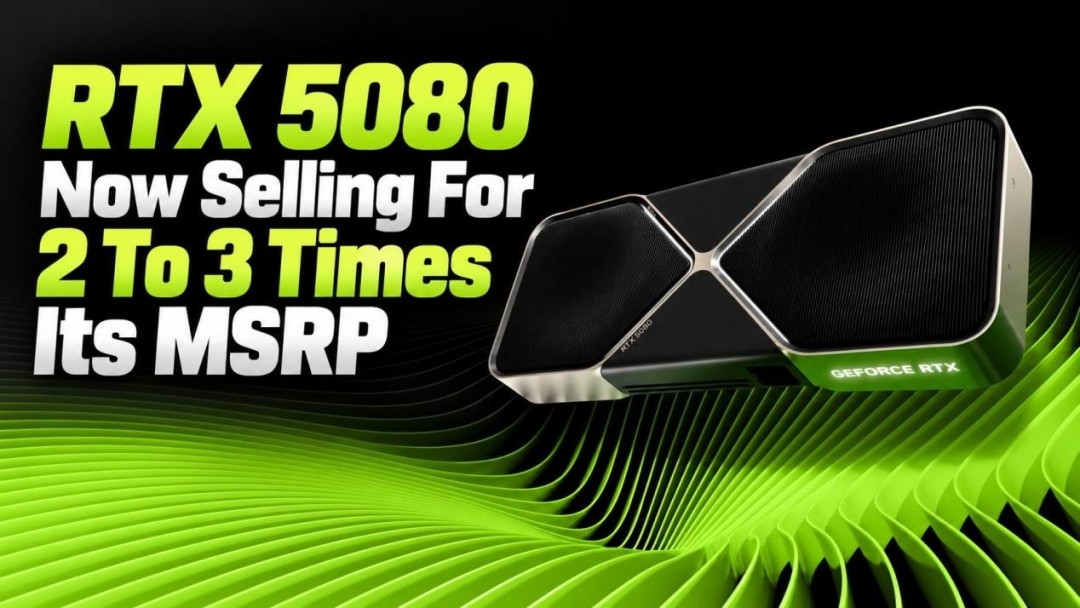
Read from the upstream side, this is a memory-allocation story rather than a demand story. The 16GB GDDR7 device at the center of current board-design roadmaps has been repriced by fab capacity decisions, not by buyer enthusiasm: the lowest purchasable RTX 5080 listings across major United States retailers have moved completely past $2,000 (approx. RMB 13,322), while the reference quote that sat at about $1,200 (approx. RMB 7,994) two months ago now reads $1,979.99 (approx. RMB 13,190) — an $800 (approx. RMB 5,329) swing inside a single quarter-scale window.
Channel Inventory and Quoting Have Diverged
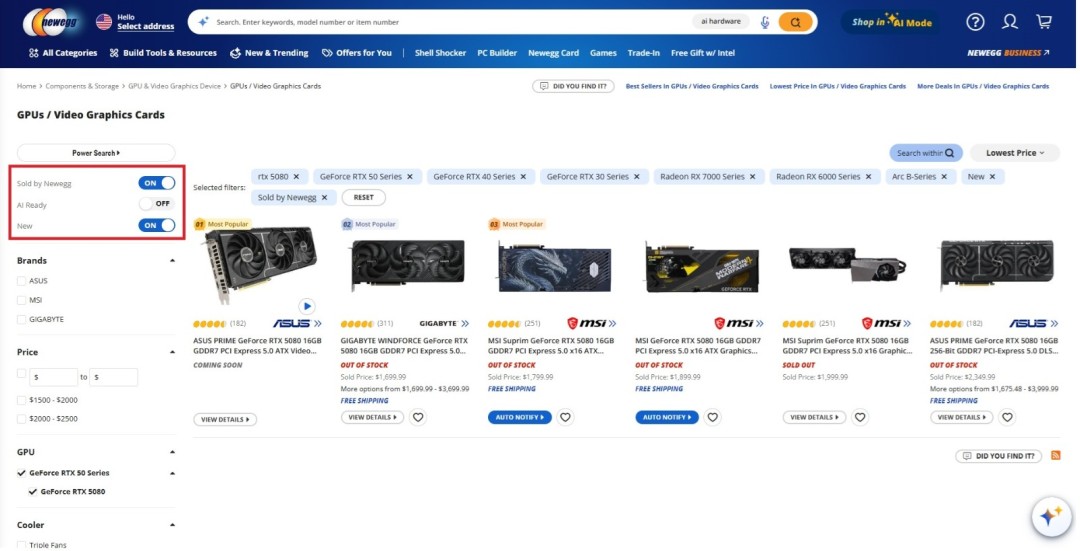
First-party and third-party stock now behave like two different markets. Newegg's own inventory of RTX 5080 cards is fully sold out or tagged as incoming; the only live offers come from marketplace sellers placing units at $2,299 (approx. RMB 15,325), which is 130% above the $999 (approx. RMB 6,659) official recommended price.
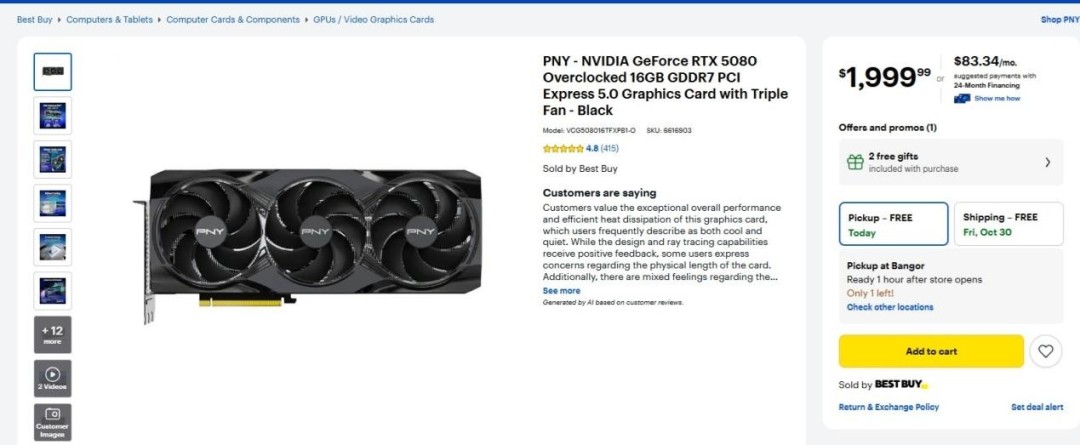
At Micro Center, the lowest posted quote belongs to the Gigabyte Windforce SFF OC and the MSI Suprim Liquid SOC at $1,979.99 (approx. RMB 13,199), valid only for in-store pickup. Best Buy lists the PNY Triple Fan OC at $1,999.99 (approx. RMB 13,332), currently the sole card that can be ordered online.
| Channel | Product or status | Quoted price | Constraint |
|---|---|---|---|
| Newegg (first-party) | RTX 5080 new stock | — | Sold out or incoming |
| Newegg (third-party) | RTX 5080 | $2,299 (approx. RMB 15,325) | 130% above $999 (approx. RMB 6,659) MSRP |
| Micro Center | Gigabyte Windforce SFF OC, MSI Suprim Liquid SOC | $1,979.99 (approx. RMB 13,199) | In-store pickup only |
| Best Buy | PNY Triple Fan OC | $1,999.99 (approx. RMB 13,332) | Only online-orderable option |
Price Inversion: Tier Logic Has Broken Down
The clearest structural signal is that positioning no longer maps to price. Inside the same Micro Center channel, the lower-tier ASUS PRIME OC is tagged at $2,349.99 (approx. RMB 15,665) — $270 (approx. RMB 1,800) more than the flagship-oriented ROG Astral OC. For procurement models that assume a monotonic price ladder across AIB tiers, that inversion invalidates the baseline assumption.
The Same Pressure Is Visible in the Domestic (China) Market
- China-market RTX 5080 reference edition launch MSRP: RMB 8,299
- AIB (non-reference) launch band: RMB 8,999 to RMB 9,999
- Current listing: ASUS and Gigabyte RTX 5080 16G cards on JD.com have both crossed RMB 22,000
Root Cause: GDDR7 Losing the Capacity Competition to HBM
The RTX 5080 carries 16GB of GDDR7, and that memory subsystem is where the cost pressure enters. DRAM suppliers are shifting large volumes of capacity toward HBM, which offers a far richer margin profile, so consumer graphics memory supply is being compressed systematically rather than cyclically.
SK hynix confirmed to investors this week that memory undersupply will persist until 2030. Graphics memory cost inflation therefore transfers directly to AIB partners and is ultimately absorbed in full at the retail layer — which is why channel quotes, not bill-of-materials logic, now set the market clearing price.
Demand Migration From the RTX 5090 Compounds It
The RTX 5090 has effectively disappeared from United States channels, with some quotes reaching $5,599 (approx. RMB 37,323). Buyers originally scoped for the 5090 are being forced to step down to the 5080, concentrating high-end demand on the sub-flagship part.
Layered on top, market rumors suggest NVIDIA may replace the 16GB model with a 24GB version of RTX 5080 and let that device inherit the position vacated by the 5090; the expectation that the 16GB version will be discontinued is accelerating channel price disorder. NVIDIA has issued no public explanation of this price move to date.
Selection and Risk Checklist for Engineering and Procurement
- Treat GDDR7 density (16GB versus the rumored 24GB) as the primary roadmap variable, ahead of core-count or cooler-tier assumptions.
- Use HBM-versus-GDDR7 capacity competition as your leading indicator for graphics memory cost direction.
- Read channel divergence — first-party sold out while marketplace sits 130% above MSRP — as a shortage signal, not a demand signal.
- Re-baseline BOM and budget tables whenever tier inversion appears, since the $270 (approx. RMB 1,800) gap between the ASUS PRIME OC and ROG Astral OC is a pricing-allocation artifact.
- Verify fulfillment constraints before committing a purchase window: Micro Center pickup versus Best Buy online ordering changes real lead time.
Common Misconceptions
- "Retail prices are up because end demand is strong." In this cycle the drivers are GDDR7 supply compression plus demand pushed down from the RTX 5090.
- "A cheaper tier always means a cheaper card." The ASUS PRIME OC versus ROG Astral OC case shows the opposite.
- "Memory tightness normalizes within a couple of quarters." SK hynix's guidance this week extends undersupply to 2030.
Action Recommendations
- If a schedule depends on the current 16GB GDDR7 part, place purchase orders now rather than waiting for a return to the $999 (approx. RMB 6,659) MSRP anchor.
- Where memory capacity can flex, qualify designs against both the 16GB version and the potential 24GB version of RTX 5080 to avoid a mid-program re-qualification.
- Set an escalation threshold at the $2,000 (approx. RMB 13,322) line and require management approval for any buy above it.
- Given NVIDIA's silence to date, budget for continued channel volatility rather than assuming an imminent official price statement.
FAQ
Why did the RTX 5080 move above $2,000 in roughly two months?
Because the memory subsystem repriced it. Capacity reallocation from GDDR7 to HBM compressed graphics memory supply, and displaced 5090 demand piled onto the 5080, lifting listings from about $1,200 (approx. RMB 7,994) to the $1,979.99 (approx. RMB 13,190) to $2,000 (approx. RMB 13,322) band.
Is this specific to one board partner?
No. Gigabyte, MSI, ASUS and PNY parts are all quoted above MSRP, with marketplace offers at $2,299 (approx. RMB 15,325); the constraint sits upstream in memory, not in a single AIB's inventory.
Should I buy the 16GB model or wait for a 24GB variant?
The 24GB version of RTX 5080 remains an unconfirmed market rumor and NVIDIA has said nothing to date, so any wait carries both price risk and discontinuation risk on the 16GB version.
Bottom line for this column's readers: track wafer-level memory allocation, not retail stickers. The price ladder you design and budget against will keep behaving irrationally until GDDR7 availability improves — and supplier guidance currently frames that as a multi-year condition rather than a passing shortage.