
Electronicseng Semiconductors Review: Samsung Electronics AI Memory Allocation, 2027 Tightness, and the Supply Gap Before 2028
By Rachel Williams | Electronics & Engineering
For semiconductor product planners, board designers, and component buyers following Electronicseng Semiconductors, the signal from Samsung Electronics' latest earnings call is less a simple shortage headline than a change in how memory capacity is allocated. Demand this year that cannot be satisfied is expected to roll into next year, and the company's view is that 2027 may be tougher than 2026 because customers are pre-committing future orders while new fabrication capacity cannot arrive fast enough before 2028.
What the Samsung Electronics Outlook Changes in Supply Planning
The core operational fact is timing. Samsung's memory business executive vice president, Jaejune Kim, said that, based on customer demand now received by the company, 2027 supply pressure is expected to be more severe than 2026. The reason is not only demand growth, but the physical lead time of semiconductor manufacturing: new wafer fabs and added capacity generally take years from construction to formal production. Therefore, the industry is unlikely to see a clear release of incremental supply before 2028.
Another change is customer behavior. Instead of purchasing through normal quarterly procurement cycles, buyers of high-performance memory are sharing medium-to-long-term forecasts to secure future capacity. When orders cannot be fulfilled this year, they are likely to remain live next year, increasing the risk of deeper supply-demand imbalance.
Product Map: Where the Pressure Is Concentrated
| Memory or storage category | Reported status or plan | What supply teams should infer |
|---|---|---|
| HBM4 | Samsung's 2027 HBM4 capacity is sold out; orders have already been secured by customers. | Advanced AI accelerator programs should treat 2027 HBM4 as contract-controlled, not spot-available. |
| HBM4E | Mass production is planned for the first half of 2027; shipment volumes are expected to rise in the second half. | Design qualification should separate production start from meaningful volume supply. |
| DDR5 | High-speed DDR5 demand remains strong, especially 8000MT/s and above, favored by server customers. | Server memory BOMs may face speed-grade availability pressure, not only capacity pressure. |
| NAND flash | Samsung is accelerating AI-oriented products, including PCIe Gen6 enterprise SSDs, high-density QLC SSD products, and related storage solutions for AI infrastructure. | Storage roadmaps should track interface and density transitions, not only wafer capacity. |
Financial Data: Evidence That the AI Buildout Is Real
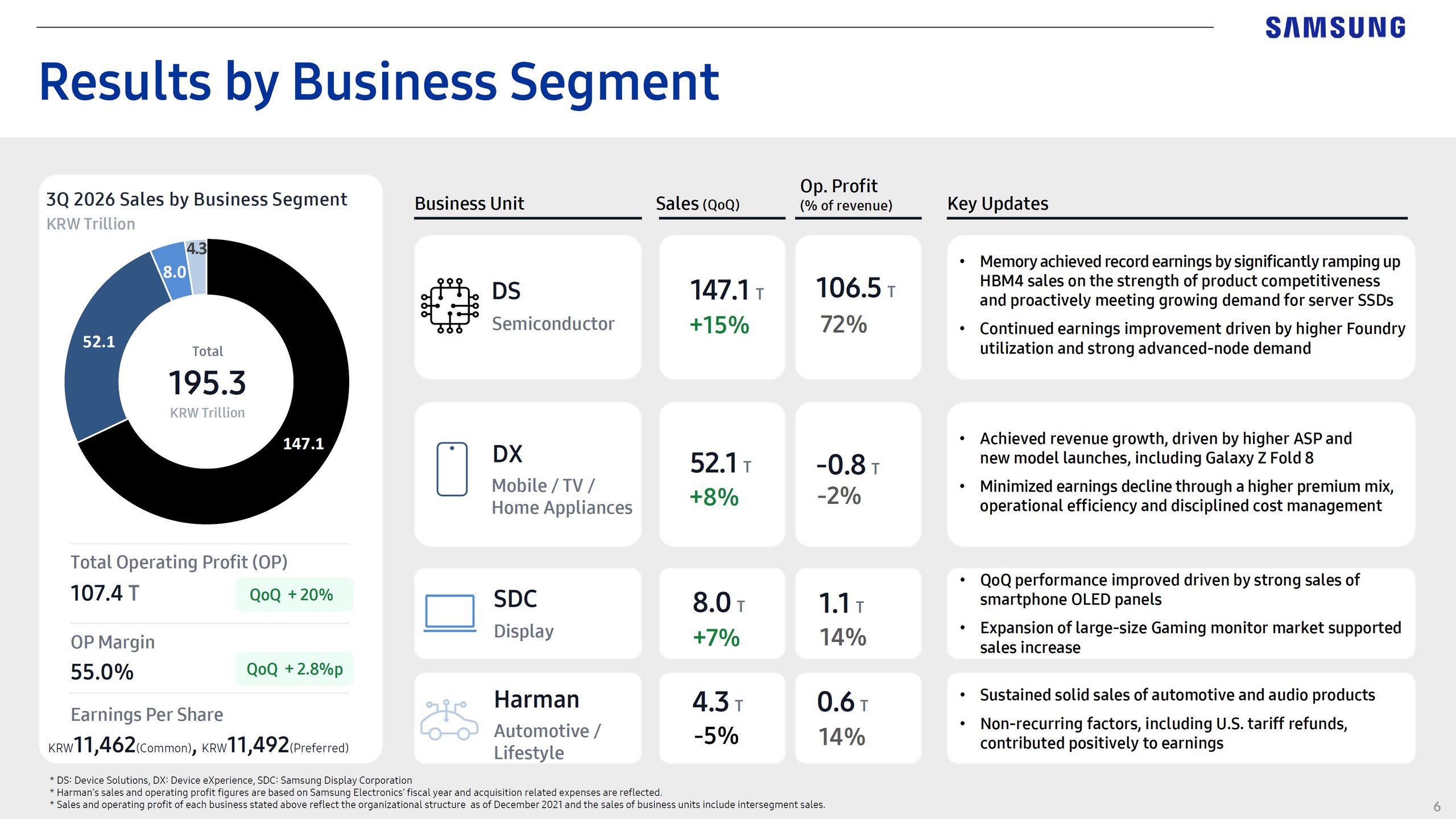
The earnings data referenced by Samsung Electronics supports the demand-side argument. In the third quarter of 2026 (Q3 2026), revenue reached 195.3 trillion won, up 127% year over year and up 14% quarter over quarter. Operating profit surpassed 100 trillion won, making the company the first global technology company to reach that level; operating profit rose 783% year over year and 20% quarter over quarter.
Research and development spending was 14.4 trillion won, up 63%, with funds directed toward capacity expansion, next-generation memory technology development, and new production facilities. Within the company, the Samsung DS division, which handles the semiconductor business, showed operating profit growth of 72% and revenue growth of 15%, driven by HBM, DRAM, and SSD demand.
Data reference: These figures are used as disclosed by Samsung Electronics in the earnings call and are included here to support the supply analysis rather than as a new performance claim.
Contracting, Allocation, and Consumer Impact
Samsung also described a shift toward longer contractual horizons. Large AI companies and data-center operators are increasingly seeking multi-year supply contracts to protect future memory availability. To reduce exposure to market volatility, Samsung plans to place around 60% to 70% of capacity inside long-term supply agreements. Customers willing to sign long-term purchase contracts receive higher priority supply assurance.
The allocation consequence is direct for downstream electronics. If advanced memory is prioritized for AI data-center markets, consumer-facing categories may receive a relatively limited share of capacity. Smartphones, personal computers, graphics cards, and consumer storage products could continue to face rising cost pressure.
Foundry View: 2nm, 4nm, and AI Chip Demand
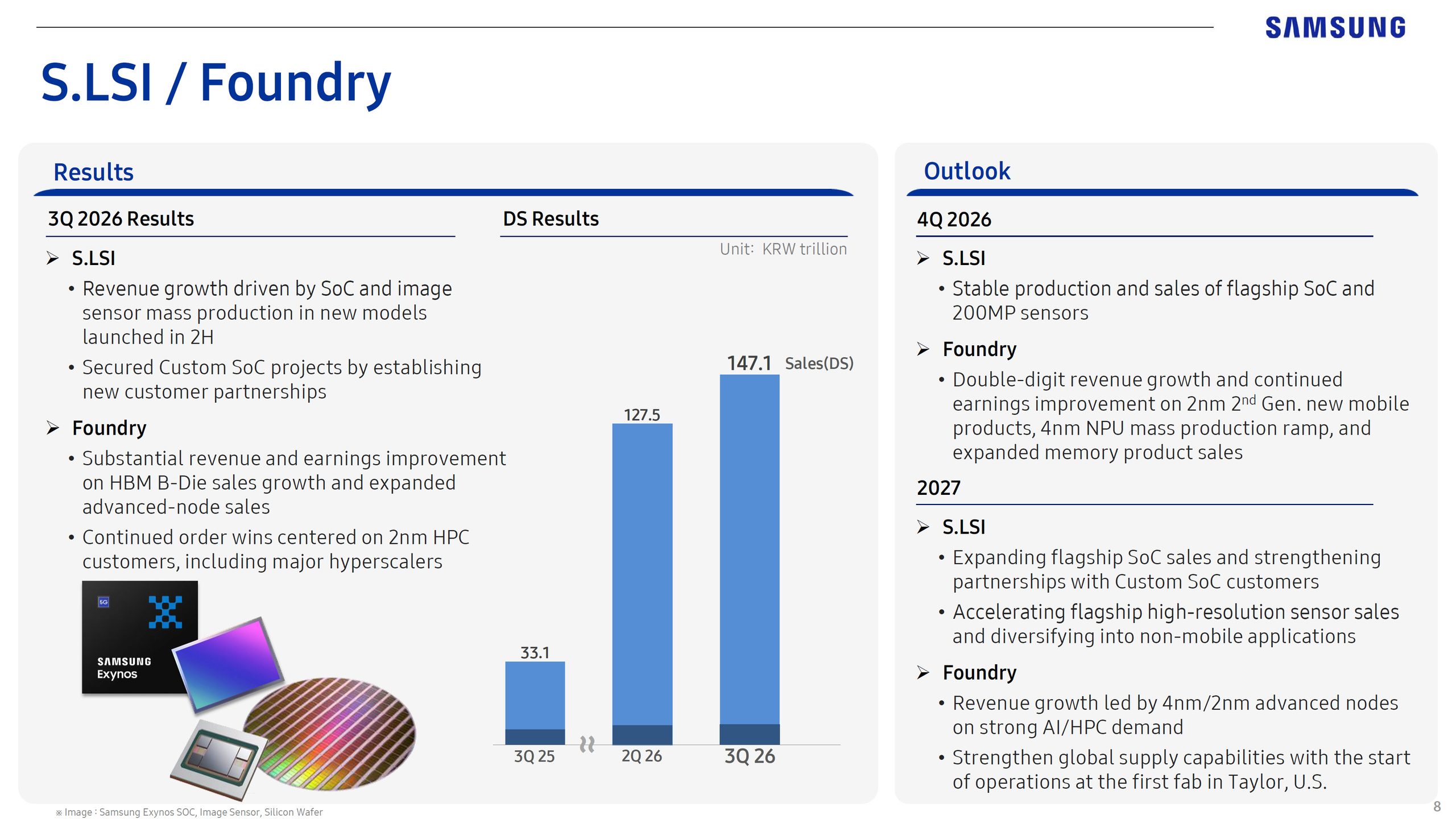
Beyond memory, Samsung's foundry commentary adds another data point on AI compute demand. The company expects 2nm process order volume to grow more than twofold this year. The 4nm process has been adopted by several major United States AI customers, and major 2nm customer products are planned to enter mass production in the second half of this year. These developments do not solve memory capacity constraints, but they reinforce that AI silicon demand is pulling the broader semiconductor supply chain toward advanced products.
Checklist: How Electronicseng Semiconductors Teams Should Respond Now
- Confirm whether your 2027 HBM4 requirement is covered by a long-term supply contract, because Samsung Electronics has stated that its 2027 HBM4 capacity is sold out.
- Build separate risk buffers for HBM4E: first half of 2027 is a mass-production start window, while the second half is when shipment volumes are expected to scale.
- Review server memory specifications around DDR5, especially 8000MT/s and above, and document fallback performance boundaries before final platform lock.
- Map storage product transitions to PCIe Gen6 and high-density QLC SSD if your roadmap depends on AI infrastructure or enterprise SSD availability.
- Track NAND flash product acceleration plans, because AI-oriented storage development is now part of the supply conversation, not only traditional capacity expansion.
- Reprice consumer electronics assumptions if capacity continues to flow toward long-term AI data-center agreements.
Common Misconceptions About the Memory Supply Situation
| Misconception | What the reported facts support |
|---|---|
| The issue is only a short-term AI ordering spike. | Samsung Electronics points to customer behavior, order carryover, and fab lead times, with pressure expected to be worse in 2027 than in 2026 and limited incremental supply before 2028. |
| Sold-out HBM4 capacity means no product will exist in 2027. | The statement is that Samsung's 2027 HBM4 capacity is sold out and pre-locked by customers, which changes availability from open supply to contracted allocation. |
| All memory categories face identical constraints. | The company highlights HBM4, HBM4E, high-speed DDR5 at 8000MT/s or above, NAND flash, PCIe Gen6 enterprise SSDs, and high-density QLC SSD products as the AI-driven focus. |
| Record results mean downstream supply is guaranteed. | Record financial results reflect AI server demand, but around 60% to 70% capacity under long-term agreements suggests non-contracted demand may still be allocated later. |
FAQ: Supply, Timing, and Selection Questions
Why is the before-2028 window so important?
New wafer fabs and added capacity take years from construction to formal production. Based on that timeline, Samsung Electronics does not expect the market to see obvious incremental supply before 2028.
Does HBM4E mass production mean immediate volume supply?
No. The plan is for HBM4E to begin mass production in the first half of 2027 and to increase shipment volumes in the second half. Engineering teams should not treat production start and volume availability as the same milestone.
Why does DDR5 speed matter if DDR5 already exists?
The demand issue is not simply DDR5; it is high-speed DDR5, especially 8000MT/s and above. Server customers are favoring these specifications, which can create product-grade pressure in high-speed segments.
What does the Samsung DS division result tell us?
The Samsung DS division, which covers semiconductors, grew operating profit by 72% and revenue by 15%, driven by HBM, DRAM, and SSD demand. That shows the tightness is supported by real revenue and demand, not only forecast language.
Will foundry growth relieve memory tightness?
Not directly. The 2nm and 4nm foundry developments show AI compute demand is rising, and 2nm orders are expected to grow more than twofold this year, but memory supply constraints remain tied to wafer capacity, long-term contracts, and the before-2028 release lag.
Action Recommendations for Design, Sourcing, and Operations
- For AI server, accelerator, and data-center platforms, start supplier engagement with a demand profile that extends beyond 2026, because unmet orders this year can continue into next year and 2027 is flagged as a tougher supply year.
- For HBM-dependent designs, create a contract-coverage matrix by product family: HBM4 is already sold out for Samsung's 2027 capacity; HBM4E should be planned from mass production in first half of 2027 to volume ramp in second half.
- For DDR5 memory architecture, include 8000MT/s and above as a high-demand option, but maintain validated lower-speed alternatives and clear performance degradation assumptions.
- For storage systems, track the shift toward PCIe Gen6 enterprise SSDs, high-density QLC SSD products, and NAND flash solutions developed for AI infrastructure, because these product transitions influence future allocation and pricing.
- For consumer device programs, assume that advanced memory may be prioritized toward long-term AI data-center contracts and stress-test bill-of-material costs for smartphones, personal computers, graphics cards, and consumer storage.
- For risk governance, monitor not only Samsung Electronics capacity announcements, but also the share of capacity placed under long-term agreements, around 60% to 70%, as an early indicator of open-market availability.
Bottom Line for Electronicseng Semiconductors Readers
For Electronicseng Semiconductors readers, the decision framework is now narrower than buy early. The market is being organized by contracted demand, product speed grade, and fabrication lead time. Samsung Electronics is expanding advanced memory plans and reporting record semiconductor-linked results, but customers that cannot be secured into long-term agreements may still confront 2027 allocation pressure, limited incremental supply before 2028, and cost pass-through into consumer electronics.
Published by Electronics & Engineering. Contact: info@electronicseng.com