
Self-Verifying EDA Agents in Practice: What the Siemens and Nvidia Fuse EDA AI Agent Update Changes for Long-Running Chip Design Flows
By Rachel Williams — Electronicseng Semiconductors desk
Long semiconductor design jobs rarely stall inside the solver. They stall in the gaps between runs: the log triage after a convergence failure, the retabled corner, the resubmitted job, the signoff report waiting in a queue. Siemens is now aiming squarely at that supervisory layer. The company has broadened its partnership with Nvidia to add self-verifying agentic AI workflows to the Fuse EDA AI Agent, so an agent can remain active through long-running semiconductor and printed-circuit-board (PCB) design work instead of idling until an engineer returns to the console.
In architectural terms, the capability links Siemens' electronic design automation (EDA) software with Nvidia's AI open models, agent software, secure runtime, and accelerated computing stack, and it reaches across the Siemens EDA estate: Catapult high-level synthesis, custom IC design and verification with Solido, Aprisa physical implementation, Calibre signoff verification, and Tessen design-for-test. The system is integrated into Intelligence Center X, Siemens' recently launched enterprise industrial AI environment, which provides agent creation and orchestration. For design leads and procurement teams reading this as a planning input, the material detail is not the vendor pairing. It is where final authority over correctness is placed.
Self-verification means the model proposes, the engine disposes
Siemens uses the term self-verification for a deliberate division of labour. A language model alone does not decide whether a design is correct. The agent can monitor a workflow, inspect results, alter its configuration, and trigger further operations, but it checks every step of progress against established EDA engines, and those engines produce the engineering evidence that justifies the next decision.
- Objective decomposition and multi-step planning: reasoning models from the Nvidia Nemotron line.
- Electrical, timing and physical truth: simulation, verification and physical design tools, including SPICE engines and Calibre signoff.
- Tool access: Model Context Protocol (MCP) interfaces into EDA applications.
- Execution boundary: Nvidia OpenShell secure runtime, orchestrated inside an enterprise AI platform.
That split is the reason the announcement matters beyond marketing: autonomy is added to the loop, not to the verdict.
Roadmap in three steps: 2025 data infrastructure, 2026 execution, 2026 autonomy
At DAC 2025, Siemens introduced the Fuse EDA AI System, which supplied the data and model infrastructure needed to apply generative AI to EDA data.
The execution tier followed at Nvidia GTC in March 2026, when the Fuse EDA AI Agent was announced. A supervisory agent could break an engineering objective into tasks, delegate work to specialized agents, and connect to EDA applications through Model Context Protocol (MCP) interfaces.
The expansion released at DAC 2026 adds long-running agents that continue working after the first tool call. An agent can launch a simulation, inspect returned logs, identify a failure, modify the setup, and try again — without waiting for a human to re-anchor the run.
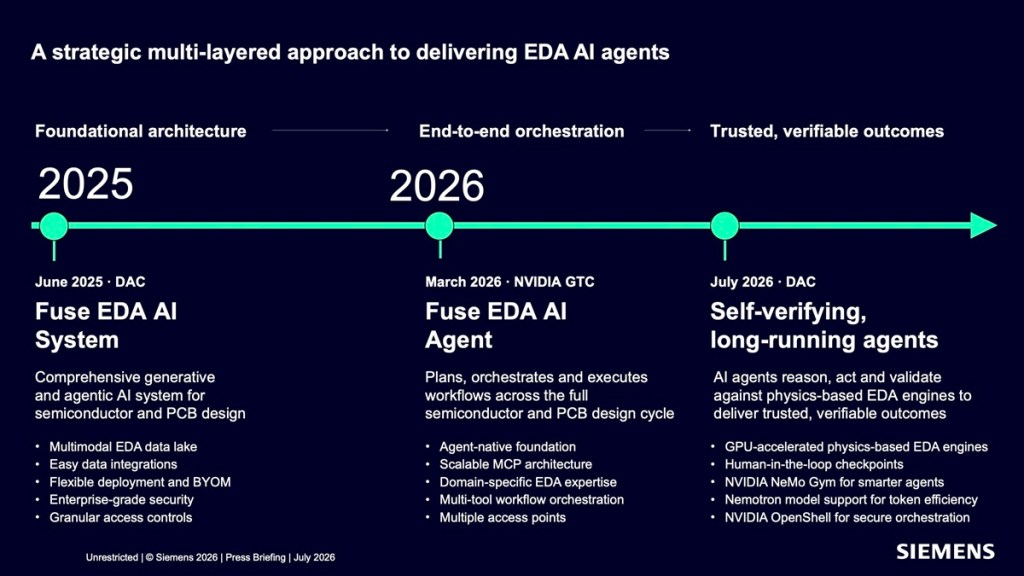 Figure 1: The Fuse EDA AI platform roadmap advances from a foundational AI architecture in 2025 to end-to-end orchestration and self-verifying, long-running agents in 2026. (Source: Siemens)
Library characterization as the reference workload
Why this class of agent is useful even when simulations are already automated is clearest in library work. For a standard-cell, memory, or custom-IP library, characterization across different operating conditions must complete before its timing and power models can be used. Engineers first configure the library and run preliminary simulations to confirm the environment is behaving correctly.
Amit Gupta, senior vice president and general manager of Solido Custom IC and chief AI strategy officer at Siemens EDA, Siemens Digital Industries Software, describes that early phase as "pipe cleaning." When simulations fail because of an incorrect setup or a convergence issue, an engineer inspects the result, changes the configuration, and reruns the task; only once the setup is stable does the full characterization run begin. Engineers keep monitoring failures, reviewing outliers, and deciding whether additional process, voltage, and temperature (PVT) corners need to be simulated before the Liberty models pass quality checks. "It comes out to about a four-to-six-week process for a library," Gupta said.
The Solido Characterization agent, delivered through the Solido Characterization Suite, automates much of that supervisory loop. Gupta says an engineer can initiate the process with a single prompt; the agent then launches hours-long runs, monitors them, reacts to failures, changes configurations, reruns jobs, and performs final quality-assurance steps. The workflow automatically generates and verifies Liberty files using Solido Characterizer, which manages characterization tasks; Solido LibSPICE, which runs the circuit simulations; Solido Generator, which produces the Liberty models; and Solido Analytics, which examines results and supports outlier analysis.
Siemens' stated outcome for that workload is a reduction in characterization turnaround by more than 10× and a reduction in token cost by 5× to 10×. Read this correctly: the gain comes mainly from removing manual work between simulations, with acceleration applied on top.
| Dimension | Traditional supervised flow | Fuse EDA AI Agent flow |
|---|---|---|
| Start of a campaign | Manual library setup, then preliminary test runs | Single prompt initiates the characterization task |
| Failure handling | Engineer opens logs, diagnoses convergence or setup errors, edits, resubmits | Agent inspects logs, alters configuration, reruns the job |
| Corner decisions | Engineer judges which extra PVT corners to run | Agent proposes the next analysis; the simulator produces the electrical result |
| Outlier review | Manual inspection across result sets | Solido Analytics supports outlier examination inside the loop |
| Cycle length reference | "It comes out to about a four-to-six-week process for a library" | Characterization turnaround reduced by more than 10× |
| Authority over correctness | Deterministic tools plus human signoff | Deterministic tools plus human signoff; the agent keeps the workflow moving |
What the Nvidia layer actually contributes
The Fuse EDA AI Agent translates an engineer's objective into a plan, and the specialized agents select tools and execute the steps. Extending the agentic AI workflows with Nvidia's Nemotron 3 Ultra model provides reasoning for planning and multi-step execution, while the Nvidia NeMo Gym open library is used to evaluate agent behavior to improve results and optimize workflows. Nvidia OpenShell secure runtime supplies a sandboxed environment for running the agents.
The engineering result, however, still comes from Siemens' EDA tools. A model may decide which SPICE analysis to run, or whether another PVT corner is needed, but the simulator produces the electrical result.
Nvidia CUDA-X libraries accelerate numerical operations used by the simulation and physical verification tools, which shortens the interval between an agent's action and the feedback required for its next decision — a first-order effect on how long an unattended run can stay productive. Nvidia's PhysicsNeMo open-source PyTorch framework for physics AI models adds a further layer, where physics-aware models give the agent fast estimates to explore a design and decide where a higher-fidelity simulation is required. Those models are explicitly not a substitute for engineering validation: trusted solvers, test data, and domain-specific criteria remain the final references.
"The goal is not to replace physics with AI," said Timothy Costa, general manager for industrial and computational engineering at Nvidia. The objective, he added, is to connect AI reasoning with accelerated simulation and physics-aware models while keeping trusted engineering tools as the source of validation.
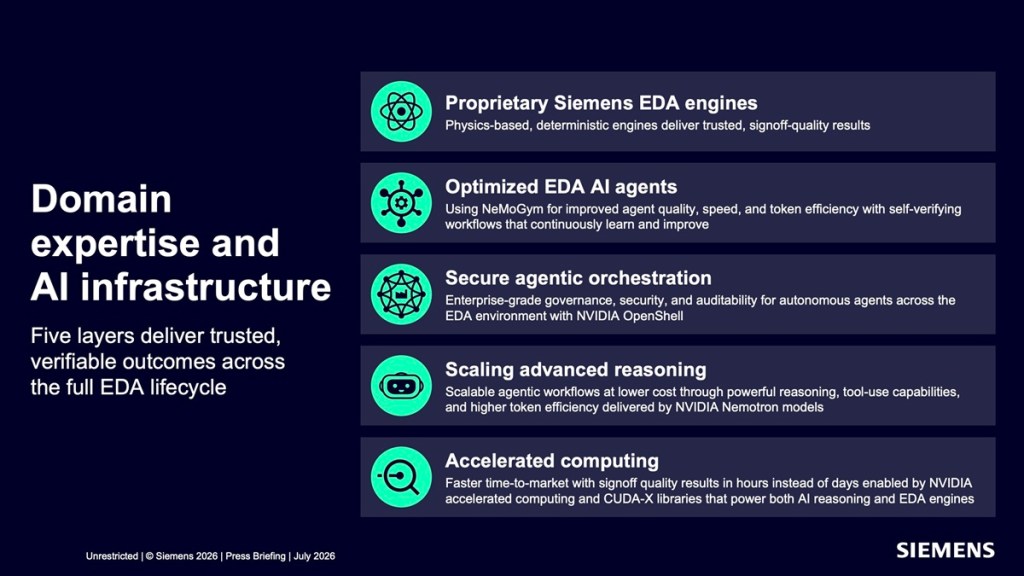 Figure 2: Siemens' self-verifying EDA architecture combines deterministic EDA engines, optimized AI agents, secure orchestration, Nemotron reasoning models, and CUDA-X accelerated computing. (Source: Siemens)
Cross-domain autonomy is the harder engineering problem
Library characterization has well-defined inputs, tools, and acceptance checks. Extending the same autonomy across several EDA domains is materially more difficult.
Gupta says Siemens is currently focused on long-running agents within individual areas such as custom IC design, digital verification, design-for-test, and Calibre physical verification. "What we see as the next step is being able to stitch those product families together," he added.
An early demonstration shows the direction: Calibre detects a design rule violation, and the agent invokes Aprisa semiconductor software for a digital physical design repair, or Solido for an analog repair. This moves the agent from identifying a problem to changing the design, and it creates new verification requirements, because fixing a local design rule check violation can introduce a timing, congestion, or signal integrity problem elsewhere in the design.
The obstacle is more than exposing additional applications through MCP. Even a cross-domain agent has to understand how different representations of the same design correlate with one another. Gupta explains that Siemens is developing EDA ontologies that map relationships between domains and improve the models' ability to understand different data types; that context is necessary because a change in one stage may invalidate results elsewhere.
Human judgment therefore remains part of the design and verification workflow. When an agent repairs a design rule violation it can create another physical problem, so engineers need to observe the agent's actions, pause or stop execution, and redirect the workflow. Near-term deployment will remain domain-scoped and supervised. Fuller autonomy arrives only when EDA companies can preserve engineering intent while agents move across multiple tools, data models, and verification steps. The expanded EDA AI capabilities will be available in upcoming releases of Siemens' AI-native EDA portfolio.
Common misconceptions worth pre-empting
- Myth: an agent can sign off a design. Signoff still belongs to deterministic engines such as Calibre; the agent only decides what to run next.
- Myth: the 10× figure is a solver speedup. Siemens attributes the gain to removing manual work between simulations, with CUDA-X acceleration applied on top.
- Myth: physics-aware models will replace SPICE. PhysicsNeMo-based estimates are for exploration and for deciding where higher-fidelity simulation is required.
- Myth: MCP access equals cross-domain competence. EDA ontologies that relate different design representations are still under development.
- Myth: autonomy means removing engineers from the loop. Observation, pause/stop authority, and redirection remain explicit requirements.
Evaluation checklist for design, verification and supply-chain teams
- Identify flows whose elapsed time is dominated by supervision rather than computation — setup triage, rerun decisions, outlier review — since that is where a long-running agent earns back time.
- Confirm which deterministic engines provide your acceptance evidence today (for example Catapult, Solido, Aprisa, Calibre, Tessen) and whether their results are machine-readable enough for an agent to consume.
- Baseline your own turnaround before comparing with vendor claims such as more than 10×; a four-to-six-week characterization cycle is a useful reference point for a library campaign.
- Define human checkpoints in advance: who may pause or stop an unattended run, and who owns final signoff.
- Assess data readiness for Liberty models, PVT corner definitions, run logs, and result analytics; the agent's planning quality depends on this context.
- Review the security envelope for agent code — a secure runtime such as OpenShell, plus enterprise orchestration of the Intelligence Center X class — before granting tool access over MCP.
- Model both sides of the cost curve: token consumption, where the cited improvement is 5× to 10×, and accelerated computing capacity needed for CUDA-X-path workloads.
- Plan change-impact tracking before enabling cross-domain repairs, since a local fix can propagate into timing, congestion, or signal integrity issues.
Action recommendations
- This quarter: instrument one long-running workflow (a library characterization or a physical verification loop) and record where hours are lost to supervision rather than compute.
- Next 6–12 months: pilot domain-scoped, supervised agents on a single product family, keep the deterministic engine as the acceptance authority, and verify the claims internally against your own baseline.
- Beyond that: treat cross-domain autonomy as an integration roadmap item — design data consistency and EDA ontology coverage, not model choice, will set the pace.
- Throughout: budget for accelerated compute and secure agent runtime as infrastructure line items, not as seat add-ons, and keep engineer oversight rights documented in the flow.
FAQ
What does "self-verifying" add that ordinary automation did not?
Automation runs a script; a self-verifying agent inspects the result of each run, decides whether it passed, and repairs the setup when it did not — while using proven engineering tools, not a language model, as the arbiter of correctness.
Which EDA domains get long-running agents first?
Siemens is focusing first on individual areas: custom IC design, digital verification, design-for-test, and Calibre physical verification, with stitching across product families described as the next step.
Does the library-characterization number apply to every team?
It is Siemens' stated result for library characterization using the Solido Characterization Suite with agentic AI — more than 10× faster turnaround and 5× to 10× lower token cost. Your own gain depends on how much of your cycle is setup triage versus compute.
Can physics-aware models reduce the number of SPICE runs enough to skip signoff?
No. PhysicsNeMo-based models give the agent fast estimates for exploration; trusted solvers, test data, and domain-specific criteria remain the final references.
When is this available?
The expanded EDA AI capabilities are slated for upcoming releases of Siemens' AI-native EDA portfolio; near-term deployment is domain-scoped and supervised.
For semiconductor teams, the practical takeaway is narrow but durable: agentic EDA is not replacing the physics-based tools used to design and verify chips. The agent keeps the workflow moving and decides what should happen next, while deterministic engines — and the engineers who authorize them — decide whether the result can be trusted. Teams that measure their supervision overhead now will be the ones able to tell, on their own numbers, whether that trade is worth making.