
SK Hynix Profit, Net Cash and Product Outlook: HBM4, 321-Layer NAND, HBF and Memory Shortage Through 2030
By Rachel Williams, Electronics & Engineering
The company's latest earnings picture presents two signals that semiconductor engineers, system architects, hardware procurement teams, and market analysts can read together: a strengthened balance sheet and a faster move toward AI-oriented memory products. SK Hynix reported operating profit of 83.3 trillion Korean won and net profit of 39.8 trillion Korean won, with operating margin about 80% and net margin about 38%. As of end of the third quarter, cash and cash equivalents reached 114.5 trillion Korean won, up 26.5 trillion Korean won from the previous quarter, while borrowings fell to 15.8 trillion Korean won, down 2.8 trillion Korean won from the prior quarter. The resulting net cash position increased to 98.7 trillion Korean won. For suppliers and buyers, these numbers are not only a financial result; they describe the funding environment behind HBM4 expansion, server DDR5 growth, 321-layer NAND adoption, and capacity projects such as M15X.

Financial Positioning: A Net Cash Base for Capacity and Product Push
A high-margin profit outcome and an increasing net cash balance are closely tied to product investment. The disclosed figures show that the company is not entering the next product transition from a weakened position. The main points can be summarized as a checklist for analysts and purchasing managers:
- Operating profit: 83.3 trillion Korean won, showing the earnings scale disclosed in the report.
- Net profit: 39.8 trillion Korean won, with net margin about 38%.
- Operating margin: about 80%, indicating profitability level disclosed.
- Cash and cash equivalents: 114.5 trillion Korean won as of end of the third quarter, up 26.5 trillion Korean won from previous quarter.
- Borrowings: 15.8 trillion Korean won, down 2.8 trillion Korean won from prior quarter.
- Net cash: 98.7 trillion Korean won, a further improvement in financial condition.
HBM4, Server DDR5, and SOCAMM Demand
The clearest product transition in the update is HBM4. High Bandwidth Memory is used to address the bandwidth requirements of AI server systems, and the company said sales of HBM4 continue to expand. The forecast is specific: next quarter, HBM4 is expected to surpass HBM3E in both shipment volume and revenue contribution, making HBM4 the main product. This matters for platform planning because a change in the dominant HBM generation affects qualification, cost assumptions, and supply coordination. The report does not describe a single-product market; it also shows wider server memory momentum. Server DDR5 sales have achieved significant growth, and LPDDR5 SOCAMM demand for AI servers continues to climb. Capacity is being prepared in parallel: the newly built M15X fab is expected to reach full operation by end of this year, with monthly capacity of about 55,000 to 60,000 1b DRAM wafers. Meanwhile, the share of next-generation 1c DRAM technology used in LPDDR6 products is steadily rising.
For technical decision-makers, the combination of HBM4 becoming main, DDR5 and SOCAMM demand increasing, and 1b/1c process transition is the part of the announcement with the most direct selection impact. The disclosed schedule, however, is tied to M15X full operation by end of this year and a product mix shift already visible in the reported quarter.
NAND: 321-Layer TLC and High Bandwidth Flash
NAND progress is centered on 321-layer TLC. The company said sales of 321-layer TLC flash chips in embedded SSD market are growing rapidly. It also expects that by the end of this year, 321-layer products will occupy more than half of its NAND capacity in Korea. This gives a concrete view of node transition inside NAND manufacturing: the reported product is not limited to a pilot, but is tied to a majority of Korean NAND capacity at the year-end point.
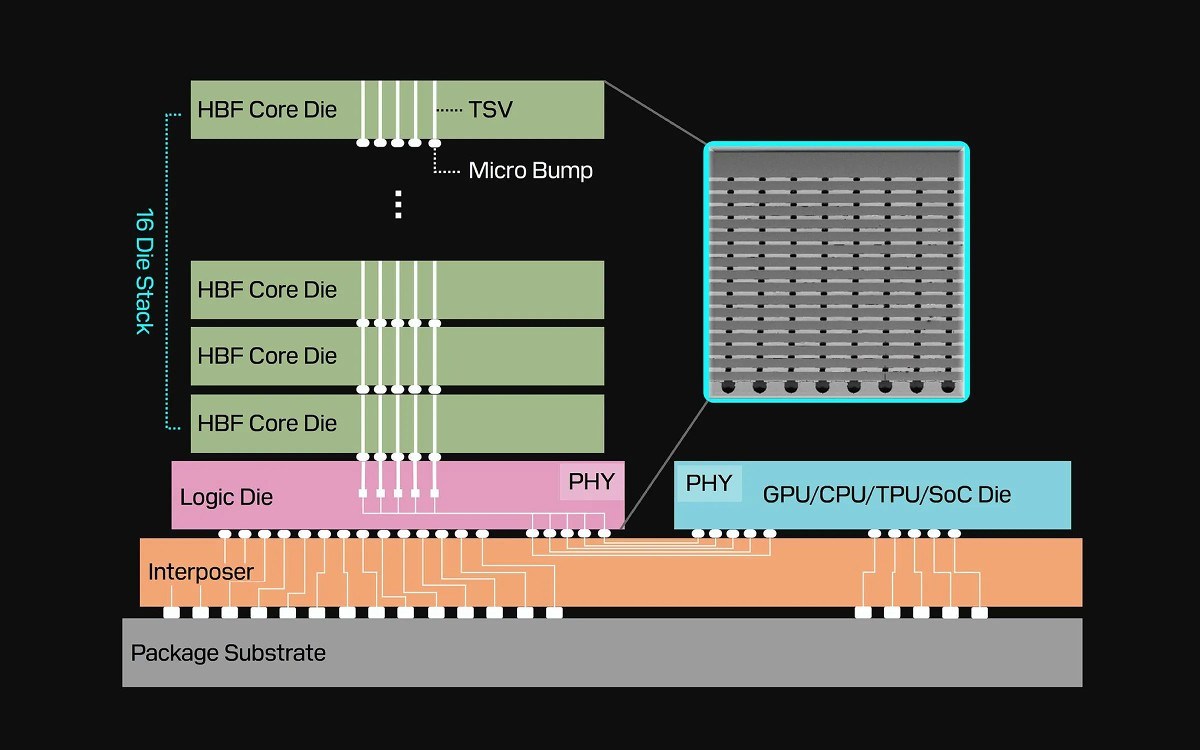
A second NAND-related item is HBF, High Bandwidth Flash. This solution is aimed specifically at AI servers. The concept is similar to HBM, but its role is different: it is intended to take on long-term data storage tasks rather than traditional memory functions. The practical use described is helping artificial intelligence models quickly access large datasets that cannot all be placed into RAM, thereby easing memory capacity constraints. For server architecture teams, this positions HBF as a storage-side idea in the AI memory hierarchy, while the report does not provide additional performance claims beyond the disclosed role.
Supply Shortage Through 2030 and Demand Drivers
The supply-side warning is important. SK Hynix said in the earnings update that global memory supply shortage is expected to last until 2030. This forecast is not presented as a simple product-demand spike; it is linked to the timing of new manufacturing capacity. The company plans to accelerate expansion, but the disclosed reasoning is that newly added production capability requires time, so short term demand cannot be completely met. For buyers, that means availability planning should not assume a rapid reversal even when expansion projects are underway.
The demand outlook is also layered. Over the next several years, the company sees enterprise AI and personal AI applications as the main forces behind growth. In the medium to long term, as technology matures further, AI applications in autonomous driving and robotics will also become important demand sources. These applications generally depend on advanced memory and storage performance, which is why the report connects product roadmap and shortage risk.
Market Ranking and Comparison
Counterpoint Research report released in September this year provides market-share context. By revenue, SK Hynix is described as the second largest DRAM manufacturer, with about 25% market share. Samsung Electronics ranks first with 38%, and Micron Technology ranks third with 24%. The same report identifies all three companies as suppliers of LPDDR and NAND storage products to Apple and numerous smartphone makers. This comparison is useful because it shows concentration in the advanced memory market and the breadth of mobile supply exposure across the leading vendors.
| Company | DRAM ranking by revenue | Share | Report basis |
|---|---|---|---|
| Samsung Electronics | first | 38% | Counterpoint Research report in September this year |
| SK Hynix | second largest | about 25% | Counterpoint Research report in September this year |
| Micron Technology | third | 24% | Counterpoint Research report in September this year |
Solidigm IPO Withdrawal and Capital Planning
SK Hynix Chief Executive Officer Kwak Noh-Jung responded to Solidigm's withdrawal of its initial public offering plan. The explanation centers on the intended purpose of the IPO. It was meant to raise external funding to expand Solidigm production facilities, reduce the group's own investment burden, and improve the capability to return value to shareholders. After evaluating recent financial market conditions and other factors, the company decided that moving forward with a listing at this stage would make it difficult to achieve the expected goals. As a result, the related review procedures were terminated. The episode matters because it links capital-market timing to NAND production expansion plans, without changing the underlying aim of facility growth disclosed earlier.
FAQ: What Buyers and Engineers Should Ask
- Q: Is HBM4 already replacing HBM3E?
A: Not yet as the main product in the reported quarter. The company expects next quarter that HBM4 will surpass HBM3E in both shipment volume and revenue contribution, making HBM4 the main product. - Q: Why does M15X capacity matter?
A: The newly built fab is expected to reach full operation by end of this year, with monthly capacity of about 55,000 to 60,000 1b DRAM wafers, supporting AI-server memory demand and DDR5-related supply. - Q: What is the role of 321-layer NAND?
A: The company reports rapidly growing 321-layer TLC flash chip sales in embedded SSD market and expects that by the end of this year, 321-layer products will take more than half of its NAND capacity in Korea. - Q: How is HBF different from HBM?
A: HBF, or High Bandwidth Flash, is aimed at AI servers and uses a high-bandwidth idea similar to HBM, but its disclosed role is long-term data storage rather than conventional memory. It is intended to help AI models access large datasets that cannot all fit into RAM. - Q: Is memory shortage a near-term only problem?
A: SK Hynix warned that global memory supply shortage is expected to continue until 2030. The company plans faster capacity expansion, but new manufacturing capability takes time, so short term supply remains difficult. - Q: What changed with Solidigm's IPO?
A: The IPO was originally intended to raise external funding to expand Solidigm production facilities, reduce the group's investment burden, and improve shareholder returns capability. After considering recent financial market conditions and other factors, the company judged that listing at this stage was unlikely to meet expected goals and terminated review procedures.
Common Misconceptions
- Misconception: HBF is another name for HBM. Clarification: HBF is a separate AI-server storage scheme. It borrows the high-bandwidth concept, but it is described as handling long-term data storage rather than conventional memory functions.
- Misconception: 321-layer NAND is only a marginal product update. Clarification: The disclosed point is faster embedded SSD market sales and a year-end target of more than half of Korea NAND capacity for 321-layer products.
- Misconception: Strong net cash removes supply risk. Clarification: Even with 98.7 trillion Korean won of net cash, the company still says capacity additions take time and shortage may persist until 2030.
- Misconception: HBM4 demand is the only driver in the update. Clarification: The same report also highlights server DDR5 growth, LPDDR5 SOCAMM demand for AI servers, 321-layer NAND in embedded SSD, and a broader shortage signal across memory.
Action Recommendations
- Monitor the HBM4 transition. The expectation that next quarter HBM4 will surpass HBM3E in shipments and revenue contribution can influence sourcing priorities, platform qualification order, and supplier conversations for AI server memory.
- Check 1b and 1c DRAM readiness. M15X full operation by end of this year, with about 55,000 to 60,000 monthly 1b DRAM wafer capacity, plus a steadily rising share of 1c DRAM technology in LPDDR6, should be tracked as inputs for future capacity and product mix assumptions.
- Evaluate 321-layer NAND and HBF use cases separately. Embedded SSD buyers should watch the expected shift to more than half Korea NAND capacity in 321-layer products. AI infrastructure teams should treat HBF as a storage-layer complement for long-term data, not as a replacement for HBM in conventional memory functions.
- Build shortage assumptions into schedules. Because SK Hynix expects memory supply shortage to continue until 2030 while new manufacturing capability takes time, buyers should avoid assuming a short term reversal and should align allocation questions with HBM4, DDR5, SOCAMM, and NAND plans.
- Track market-share concentration. The Counterpoint Research September report gives a useful benchmark: Samsung Electronics at 38%, SK Hynix at about 25%, and Micron Technology at 24% by DRAM revenue, with all three supplying Apple and many smartphone makers. That concentration affects negotiation leverage and second-source planning.
- Watch Solidigm production plans after IPO withdrawal. The company terminated review procedures, but the disclosed purpose of the IPO was still external funding for expanding Solidigm production facilities and reducing the group investment burden, so follow-up financing or schedule changes are relevant to NAND supply planning.
Data References Used
- SK Hynix earnings update, including financial results, cash position, HBM4, server memory, NAND, HBF, supply outlook, and Solidigm IPO response.
- Counterpoint Research report released in September this year, ranking DRAM revenue share for Samsung Electronics, SK Hynix, and Micron Technology.