
Electronicseng Semiconductors Review: SK hynix Q3 Performance and the Path to AI Memory Tightness Through 2030
Electronicseng's Semiconductors desk reads the October 28, 2026 third-quarter disclosure from SK hynix as a timing signal for component users, not only as a corporate earnings item. The company's revenue of 104.6155 trillion won, operating profit of 83.3338 trillion won, net income of 39.7756 trillion won, and operating margin of 80% all point to one practical conclusion: AI-related memory has moved from a favorable sales mix into a structural capacity constraint that can shape product cost, configuration, and delivery schedules.
Data references that matter for supply planning
The following figures are the minimum anchors for engineers, purchasing teams, and supply-chain planners evaluating how far the AI memory cycle has progressed. They should be treated as decision inputs, not merely as background statistics.
| Reported data point | Value | Semiconductors implication |
|---|---|---|
| First revenue level crossed by SK hynix | 100 trillion won | The scale of demand is now visible in reported revenue, not only in forecast documents. |
| Q3 operating margin | 80% | Pricing power in high-value products, especially AI memory, is strong. |
| Key growth drivers | DDR5, HBM4, 321-layer TLC enterprise SSD | Server, accelerator, and enterprise storage requirements are pulling wafer and packaging resources. |
| Next-generation HBM inflection | HBM4 shipments and revenue expected above HBM3E in Q4 2026 | Design teams need to plan for a faster generational shift in accelerator memory. |
| Capacity commitment signal | 14 major long-term customers, covering more than 50% of 2027 and 2028 capacity, with some terms about five years | A sizable portion of future output is being reserved before it is fully produced. |
| Structural shortage outlook | Through 2030 | Memory availability should be modeled as a risk variable, not assumed to revert to a commodity background. |
Why this earnings quarter changes the semiconductor supply conversation
The quarter's improvement was attributed by SK hynix to shipments of DDR5 server memory, HBM4 high-bandwidth memory, and 321-layer TLC enterprise solid-state drives. The logic is direct: as AI models grow, data centers need larger capacity, higher data-transfer bandwidth, and lower access latency. In that environment, memory is no longer a supporting bill-of-materials item; it is one of the hardware gates on AI infrastructure construction.
For Electronicseng readers designing boards or sourcing components, the practical issue is not whether AI demand is strong enough to support record results. The issue is whether the production chain can expand quickly enough without leaving standard products under-served while premium products take priority.
HBM, conventional DRAM, and the slow economics of capacity
Compared with traditional personal computer memory, HBM is harder to manufacture. It requires stacking multiple memory chips and coordinating advanced packaging with compute devices so that bandwidth can support demanding workloads. As Nvidia and other vendors push newer AI accelerators, HBM demand rises quickly, and storage vendors allocate more manufacturing resources toward higher-margin products.
Production capacity cannot grow in lockstep with that demand. Researching and mass-producing advanced DRAM processes has become more difficult, while new semiconductor fabs involve construction, clean-room deployment, equipment installation, process tuning, and yield ramp-up. Those steps usually take years. Even if suppliers announce large investment, new output does not appear immediately in the market.
From data centers to physical AI: demand spread
SK hynix describes a self-reinforcing cycle: companies use AI to improve software development, customer service, and search efficiency, gain new revenue from those improvements, then increase spending on AI applications and infrastructure. AI investment is no longer limited to a small number of major technology firms; ordinary enterprises and national projects are also joining, increasing data center build-out demand.
The company also expects memory demand to extend beyond large language models and cloud data centers. Autonomous vehicles and robots, once physical AI applications scale, will require devices to process more data from sensors, cameras, and real-time control systems. That raises requirements for memory capacity, speed, and reliability.
What SK hynix plans next
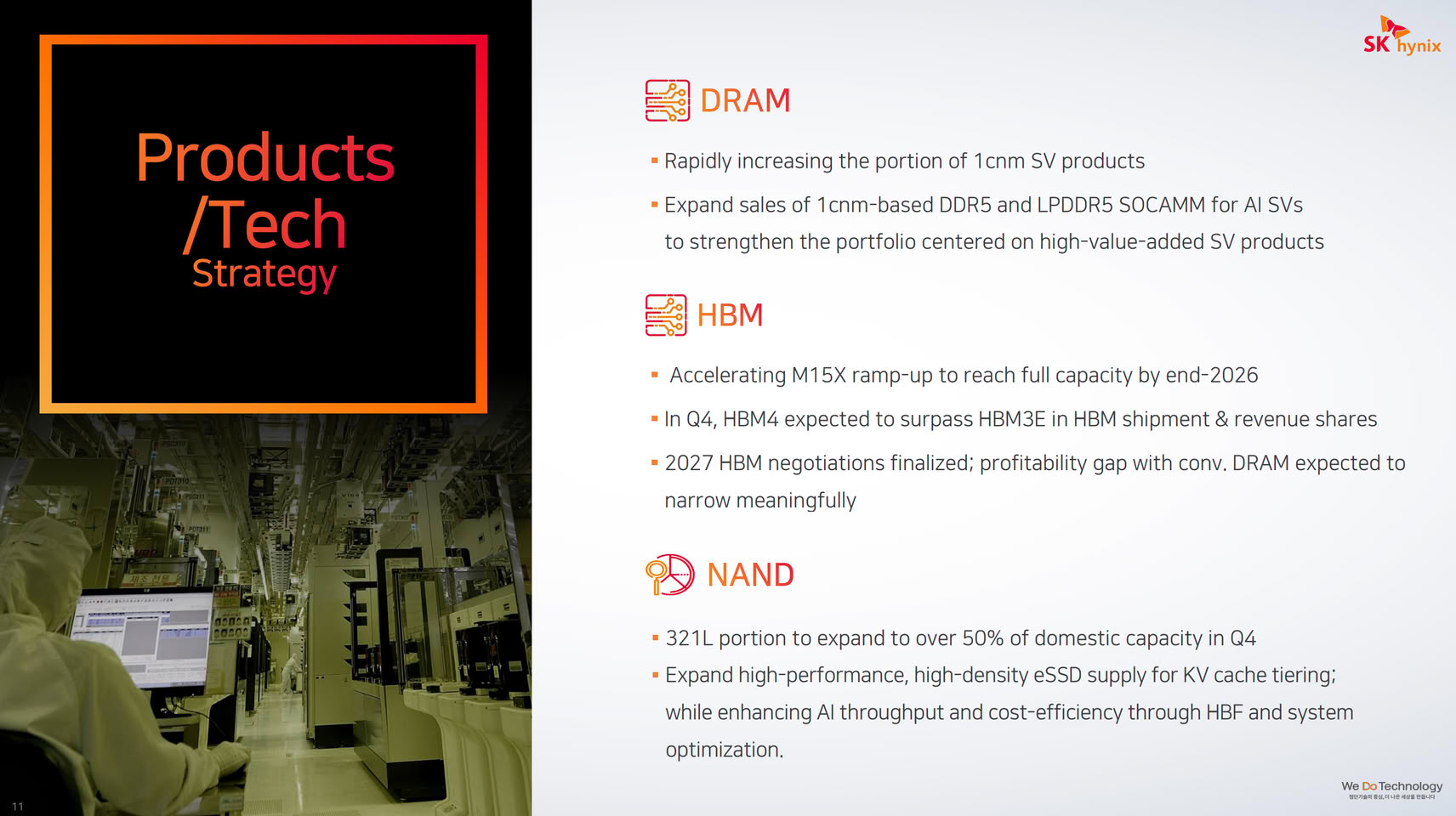
SK hynix plans to raise output at the South Korea M15X fab to the highest level before year-end, expanding HBM4 production. It expects HBM4 shipments and revenue to exceed HBM3E in Q4 2026, making the newer generation gradually mainstream.
In traditional DRAM, it will increase the share of products using sixth-generation 10-nanometer-class technology, known as 1c, while expanding DDR5 and LPDDR5 SOCAMM sales for AI servers. In NAND, it plans to lift the production share of 321-layer flash to increase supply of high-performance, high-capacity enterprise SSDs.
These moves can ease future supply pressure, but they will not fully change the market in the short term. SK hynix expects DRAM and NAND demand to keep growing in 2027. Because capacity is limited by fab build cycles and advanced process constraints, additional output may still be absorbed by strong demand.
Long-term agreements: protection for some, exposure for others
To reduce operating risk from demand swings, SK hynix has expanded long-term agreements with major customers. It says 14 main customers have signed such agreements, including global cloud service providers. The contracted volume equals more than 50% of total 2027 and 2028 capacity. Some contract terms are about five years.
These agreements help customers reserve supply in advance and help SK hynix plan equipment, fab construction, and capital spending. They also give the company more predictable visibility into future orders. However, they do not guarantee stable allocation for every consumer-market buyer. Large cloud providers and AI chip companies can lock in substantial capacity; personal computer makers, phone manufacturers, and retail channels may remain exposed to leftover supply and price swings.
Comparison: where the squeeze is likely to be felt
| Product segment | Demand driver | Supply pressure | Planning implication |
|---|---|---|---|
| HBM4 | AI accelerators, data center bandwidth, advanced packaging | High; stacking and packaging make it difficult to ramp quickly | Expect early allocation for large AI infrastructure buyers |
| DDR5 server memory | Larger models, server refresh, AI data pipelines | Medium to high; wafer and advanced process competition | Watch lead times and pricing for server platforms |
| LPDDR5 SOCAMM | AI server memory products and power-sensitive server workloads | Medium; shares manufacturing and packaging priorities | Validate compatibility, supply commitment, and platform timing |
| 321-layer enterprise SSD | Data center storage capacity and performance | Medium to high; advanced NAND layer count and capex | Plan enterprise storage refresh around availability, not list price |
| Consumer PC and phone memory | Device refresh and retail demand | Indirectly affected by wafer, packaging, and capital allocation shifts | Monitor configuration changes and base-storage pricing |
Common misconceptions
- The forecast that supply shortage may persist through 2030 does not mean every memory product will keep rising in price for the next four years. Different memory types can move in different directions.
- Consumer devices are not automatically insulated from AI memory pressure. When HBM and server products use more wafer, packaging, and capital resources, traditional DRAM supply can still feel indirect effects.
- Long-term contracts by 14 major customers do not guarantee retail availability or stable component pricing for all downstream manufacturers.
- Q4 2026 HBM4 overtaking HBM3E is a product transition signal, but it does not mean HBM3E demand disappears or that older platforms are immediately obsolete.
- The 1c node, 321-layer NAND, and LPDDR5 SOCAMM roadmap are not merely technology labels. They indicate where manufacturing resources, qualification cycles, and future capacity will be concentrated.
FAQ
Is this only a corporate results story?
No. The revenue, margin, and product mix reported by SK hynix show how AI-related memory is now shaping semiconductor investment, packaging capacity, and customer commitments. That affects design decisions and procurement risk.
Why can capacity not respond immediately?
Advanced DRAM development is harder, and new fabs require construction, clean rooms, equipment installation, process tuning, and yield ramp-up. Even strong capital spending cannot convert into sellable supply in the next quarter.
Does the 2030 shortage outlook mean all memory will be scarce?
No. The outlook is structural, not uniform. Expansion pace, competitor investment, customer procurement plans, AI adoption, and product differentiation can create very different results for HBM4, DDR5, enterprise SSD, LPDDR5, and consumer memory.
What should product teams watch most closely?
Watch the capacity and contract signals: M15X ramp, sixth-generation 10-nanometer-class 1c DRAM share, 321-layer NAND production ratio, HBM4 versus HBM3E transition, and whether long-term agreements continue to absorb a large share of 2027 and 2028 output.
Action recommendations for Electronicseng procurement and engineering teams
- Separate AI memory demand from general memory demand in forecasts. HBM4, DDR5 server memory, and 321-layer enterprise SSD may be pulled by different customers and different capacity constraints.
- Treat 2027 and 2028 as allocation years rather than merely price years. More than 50% of that capacity is already linked to long-term agreements, and contract terms around five years can move volume out of the spot market.
- Review bill-of-materials exposure around sixth-generation 10-nanometer-class 1c DRAM, LPDDR5 SOCAMM, DDR5, and NAND at 321 layers. These nodes are not only performance choices; they are capacity and supply-risk choices.
- Build product-cost scenarios for HBM4 ramping past HBM3E in Q4 2026. Accelerator platform changes can affect memory pricing, board design, and qualification timing.
- For consumer products, monitor indirect effects. Even if a personal computer does not use HBM, wafer, packaging, and capital allocation shifts can influence component cost and base configuration decisions.
- Keep supplier planning tied to reported signals from SK hynix and comparable market updates, especially South Korea fab activity, advanced packaging needs, and long-term customer commitments.
The key lesson for the Electronicseng audience is that SK hynix's record quarter is not simply a company milestone. It is evidence that AI has changed the semiconductor value chain from a cycle of temporary shortages into a longer-duration capacity problem. If AI investment continues to broaden, memory suppliers will keep prioritizing HBM, server DRAM, and enterprise SSD. If investment slows or new capacity lands together, market balance can still change. For now, the more useful planning assumption is not that memory will be cheap again next quarter, but that supply discipline, technology transition, and customer contracts will shape the market well beyond 2027 and through 2030.