
STM32 Platform Adoption Guide: Choosing STM32A, STM32G5 and STM32H7P Without Rebuilding Your Software Stack
Electronicseng — Semiconductors desk, by Rachel Williams
Short answer: judge STMicroelectronics' latest STM32 wave on reuse, not on raw specs. The company has folded STM32A, STM32G5, STM32H7P and a redesigned edge AI toolchain into one platform, so the real engineering question is which layer of your existing code, tools and IP carries across automotive, industrial and robotic nodes. Below you will find a selection table, a six-step adoption path, sizing notes for digital power, and the pitfalls that actually bite in migration projects.
What changed on the roadmap — and what it means for your next design
“There are two rapidly growing markets today, cloud AI and physical AI, and it is our duty at ST to make sure that the STM32 platform will be the king of the microcontroller market in cloud AI and physical AI,” said Remi El-Ouazzane, president, microcontrollers, digital ICs, and RF products group at STMicroelectronics, answering a question posed by EE Times at the company’s global press briefing.
For a design team, the news is less about part numbers than about where engineering effort now has to go. Maria Erez, executive VP of STMicroelectronics’ embedded processing subgroup, describes the unified STM32 microcontroller platform spanning industrial, automotive, and robotics applications as a way for customers to reuse existing software, development expertise, and manufacturing investments across product generations and application domains. El-Ouazzane sees convergence running across automotive, industrial, and other domains in AI, security, safety, connectivity, sensing, and control.
“Across many applications, the challenge for customers and developers is shifting from selecting a single device to finding ways to reuse software, tools, architectures, and engineering expertise across multiple products and evolving requirements,” El-Ouazzane said. “In other words, the value is shifting from the individual MCU to the broader platform surrounding it.”
The new additions to plan around:
- STM32A — automotive and high-safety MCU portfolio, with the first three devices sampling and broader availability planned in 2027.
- STM32G5 — mixed-signal MCU series for digital power and motor control, already in production.
- STM32H7P — high-performance part pairing a Cortex-M7 core with ST’s proprietary neural processing unit (NPU).
- Redesigned edge AI development tools — Model Zoo, Model Factory, Dataset Factory and on-board test tooling.
- STM32Cube for agentic AI — a model context protocol (MCP) server that exposes STM32 knowledge, resources and validated reference code to AI agents.
Ecosystem scale is a support-risk variable you can price in. Erez put the base at nearly 2 million unique developers, with active users grown by around 20% over the past three years; the company also states that more than 100 billion devices use Arm Cortex-M cores.
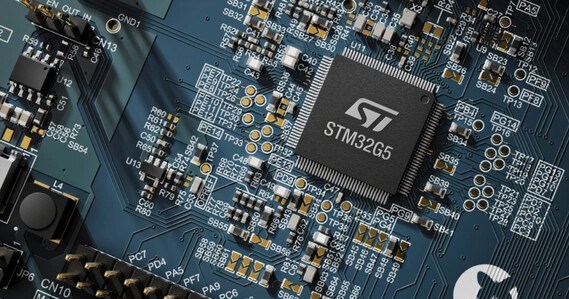
Source: STMicroelectronics
Which device goes where: a practical mapping table
Read this as a mapping exercise rather than a datasheet digest. The selection driver in the new STM32 generation is which constraint binds first — certification, control bandwidth, or inference throughput.
| Device | Where it fits | Silicon that decides the choice | Availability to design against |
|---|---|---|---|
| STM32A4 | Entry-level automotive local control nodes and safety systems | Shares the STM32Cube ecosystem; Cortex-M cores, timers, clock sources, analog and power-management IP are reusable across domains | First of the first three devices in sampling; broader availability in 2027 |
| STM32A5 | Mid-range safety-critical work in industrial automation, robotics, energy systems and automotive | Certification path is still market-specific: automotive is commonly assessed under ISO 26262 and its ASILs | Sampling with the STM32A debut tranche |
| STM32A9 | Safety-critical, multi-domain control where real-time control, low latency, Ethernet and deterministic communication are essential | Deterministic communications plus safety mechanisms; both STM32 and STM32A sit on the same STM32Cube ecosystem | Sampling; ST plans broader availability in 2027 |
| STM32G5 | Digital power and motor control: data centers, robotics, photovoltaic installations, wind turbines, industrial drives, commercial drones | Cortex-M33 at 280 MHz with twice the compute performance of the STM32G4 series, a 12-channel high-resolution timer, PLAy programmable logic, Arm TrustZone, an immutable root of trust and ST’s post-quantum cryptography (PQC) libraries, targeting Platform Security Architecture (PSA) Level 3 | In production; 64 Kbytes to 512 Kbytes of on-chip flash, QFN32 to LQFP128, starting at $1.034 for orders of 10,000 pieces; dual-core variants planned for 2027 |
| STM32H7P | Perception plus actuation on one die — the arc-fault, predictive-maintenance and vision-control class of work | Cortex-M7 core combined with ST’s proprietary NPU for AI processing | Volume production from early 2027 |
How to reuse software across automotive and industrial in six steps
The sequence below assumes you are migrating an existing product family, not starting from a clean sheet. Breaking the order is where most of the rework comes from.
- Inventory assets against the STM32Cube ecosystem before touching a part number. Log which drivers, HAL layers, RTOS abstractions, control loops and test benches you own. That register tells you how much of the platform promise you can actually bank.
- Freeze the safety concept first. Industrial and automotive products must meet different functional safety standards and qualification requirements. ASIL levels under ISO 26262 and SIL levels under IEC 61508 are derived from different risk parameters and are not interchangeable by simple lookup; the mapping is a system-level exercise (see the comparison in Conclusive’s SIL vs ASIL vs PL note and the peer-reviewed mapping study in the Journal of Risk Research).
- Bank the reusable silicon blocks. ST says Cortex-M cores, timers, clock sources, analog components and power management can be reused across domains, which is what makes a shared control library realistic.
- Re-base your memory and process assumptions. Future STM32 products will be built on ST’s 40-nm flash technology and 18-nm fully depleted silicon-on-insulator (FD-SOI) technology with embedded phase-change memory, supplemented by TSMC’s embedded non-volatile memory (eNVM) technologies. ST’s own whitepaper on 18 nm FD-SOI with embedded PCM frames the shift as a density, performance and cost balance rather than a frequency bump — so plan flash budgets and endurance margins, not just clock speed.
- Choose the memory and package ladder deliberately. With STM32G5 spanning 64 Kbytes to 512 Kbytes of on-chip flash and packages from QFN32 to LQFP128, starting at the bottom of the ladder to save cents typically forces a layout respin when model data or fault logs grow.
- Write the security lifecycle into the migration plan. STM32G5 carries Arm TrustZone, an immutable root of trust for secure boot and firmware updates, and support for ST’s PQC libraries. Verify which algorithm families the stack implements: NIST finalized its first three post-quantum standards — FIPS 203, FIPS 204 and FIPS 205 — on 13 August 2024, and product security roadmaps are now measured against those documents.
How to size a STM32G5 power stage for AI racks and motor drives
“This new generation of microcontrollers addresses the challenge to meet the growing energy needs of AI data centers efficiently, realize more sophisticated humanoid robots, and power more complex motor-control systems,” said Patrick Aidoune, general manager, general purpose and automotive microcontrollers division at STMicroelectronics.
ST’s own numbers frame the problem: GPU clusters are driving rack power toward 1 MW, and the largest data centers could demand more than 2 GW of peak power by 2030. Independent infrastructure reporting is consistent — NVIDIA documents its 800 VDC architecture as supporting racks from 100 kW to over 1 MW on the same power infrastructure, and Schneider Electric described an 800 VDC sidecar as the first step toward 1 MW IT racks in October 2025. ST’s own 800 V HVDC material describes server power stages in the 6 kW to 18 kW band, which is where this class of MCU control lands.
On the control side, ST says STM32G5 is the first MCU with the company’s enhanced 12-channel high-resolution timer. Equipment makers can use it to reconfigure power supply units dynamically as server workloads change, and the timer also lets the MCU handle the higher switching frequencies of power supplies built with silicon carbide (SiC) and gallium nitride (GaN).
Sizing note (this is analysis, not a vendor claim): wide-bandgap designs commonly split by bus voltage and frequency — GaN where the loop pushes into the MHz class, SiC where the bus exceeds roughly 650 V (see this SiC vs GaN decision framework). As switching frequency rises, PWM resolution and dead-band granularity, not core clock, become the binding constraint, so verify timer resolution at your target frequency before committing a topology to a single MCU.
Mixed-signal flexibility is the other reason to look at this series: the programmable logic array, PLAy, lets developers implement custom hardware functions on chip. Robotics company Ruiyan Intelligent is using the STM32G5 in its next-generation robotic hands. “In humanoid robotics, dexterity depends on combining strength, precision, sensing, and real-time control in an extremely compact space,” said Paul Tian, CEO of Ruiyan Intelligent.
What to check before you commit inference to an MCU
The hardware answer arrives with STM32H7P, which combines a Cortex-M7 core with ST’s proprietary NPU and enters volume production in early 2027. Aidoune said one alpha customer working on solar inverters moved from managing arc-fault circuit breakers across four panels to 20 panels using a single MCU.
The tooling answer is already shipping. ST began rolling out new and redesigned edge AI tools at the end of October, including Model Zoo for finding models, Model Factory for customizing and optimizing models, Dataset Factory for organizing datasets, and tools for basic model testing on ST boards; the company says it offers more than 400 pre-validated models and has supported more than 260,000 active projects with its AI tools over the past 12 months. ST’s position is blunt: deploying AI models on MCUs depends far more on development tools than on computing power.
Two practical guardrails before you schedule a model onto a Cortex-M part:
- Calibration data quality dominates accuracy. With post-training quantization, a converter that is not given a representative dataset falls back to dynamic-range quantization — weights at INT8, activations still in float — which silently changes your memory and latency profile (documented in this STM32Cube.AI conversion walkthrough). Calibrate on field sensor data, not on the public training set.
- Anchor expectations on published latency. ST’s Cube.AI model performance tables put MLPerf Tiny image classification at roughly 43 ms and anomaly detection near 1.2 ms on a 280 MHz H7-class part. Treat those as order-of-magnitude budget figures for CPU-only inference, and as the reason an NPU changes what fits inside a control loop period.
For workflow, STM32Cube for agentic AI gives AI agents access to STM32 knowledge, resources, and toolkits through a model context protocol (MCP) server, while providing validated reference code and STM32 code generation and review tools. Aidoune positioned it alongside an existing assistant: “STM32 Sidekick helps answer developers’ technical questions, while STM32Cube for agentic AI integrates into the coding workflow itself.” El-Ouazzane was careful not to call that finished: “Today’s announcement of STM32Cube for agentic AI is a step in the right direction, but there is more we can do,” he said, adding that ST needs to strengthen its MCU portfolio with single-core and multicore devices, different security levels, and different types of accelerators, peripherals, and memory.
Asked by EE Times China whether the industry is heading toward a computing power race, ST said its ecosystem will be its biggest differentiator, and expects multicore architectures to become a trend within the cost constraints of the microcontroller category. The company defines physical AI as a subset of edge AI: systems that perceive, decide, and act in the physical world, with actual movement through components such as joints and actuators — the area where convergence between automotive and industrial applications is strongest. “The industry needs less fragmentation and a stronger focus on helping MCU technologies converge around a common foundation, while maximizing software reuse,” El-Ouazzane said.
How the Arm partnership changes your planning horizon
Through its longstanding partnership with Arm, STMicroelectronics says it will help define the future Cortex-M processor roadmap, aiming to set up a common foundation for embedded systems, with early access to Arm cores to optimize its platform against that roadmap. Erez credits STM32 with helping drive Cortex-M adoption.
The structural piece to watch is Arm’s Total Design program for physical AI, announced in September, through which ST is working with more than 100 ecosystem companies; Arm names STMicroelectronics and Cadence as key partners. “Now, we want the entire industry to adopt it,” said a company spokesperson during the Q&A session, referring to the Cortex-M roadmap.
“The next major frontier for computing is bringing intelligence into the machines that move, manufacture, and operate in the physical world,” said Drew Henry, executive VP, physical AI at Arm.
For procurement, that translates into one planning rule: if your instruction-set assumptions are set three product generations out, an MCU vendor that co-defines the Cortex-M roadmap lowers the odds that your software investment is orphaned.
Three misconceptions that derail STM32 platform migrations
Misconception 1: a unified platform means one binary across markets
Process technologies and IP such as Cortex-M cores, timers, clock sources, analog components, and power management can be reused across domains, but safety certification requirements still differ by market. Reuse applies to architecture and tooling; it does not transfer a certificate.
Misconception 2: STM32A is a separate product line to evaluate on its own
“This is about continuity,” Erez said. “STM32A is not a separate story. It is an extension of the STM32 platform strategy, which we plan to continue and expand.” Customers choosing its Stellar automotive MCUs or STM32A have different application requirements, the company said, and ST also sees more automotive companies moving into humanoid robotics, citing commonalities in functional safety and architecture.
Misconception 3: MCU-class AI is decided by accelerator throughput
ST’s stance is that tooling, not computing power, gates deployment. A team that budgets for dataset preparation, model conversion validation and on-target testing will ship; a team that budgets for TOPS alone usually stops at a demo.
Six pitfalls to budget for in advance
- Calendar risk on the new families. STM32A’s first three devices are sampling with broader availability planned in 2027, STM32H7P reaches volume production in early 2027, and STM32G5 dual-core products are slated for 2027. Do not anchor a launch to a part that is not in broad supply.
- Treating list price as a volume model. The STM32G5 entry point of $1.034 applies to orders of 10,000 pieces; small-run programs need their own cost line.
- Assuming ASIL and SIL map directly. They are computed from different risk parameters, so cross-domain reuse of a safety case requires re-qualification work.
- Overselling PLAy. It implements custom hardware functions on chip; it is not a replacement for external logic where pin-level parallelism or high gate counts are required.
- Skipping on-target validation. Test latency, accuracy and memory on ST boards before sizing flash — model footprints grow faster than datasheet margins.
- Under-specifying the security lifecycle. Boot, firmware update and key management need to be designed together if PSA Level 3 and PQC support are in your roadmap.
FAQ: questions engineers ask before committing
Does STM32A replace Stellar for automotive programs?
No. ST says customers choosing its Stellar automotive MCUs or STM32A have different application requirements, and both are supported by the STM32Cube ecosystem — the split is by application, not by generation.
Can software work start before STM32H7P hardware ships?
Yes, and ST is explicitly betting on that path: the edge AI tool chain went out at the end of October, ahead of volume production in early 2027, so model selection, dataset preparation and code generation can be front-loaded.
Which STM32G5 variant should a first prototype use?
Take the middle of the flash range rather than the minimum. The series spans 64 Kbytes to 512 Kbytes, and most respins in this class of design come from firmware, log and model storage outgrowing the smallest option.
Do I need post-quantum crypto on an MCU today?
Design for it if your product has a long field life or a secure-update path. STM32G5 already supports ST’s PQC libraries, and the reference framework is the NIST FIPS 203/204/205 set finalized in August 2024.
What is the single biggest risk to escalate?
Fragmentation. El-Ouazzane’s stated requirement for the industry is fewer splits and a common foundation that maximizes software reuse — which means vendor platform breadth, not device price, is the variable to defend in a sourcing review.
Action plan: the first 90 days
- Weeks 1–2 — asset audit. Map drivers, control libraries, and test benches to the STM32Cube ecosystem; list what is portable and what is board-specific.
- Weeks 2–4 — constraint triage. Assign each product line its binding constraint: certification (STM32A class), control bandwidth and timer resolution (STM32G5), or inference in the loop (STM32H7P).
- Weeks 4–8 — proof on production parts. Build the power-timing or inference path on STM32G5, which is already in production, and record PWM resolution and dead-band behaviour at target switching frequency.
- Weeks 6–10 — tooling pipeline. Stand up a dataset-to-target flow using Dataset Factory, Model Factory and Model Zoo, with representative calibration data and on-board test.
- Weeks 8–12 — dual-sourcing and lifecycle review. Confirm supply status for the parts you intend to design in, document the safety-qualification delta per market, and sign off the security update architecture.
Reference sources
- NIST Computer Security Resource Center — approval of the first three post-quantum cryptography FIPS standards, 13 August 2024 (https://csrc.nist.gov/news/2024/postquantum-cryptography-fips-approved)
- NVIDIA Developer Blog — 800 V HVDC architecture for AI factories, rack power from 100 kW to over 1 MW (https://developer.nvidia.com/blog/nvidia-800-v-hvdc-architecture-will-power-the-next-generation-of-ai-factories/)
- Schneider Electric Data Center Journal — “The 1 MW AI IT rack is coming, and it needs 800 VDC power”, October 2025 (https://blog.se.com/datacenter/2025/10/16/the-1-mw-ai-it-rack-is-coming-and-it-needs-800-vdc-power/)
- STMicroelectronics whitepaper — maximizing MCU performance with 18 nm FD-SOI and embedded phase-change memory (https://content.st.com/whitepaper-embedded-nvm-for-high-performance-mcus-z11-6770.html)
- STMicroelectronics blog — 800 V HVDC for AI data centers and server power stages (https://blog.st.com/800-v-hvdc-data-center/)
- ST wiki — STM32Cube.AI model performance benchmarks on STM32 parts (https://wiki.stmicroelectronics.cn/stm32mcu/wiki/AI:STM32Cube.AI_model_performances)
- Hubble community guide — STM32Cube.AI TensorFlow conversion and quantization fallback behaviour (https://hubble.com/community/guides/how-to-use-stm32cube-ai-to-convert-a-tensorflow-model-for-stm32/)
- Conclusive — SIL vs ASIL vs PL functional safety levels compared (https://conclusive.tech/glossary/sil-vs-asil-vs-pl-functional-safety-levels-compared/)
- Journal of Risk Research — mapping IEC 61508 hardware safety integrity for elements developed to ISO 26262 (https://www.tandfonline.com/doi/full/10.1080/09617353.2024.2343959)
- Cosolvic — SiC vs GaN decision framework for power electronics (https://cosolvic.com/blog/sic-vs-gan-power-semiconductor-decision-guide-2026/)