
Electronicseng Semiconductors: Synaptics Astra SR200 Series Tiered Memory for Edge AI MCUs
For semiconductor teams evaluating edge AI microcontrollers, Synaptics Astra SR200 Series is relevant because it reframes MCU selection around on-device multimodal inference, tiered memory and power-constrained always-on operation. Instead of treating hundreds of megabytes as cloud infrastructure territory, the series integrates AI-native compute and custom DRAM so larger models and richer voice, vision, audio, motion and contextual sensing can remain on the device.
Why Electronicseng views SR200 as a platform shift
Conventional MCUs often reach limits when on-chip memory and compute are fixed, while SR200 attempts to expand that envelope. At Synaptics Tech Day in San Jose on Oct. 20, 2026, CEO Rahul Patel called the chip an xMCU because multiple compute dimensions sit on one piece of silicon; he also positioned Synaptics as a processor company at the edge.
Compute architecture: three tenets and first Arm pairing
John Weil, VP and GM for IoT and Edge AI Processor Business, said the move rests on three fundamental tenets. “Synaptics went down this path to enable edge AI-capable devices with always-on low-power modes and a greater compute envelope found in entry-level microprocessor units,” he said.
As the industry’s first pairing of Arm Cortex-M85 and Cortex-M52 cores, the MCU combines high-performance compute, up to 400 GOPS of AI acceleration, 256 MB custom DRAM, vision and audio capabilities, and hardware-rooted security. It runs CNN and transformer workloads using Synaptics’s Torq NPU and Google Research’s Coral NPU.
Weil framed the core strategy directly: “Synaptics brings a variety of Arm cores from an ultra-low-power domain to a high-performance domain,” and added, “This allows engineers to pick exactly the compute level they want.” In his account, that core selection plus tiered memory is what lets a single device combine modalities such as voice, vision, audio, motion and contextual sensing and respond to them in real time.
“We have put a lot of time and effort into bringing high-performance and efficient compute to a low price point and low power point,” Weil said. “But we also invested heavily in memory architectures that were designed to feed CPUs and NPUs more efficiently.”
Memory tiers as the edge AI bottleneck
Memory architectures are traditionally designed to feed CPUs and NPUs, yet many AI applications are not primarily straining the compute element; they are straining the memory interface hard. That pattern explains why the amount of memory being procured and placed into cloud infrastructure is huge. Traditional microcontrollers once offered hundreds of kilobytes, then megabytes became common, and the discussion now reaches hundreds of megabytes.
Around an on-chip memory architecture, SR200’s tiered memory architecture builds high-performance compute, and it also adds a custom DRAM interface with in-package memory to bring HBM-like high-performance memory to a microcontroller. The tiered memory addresses two problems: it feeds compute cores efficiently, and it supplies an appropriate amount of memory for ultra-low-power, always-on AI processing. That custom-designed memory handles applications such as always-on listening and responds to them simultaneously.
“In this memory-constrained world that we live in right now, it offers design engineers the potential to build really differentiated edge AI devices,” Weil said. “No one else is talking about MCUs having this level of tiered memory architecture and going into the hundreds of megabytes of capacity.”
Power and product tiers
Weil added that SR200 microcontrollers blend high-performance compute with low-power consumption, a trait critical for battery-powered edge devices. The tiered memory architecture also plays a key role in enabling ultra-low-power operation, and feeding the neural processors more efficiently can reduce the device’s power consumption. The SR200 microcontrollers come in three pin-compatible tiers.
| Model | AI acceleration | Target use |
|---|---|---|
| SR210 | 200 GOPS | power-optimized, always-on voice and sensing |
| SR230 | 300 GOPS | mainstream multimodal devices with vision, display, and optional audio |
| SR250 | 400 GOPS | demanding edge applications with dual vision and display paths |
Target applications
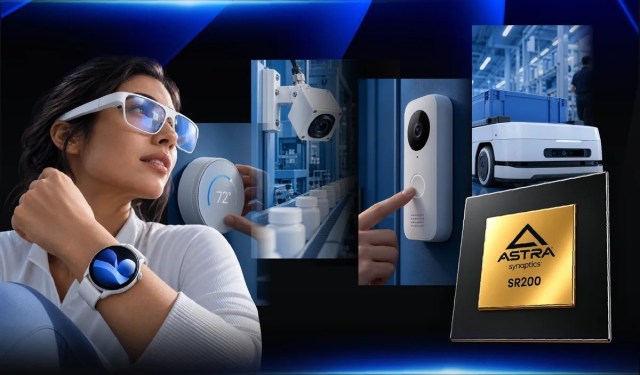
These MCUs target the next generation of AI wearables, battery-powered sensing devices, connected cameras, streamers, and industrial vision and voice systems. Weil said the strongest traction so far has come from body-worn electronics.
Semiconductor evaluation checklist
- Match AI acceleration: 200 GOPS for power-optimized, always-on voice and sensing; 300 GOPS for mainstream multimodal devices; 400 GOPS for demanding edge workloads.
- Check memory tiering: 256 MB custom DRAM and hundreds of megabytes capacity support larger on-device models and always-on processing.
- Review modality needs: vision, audio, display paths, motion and contextual sensing determine whether SR210, SR230 or SR250 is the better fit.
- Inspect power constraints: battery-powered edge devices, wearables and body-worn electronics benefit from always-on low-power modes and efficient NPU feeding.
Key data points
- Event: Synaptics Tech Day, San Jose, Oct. 20, 2026.
- Compute: industry’s first Arm Cortex-M85 plus Cortex-M52 pairing.
- AI acceleration: up to 400 GOPS, with SR210 at 200 GOPS, SR230 at 300 GOPS and SR250 at 400 GOPS.
- Memory: 256 MB custom DRAM in a tiered architecture that extends toward hundreds of megabytes.
Common misconceptions
- Misconception: edge AI is mainly a compute problem. The SR200 discussion states that many AI applications are straining the memory interface hard.
- Misconception: MCU-class memory stops at megabytes. The series moves the discussion to hundreds of megabytes.
- Misconception: high performance and always-on low power cannot coexist in an MCU. Weil described SR200 as blending both, with memory tiers supporting ultra-low-power operation.
Action recommendations
- For always-on voice and power-optimized sensing, prioritize SR210 at 200 GOPS.
- For mainstream multimodal devices needing vision, display and optional audio, evaluate SR230 at 300 GOPS.
- For demanding edge applications requiring dual vision and display paths, assess SR250 at 400 GOPS.
- For battery-powered body-worn electronics, map the chosen tier to always-on listening, contextual sensing and memory capacity needs before platform commitment.
FAQ
What makes Astra SR200 Series different from conventional MCUs?
It pairs heterogeneous, AI-native compute and acceleration with integrated high-bandwidth custom DRAM scalable to hundreds of megabytes, allowing larger AI models and richer multimodal workloads to operate entirely on the device.
Which AI accelerators and cores are used?
The design uses the industry’s first Arm Cortex-M85 and Cortex-M52 pairing, Torq NPU and Google Research’s Coral NPU, and supports CNN and transformer workloads with up to 400 GOPS of AI acceleration.
How many SR200 tiers are available?
There are three pin-compatible tiers: SR210, SR230 and SR250.