
The Grid in Massachusetts: On-Demand Circuit Board Assembly for Hardware and Semiconductor Teams
Today, circuit-board assembly in Massachusetts is being reframed around on-demand output rather than fixed production lines; The Grid is the factory-scale robot that embodies five years of quietly scaled automation.
Why High-Mix Assembly Remains Difficult
For 30 years, the West saw much electronics manufacturing leave domestic production because assembly was labor-intensive. The model placed design in the US and fabrication in China, where labor was cheap. That model worked for decades, but it created a structural gap: many hardware teams still need boards without being able to justify an offshore dedicated line.
Automation is changing the pattern, yet the strongest evidence appears at huge volumes. SpaceX can justify a dedicated line because Starlink dishes are produced by the million in Bastrop, Texas. When one product repeats on a massive scale, setup time is amortized across every unit.
The typical need is not one product repeated a million times. It is ten of one design, a hundred of another, and a revised board next week. Each new design historically added setup and manual changeover work, which is why those boards often went overseas or to quick-turn shops.
How The Grid Routes Work Differently
Instead of a fixed line that must be reconfigured for each product, The Grid functions as one large robot. Levitating movers carry each board and its parts among machines that print solder paste, place parts, reflow, solder, and inspect. AI agents, learned models, and classic optimizers schedule the routing.
That architecture matters for high-mix electronics. If a project contains semiconductor-based modules, the board route can vary design by design without a dedicated line. One unit of 100 different designs can run as easily as 100 units of one design, and prototypes and production batches can share the same machines.
Large companies also face this need. Low-volume boards appear in test stations, tooling, R&D systems, and small production batches. A leading EV maker, a top AI lab, and household-name tech companies already build on The Grid.
A Concrete Cost and Time Comparison
To make the comparison concrete, we priced one example board on The Grid and at a typical quick-turn shop in Shenzhen: a 4-layer motor controller with 118 parts per board (38 unique), five assembled boards, parts included, delivered to a US address.
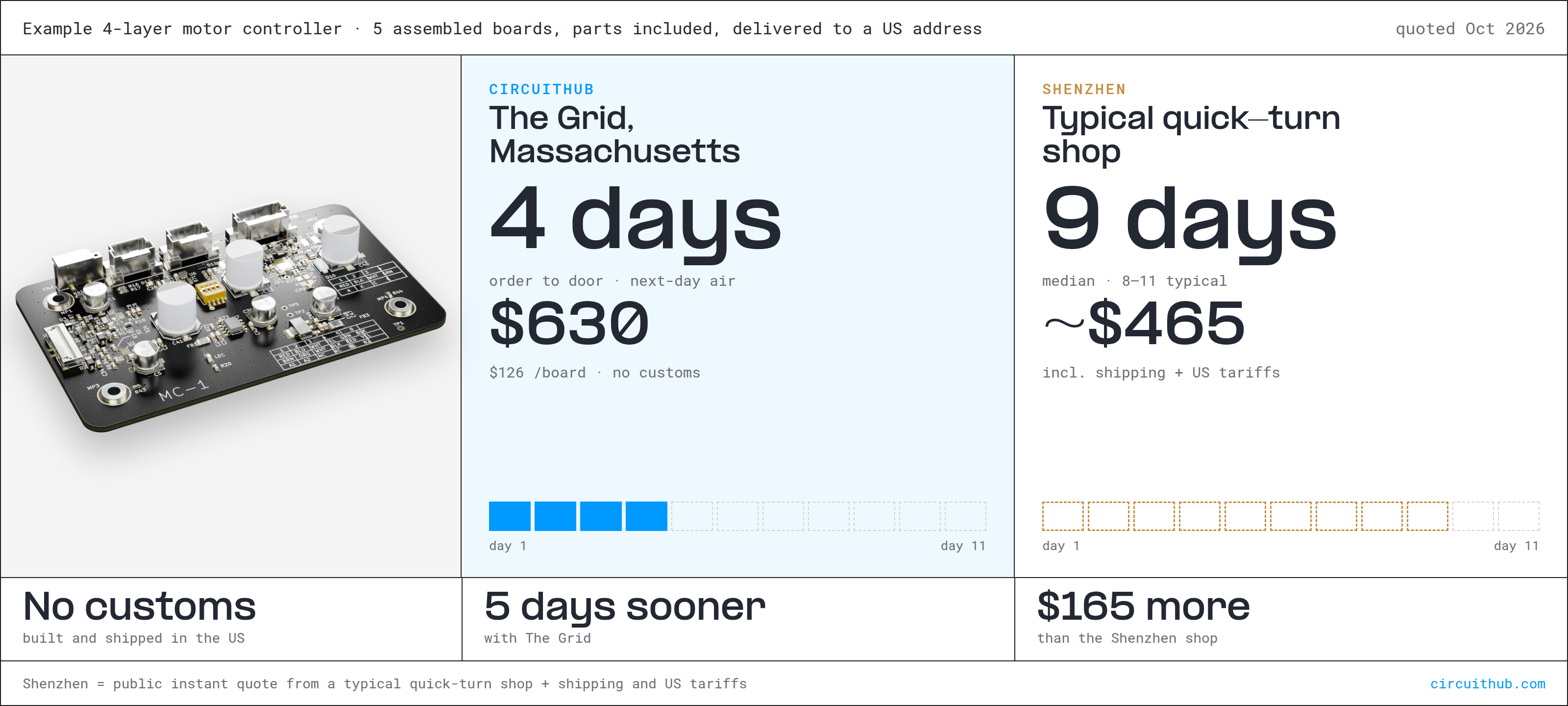
| Path | Time | Cost |
|---|---|---|
| The Grid | 4 days to your door | $630, parts included, no customs |
| Typical quick-turn shop in Shenzhen | 9 days at the median | about $465 after shipping and US tariffs |
Data citation: the 4 days, 9 days, $630, $465, 118, 38, 4-layer, and five assembled boards values come from the example comparison.
For a hardware schedule, the delta is $165 more for 4 days instead of a median 9 days. That is five days earlier, no customs step, and a more predictable route. If engineering iteration is the bottleneck, five days can outweigh $465 saved.
Scale Already Exists, Capacity Is Expanding
The Grid is not a prototype. It has been running for customers for five years and already builds tens of millions of dollars of electronics a year. Across CircuitHub, more than 2.2 million boards have shipped, more than 150 million parts have been placed, and more than 26,000 engineers have been served.
Demand is ahead of available capacity. This year the plan is to 5x capacity, with another big jump coming in 2027. The long-term goal remains unchanged: make building hardware as fast as designing it.
Checklist: When On-Demand Assembly Helps Semiconductor Programs
- Use a comparison when each new board has 100 different design constraints or many revisions.
- Route ten, a hundred, or next-week iterations through machines that do not require per-design setup.
- Price a 4-layer assembly with 118 parts (38 unique) and five assembled boards before choosing offshore quick-turn.
- Compare 4 days and $630 against 9 days and about $465, not just the sticker price.
- Treat $165 as a possible engineering-time trade, because five days can reduce schedule risk.
Common Misconceptions
- Misconception: automation only works when a single product reaches a million units. Reality: The Grid is designed as one large robot that handles many low-volume designs.
- Misconception: only startups need high-mix assembly. Reality: large companies also produce test stations, tooling, R&D boards, and small production batches.
- Misconception: lower price always wins. Reality: the Shenzhen path may be cheaper, but the $165 delta buys five days, no customs, and a more direct US delivery path.
FAQ
Is The Grid a pilot or a production capability?
It is a production capability. It has served customers for five years, builds tens of millions of dollars of electronics a year, and sits inside a record that includes CircuitHub shipments of 2.2 million boards, placement of 150 million parts, and service to 26,000 engineers.
Why has high-mix work resisted automation?
High-mix work often needs ten, a hundred, or next-week changes. Each design historically triggered setup and manual changeover, so dedicated lines could not amortize the effort across many identical units.
When is the faster route worth the extra cost?
When validation, testing, or supplier qualification depends on receiving five assembled boards sooner, the $165 premium can be justified by saving five days against a 9-day median.
Action Recommendations
Hardware and semiconductor teams should first classify boards by volume and change frequency. Designs needing one unit or ten units should not be forced into a dedicated-line model. If a board can be priced as a 4-layer, 118-part, 38-unique assembly, compare the total cost and delivery date before defaulting to China. If you have a board to build, get an instant quote.