
Electronicseng Semiconductors Analysis: NXP S32K5 and RV Tech Zonal Compute in Volkswagen Group’s 2027 SDV Platform
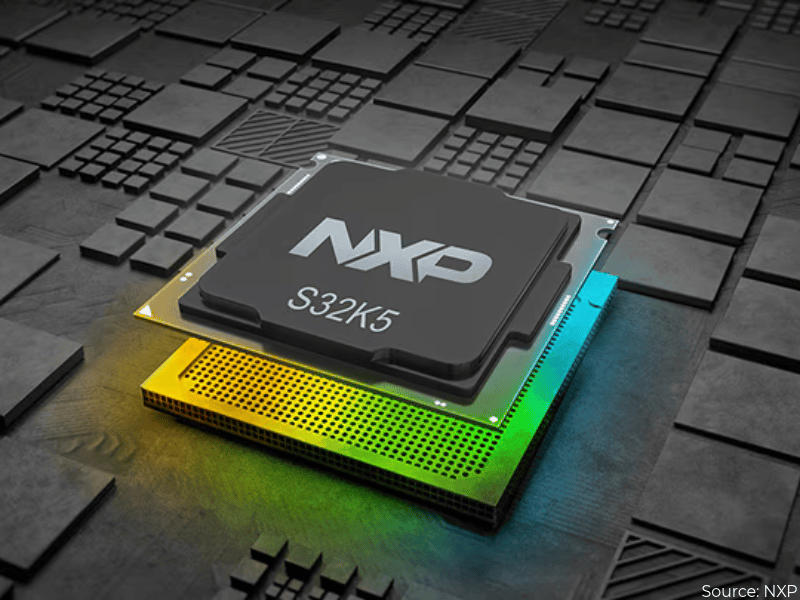
A microcontroller platform choice now has enough architectural detail to guide embedded engineers: Volkswagen Group has extended its engagement with NXP Semiconductors and placed the NXP S32K5 family at the center of its next-generation software-defined vehicle architecture, while the first vehicle is scheduled for 2027.
That disclosure, made ahead of the International Suppliers Fair (IZB) in Wolfsburg, Germany, is relevant beyond the headline. It shows a vehicle OEM working more directly with a chip supplier and standardizing MCU platforms to simplify hardware sprawl, support zonal architectures, and scale common compute patterns across several vehicle brands.
Architecture signal for electronics engineering teams
The NXP S32K5 microcontrollers are not positioned as a one-off controller for a single feature. They are assigned as core processing technology for zonal controllers in the program being developed by Rivian and Volkswagen Group Technologies (RV Tech), the joint venture involving Volkswagen and Rivian.
For engineering teams, the practical meaning is a clearer division of compute: zone-level devices handle distributed vehicle tasks, while central high-performance processors take heavier workloads that need greater throughput.
Checklist: functions assigned by layer
- At the edge of each zone, the MCU fabric links sensors and actuators, moves data across domains, and supports lighting, comfort, chassis, and safety functions.
- Above that layer, central processors absorb higher-performance workloads such as AI-enabled automated driving and advanced infotainment.
- The program aims to support Volkswagen Group brands and vehicle segments plus Rivian vehicles while leaving room for brand-specific feature differentiation.
Why zonal control reduces hardware sprawl
Conventional vehicle designs distribute functions across numerous dedicated electronic control units, or ECUs. A zonal model instead consolidates several functions into fewer controllers. The disclosed direction is to reduce chip count, simplify ECU count, and make vehicle development and component management less fragmented.
Comparison: conventional ECU layout versus RV Tech zonal layout
| Dimension | Conventional ECU layout | RV Tech zonal layout |
|---|---|---|
| Function distribution | Many dedicated ECUs are assigned to separate features. | Several functions are consolidated into fewer zonal controllers. |
| Hardware management | Component sprawl is higher across brands and platforms. | Standardized MCU platforms reduce complexity and improve component management. |
| Compute split | Feature-specific units process local tasks without a common zone layer. | NXP S32K5 devices support zone sensing, actuation, and data handling; central high-performance processors handle heavier AI-enabled automated driving and advanced infotainment workloads. |
| Deployment ambition | Platform reuse depends on supplier-by-supplier hardware choices. | The target is scalability across Volkswagen Group brands and vehicle segments, plus Rivian vehicles, with differentiated features retained. |
Supply strategy and semiconductor positioning
The deal also reinforces a semiconductor strategy built on long-term supplier relationships, technology standardization, and improved supply resilience. By defining requirements earlier and using common components across brands, Volkswagen Group aims to gain economies of scale and greater planning certainty for future vehicle platforms.
For NXP, the selection deepens its role in the automotive SDV market, an area where real-time processing, functional safety, and secure over-the-air software updates are rising in importance.
Executive framing from Volkswagen Group and NXP
Werner Tietz, Volkswagen Group executive committee member responsible for research and development, said: “Our future zonal architecture, developed by RV Tech and supported by strategic technology partners such as NXP, creates a scalable technology foundation for multiple Group brands and vehicle segments. By harmonizing key technologies across the Group, we reduce complexity, leverage scale and accelerate innovation while enabling advanced digital capabilities. This allows us to bring digital innovations to our customers faster and continuously enhance our vehicles throughout their lifecycle,”
Rafael Sotomayor, president and CEO of NXP Semiconductors, said: “Intelligent, software-defined vehicles must operate safely, securely and reliably. Together with Volkswagen Group and RV Tech, NXP is bringing scalable real-time compute, trusted edge intelligence and continuous software innovation together to create a scalable foundation for the next generation of intelligent vehicles,”
Data citation
- Announcement venue: International Suppliers Fair (IZB), Wolfsburg, Germany.
- First disclosed vehicle timing: 2027.
- Group-level strategy frame: Group Target Picture 2030.
- Selected core MCU platform: NXP S32K5.
FAQ for semiconductor decision makers
What is the concrete technical decision?
Volkswagen Group has chosen the NXP S32K5 family as a core processing building block for zonal controllers within its next-generation software-defined vehicle architecture.
Which part of the system does not move to the zonal MCU?
Demanding functions remain on central high-performance processors, including AI-enabled automated driving and advanced infotainment workloads.
Why would engineers care beyond the supplier relationship?
Because the program illustrates how standardized MCU platforms can lower hardware complexity, simplify component management, and enable scalable zonal architectures across brands.
How does this relate to supply resilience?
The disclosed semiconductor strategy emphasizes earlier requirement definition, common components across brands, long-term supplier relationships, and technology standardization.
Common misconceptions
- A zonal controller is not just another ECU name. It consolidates multiple functions into fewer controllers, changing chip count, wiring ownership, and software boundaries.
- Edge compute does not replace central compute. NXP S32K5 supports zone tasks, while central high-performance processors still carry heavier workloads.
- Supply resilience is not only purchasing inventory. It also comes from earlier specification, standardized parts, and longer-term supplier alignment.
Action recommendations
- Map current ECU functions to possible zone consolidation boundaries before selecting an MCU platform.
- Use real-time processing, functional safety, secure over-the-air software updates, and central-processor workload separation as selection criteria for next-generation vehicle platforms.
- Track IZB-adjacent supplier announcements as signals of longer-term platform standardization, not isolated contract news.
The durable engineering lesson is less about one component selection and more about platform discipline: when MCU standardization, zonal partitioning, and earlier supplier engagement are aligned, the result can be lower hardware complexity while preserving brand differentiation.