
Electronicseng General Bench Guide: Tracing RF Paths, Rolling-Code Sync, and Microamp Power Budgets
A keyless fob unlocks a car because a button wake-up launches a short RF exchange: an encrypted rolling-code command is transmitted on a sub-GHz band, validated by a shared key in the vehicle, and executed by the door or powertrain controller. The same chain must fit a 3-volt CR2032, so sleep current, antenna efficiency, counter synchronization, and relay protection decide whether the design is convenient or merely clever.
For an electronics engineer, the fob is not a plastic trinket. It is a mixed-signal, mixed-software system that must release a 4,000-pound vehicle's locks from 50 feet away, survive pocket moisture, tolerate battery sag, and resist a thief with a receiver. The practical questions are not whether it pairs, but where the link budget fails, when the counter drifts, and how much charge every wake-up consumes.
Which architecture blocks should be labeled before you probe a fob?
Before probing, write the functional blocks on a bench note: button input, microcontroller, secure memory or hardware security module, RF transmitter, antenna, matching network, vehicle receiver, body controller, and actuator. That map separates three failures people often blame on the battery: an antenna that has drifted out of tune, a rolling-code counter outside the receiver window, or a receiver that cannot meet sensitivity through the installed car body.
| Architecture variant | What to verify first |
|---|---|
| Standard RKE | Button-to-transmit latency, commanded transmit current, antenna matching, and whether the receiver still accepts the counter after out-of-range presses. |
| Passive smart key | 125 kHz wake-up field strength, response timing, sub-GHz return path, and the vehicle's threshold for treating the handle area as occupied. |
RKE transmitters and passive smart keys are often grouped together, but their test points differ. A button-driven system should be tested from the press edge; a proximity system should be tested from the wake-up field boundary.
What signal path should you trace from key press to door latch?
- Wake. The button interrupts a sleep state. In a disciplined design, the microcontroller may spend its idle time at under 1 µA, so a stray leakage path can ruin the year estimate.
- Encode. The controller forms a packet that usually includes a preamble, command code, check bits, and a rolling value. An Analog Devices technical article puts common digital data rates between 2.4 kbps and 20 kbps.
- Transmit. An RF stage keys a carrier through a small antenna. If the matching network is detuned by a hand, pocket fabric, or metal keychain, range collapses before the security protocol is ever evaluated.
- Receive and verify. A receiver in the vehicle recovers the bits, decrypts them against a synchronized counter, and sends the command to the relevant actuator.
- Close the human loop. Because many designs are one-way at the RF link, the vehicle uses lights, chimes, or a dashboard message to confirm action.
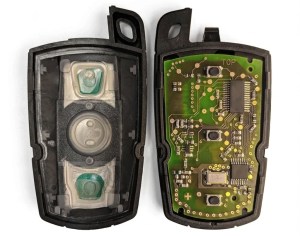
Figure 1: A disassembled remote keyless entry transmitter exposes the internal electronics assembly; image credited to Go Parts.
Why do sub-GHz bands beat 2.4 GHz for reach?
North American products usually sit near 315 MHz, while European products commonly use 433.92 MHz and 868 MHz. These allocations sit away from the congested 2.4 GHz band shared by Wi-Fi and Bluetooth, which reduces co-channel interference and gives the fob a quieter spectral environment. The propagation trade-off is equally important: lower-frequency waves pass through steel, glass, and fabric with less attenuation than 2.4 GHz, which is why the fob can still command a latch when buried in a coat pocket.
The cost is bandwidth. Fob commands are short, though, so throughput matters less than reliable arrival, low transmit duty cycle, and predictable modulation. When debugging, measure received signal strength and demodulated quality separately; a strong carrier with a noisy preamble is a different failure than a weak carrier with clean bits.
How should antennas be evaluated inside a plastic shell?
Within a compact housing, engineers use helical trace antennas or PCB loop antennas tuned to the chosen carrier. The goal is not elegance; it is an acceptable balance of size, cost, robustness, and impedance match. A larger antenna may be more efficient, but a fob must survive drops, keys, hand sweat, and pocket compression, so geometry is usually solved with matching and dual-frequency strategies.
Passive entry adds a second RF domain. Vehicles use low-frequency magnetic coupling at 125-kHz levels to wake the fob when the user touches the handle. This wake-up field is not a long-distance data pipe. It is a local trigger that lets the controller remain asleep until the car is close enough to justify transmitting. The 125-kHz magnetic field and the sub-GHz command path are therefore two different antennas, two different test questions, and two different failure modes.
How do rolling codes and provisioning prevent replay?
Legacy fixed-code remotes had a simple weakness: each press replayed the same bit pattern. An attacker could record it once and transmit it later. Modern keyless fobs remove predictability by changing the code with each use. The historical landmark was KeeLoq, which encrypts a synchronized counter and produces a unique 32-bit encrypted transmission per press. Classical KeeLoq has largely been replaced by AES-128 in newer designs to resist cryptanalysis and side-channel probing, but the synchronization principle remains the same.
The car does not expect a single perfect counter. It accepts a window because users press buttons out of range, and the fob advances without the vehicle hearing every increment. The receiver also discards old values, so a recorded packet cannot be replayed later. In a challenge-response passive system, the vehicle issues a fresh random challenge and the fob answers with a key-derived response. Because every challenge is unique, intercepting one exchange gives an attacker zero useful material for the next valid response.
Provisioning precedes protocol. During manufacturing or dealership pairing, the Vehicle Identification Number indexes or derives the vehicle's unique master cryptographic key. That seed, plus the fob secret, is written into secure EEPROM or a hardware security module. The result binds a physical RF node to the engine control unit and the body control module (BCM). Without that root of trust, the radio is just a short-range announcement machine.
What power-budget checks protect multi-year battery life?
Most fobs run from a single CR2032 with roughly 220 mAh and a nominal 3-volt supply. The design target is often three to five years of reliable service. To meet it, sleep dominates: the microcontroller sips below 1 µA in deep sleep, while a transmit burst can jump to 10–20 mA, a thousandfold increase. If the device remained active for extended periods, the coin cell would be exhausted in weeks.
The measurement workflow should mirror those numbers. Put the fob on a current profiler and record three states: sleep, wake on button, and transmit. Then calculate duty cycle. In a healthy design, the unit spends more than 99% of its life asleep and wakes only for milliseconds. That single metric explains why encryption and RF can coexist with a coin cell.
Passive wake-up improves efficiency again. When the user approaches the door handle, the car emits an inductive 125 kHz field; internal 3D receiver coils capture it and trigger a wake pin. The fob draws zero high-power RF current until the vehicle has physically proved that it is nearby. This is a clean example of power budgeting as system architecture: the expensive radio is reserved for the moment when a response is likely to succeed.
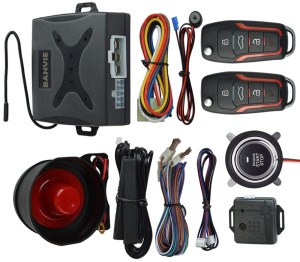
Figure 2: A do-it-yourself aftermarket PKE kit can add keyless entry and push-button start; image credited to Banvie.
Although aftermarket kits advertise do-it-yourself installation, practical integration is not casual: it touches ignition lines, central locking relays, brake-switch signals, and, when an engine immobilizer is present, a bypass module for push-start operation without the physical key inserted. Treat that as a system-safety review, not just a wiring task.
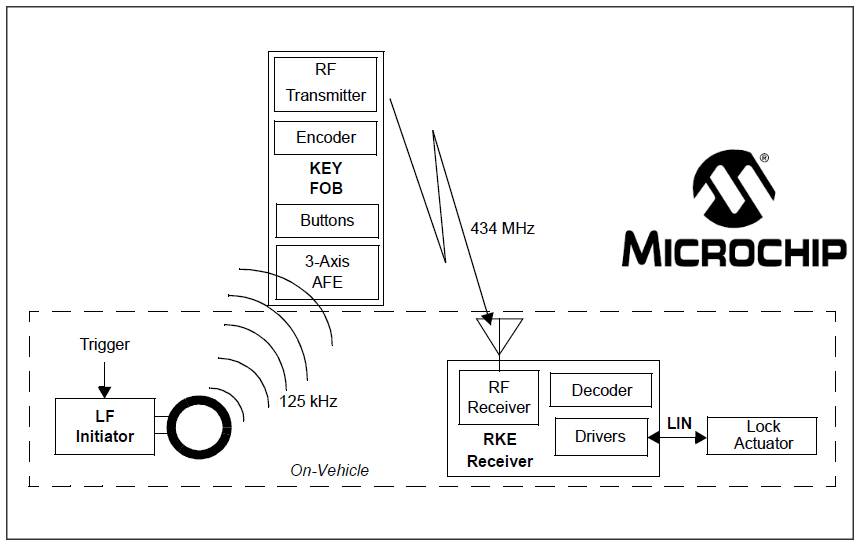
Figure 3: A reference-design signal path exposes PKE hardware blocks; image credited to Microchip.
How should a dead battery be tested as a failure mode?
Modern smart fobs usually include a battery-less backup transponder and a concealed mechanical emergency key blade. If the coin cell fails, holding the fob against the push-to-start button or placing it in the designated backup slot lets the car inductively power and read the transponder, disabling the immobilizer enough to start. The mechanical blade still opens the door. In design reviews, this fail-safe path is a requirement, not a courtesy.
How do relay attacks and UWB change distance testing?
Relay attacks exploit an assumption in many traditional proximity systems: if the RF link closes, the key must be nearby. Thieves extend the car's 125-kHz wake-up field to a fob inside a house, then forward the fob's sub-GHz response back to the vehicle. The car hears a valid answer but has no reliable way to distinguish proximity from an extension chain. The old design question was “is the signal present?”
UWB shifts the question to “is the fob physically here?” The relevant standardization includes IEEE 802.15.4z, an IEEE effort that supports time-of-flight distance bounding. Instead of asking only whether a narrowband packet decoded, the vehicle and fob exchange timestamped pulses. Because speed-of-light timing cannot be improved by relaying, the added capture-and-forward latency becomes measurable, so a relayed exchange fails the range check.
Industry context reinforces this direction. A 2023 Car Connectivity Consortium announcement describes CCC Digital Key as combining NFC, UWB, and Bluetooth Low Energy for vehicle access, with secure distance bounding used to protect against relay attacks. For engineers, that means a keyless design cannot be validated by one radio test alone; the access stack may include BLE for establishment, NFC for fallback, and UWB for ranging.
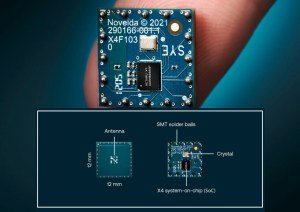
Figure 4: A UWB proximity module combines antenna, SoC, crystal, and solder balls for presence detection; image credited to Novelda.
Bench checklist: how to bring up a fob without chasing phantom bugs
- Confirm band and regulatory fit: 315 MHz for North America or 433.92 MHz and 868 MHz for Europe, depending on target market.
- Measure sleep current and wake current separately; do not average them into a single number.
- Check antenna match with the housing, battery, buttons, and key-ring assembly installed, not only on a bare PCB.
- Validate the rolling-code counter window after 10, 20, or 50 out-of-range button presses.
- Trace the full command flow from fob packet to BCM actuator message; RF decode alone does not prove system behavior.
- Run relay or ranging tests if UWB is used; verify that time-of-flight results reject added forwarding latency.
- Test emergency behavior with a dead coin cell: mechanical key access, transponder start, and any dashboard warnings.
- Document battery sag under transmit load, especially at low temperature.
Common pitfalls that make a working prototype fail in the field
- Assuming 220 mAh means 220 hours: duty cycle, leakage, and transmit duration dominate.
- Tuning the antenna on a clean bench, then discovering detuning when a hand or metal body surrounds the housing.
- Testing only in-range unlocks, so the receiver window and counter recovery never get exercised.
- Confusing standard RKE and passive smart key behavior in requirements, then failing to test the 125 kHz wake-up field.
- Treating UWB as a faster radio rather than a distance proof with security consequences.
FAQ: what engineers usually ask about RF, rolling codes, and microamp budgets
Why does a fob sometimes unlock after I press it out of range many times?
Because the vehicle accepts a rolling-code window. A fob increments its counter even when the car does not receive a packet. The receiver allows a limited forward range so the next in-range press can still work. If the window is exhausted, re-synchronization or re-pairing is required.
Is a sub-GHz fob safer than a Bluetooth design?
Not inherently. Safety comes from rolling codes or challenge-response cryptography, not from the carrier frequency alone. Bluetooth Low Energy can be used as part of a secure digital-key workflow, as described by the Car Connectivity Consortium, while a sub-GHz RKE link can still be weak if it uses fixed codes or poor pairing practice.
How do I verify that a CR2032 will last three to five years?
Measure the sleep floor, wake current, transmit current, and the number of daily events. A single 3-volt coin cell is usually rated around 220 mAh, and a deep-sleep state near 1 µA only preserves life if the device truly remains asleep more than 99% of the time.
What is the point of UWB if AES-128 already encrypts the message?
Encryption authenticates content; UWB distance bounding authenticates location. A relay attack can forward valid encrypted traffic, so cryptography alone does not solve physical proximity. IEEE 802.15.4z-style time-of-flight makes the vehicle ask, in effect, “is the fob physically here?” rather than simply “is the signal present?”
Reference sources
- Analog Devices: Requirements of Remote Keyless Entry (RKE) Systems
- Car Connectivity Consortium: Car Connectivity Consortium and FiRa Consortium partner on UWB technology used in the CCC Digital Key
Take the fob as a compact engineering brief. Ohm's Law bounds the coin-cell budget, Maxwell's equations shape the antenna and propagation path, and synchronized cryptography decides whether a packet means access or merely noise. The next time a door unlocks without contact, treat it as a testable chain: frequency, antenna, counter, power, fallback, and distance proof.