
Fraunhofer IDMT lokalRAIN, Retold as an Engineering Case: What a PV Module Can and Cannot Measure | Electronicseng General
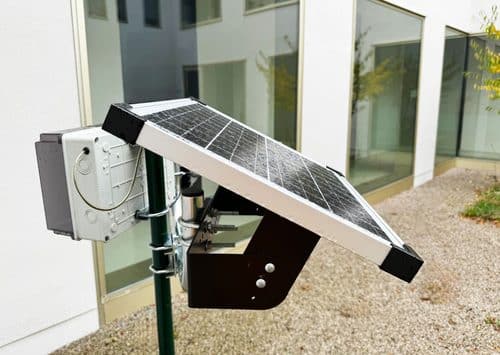
The test setup for precipitation measurement in the courtyard of the Fraunhofer IDMT (image: Fraunhofer IDMT)
Yes, but only inside a narrow band: structure-borne sound sensors bonded to photovoltaic glass, with machine learning running on an energy-efficient microcontroller, can estimate light rain between 2 and 5 mm/h at a mean absolute deviation of 1.88 mm/h. High-intensity rain remains uncharacterised. The useful output of the lokalRAIN case is that operating boundary, not the headline claim.
Read it the way a line engineer reads a new part: the panel already exists, is already mounted, is already grounded to a structure and already has a service route. Everything after that — coupling, calibration, data volume, radio budget — is ordinary engineering work. Below I walk the device chain, the measured results, the failure modes and the commercial position, then close on what is worth watching over the next two rain seasons.
How does the signal chain work, node by node?
The chain is short and deliberately boring: drop impact, elastic wave in the laminate, a bonded sensor, feature extraction and inference on a microcontroller, a compact radio payload, then central analysis. Scientists from the Fraunhofer Institute for Digital Media Technology (IDMT) in Ilmenau mounted structure-borne sound sensors on solar panels to capture the vibrations produced when raindrops strike the surface. Each sensor unit runs a machine learning algorithm locally, and only compact measurement data is sent wirelessly. That is a textbook edge decision; the same memory, latency and update-cadence trade-off is mapped out in our comparison of cloud, edge or hybrid deployment paths for physical systems.
The build is split between two organisations. Pan Acoustics, the project partner based in Wolfenbüttel, created the sensor-node hardware and the wireless transmission technology. Fraunhofer IDMT collects and analyses data from several locations centrally, producing a more detailed picture of local rainfall. Because the sensors have no moving parts, maintenance needs may be lower — a statement about the mechanical bill of materials, not about the whole service contract.
The physical detail that hardware teams should not skip is the coupling layer. A PV module is a laminated plate in a frame, and its transfer function moves with mounting stiffness, temperature, wind load, snow weight and glass condition. The laboratory phase deliberately covered different rainfall rates, drop sizes and photovoltaic modules, which is the correct sequence for exposing that variability before a customer finds it.
What did the field and link results show?
Conclusion first: the system behaves like a calibrated estimator in light rain and like an unproven one everywhere else. The method was first tested with a laboratory rain simulator. The team then installed three outdoor measurement systems at the IDMT courtyard, Pan Acoustics, and the weather garden of the Technical University of Ilmenau. Compared with reference measurements, light rain between 2 and 5 mm/h produced a mean absolute deviation of 1.88 mm/h. Fraunhofer states that this meets Class C of the World Meteorological Organization (WMO) accuracy classification for low rainfall intensities, which permits a maximum deviation of 2 mm/h.
Both numbers need context that a press summary usually drops. The accuracy framework itself sits in WMO-No. 8, the Guide to Instruments and Methods of Observation, which also prescribes siting and exposure rules for precipitation gauges; a Class C envelope is not a certificate granted to a retrofit device. And the comparator carries its own error: peer-reviewed syntheses of tipping-bucket rain gauges document sampling error, wet loss and exposure-driven undercatch, so a deviation figure is a joint property of the new node plus the reference instrument at that site. Co-locate the two, log continuously, and publish the reference model and its calibration interval.
The radio result is a separate lesson in physics. During field trials, the wireless link reached four kilometers in urban settings and over 35 kilometers in rural settings in line-of-sight mode, and each sensor node processes the data before transmission. Roof clutter, multipath and antenna height, not transmit power alone, cut that urban figure. The same site geometry that decides whether a city array sees the sky — the argument in our note on setting fixed solar panel tilt in dense cities — decides whether a node can keep sight of its gateway.
Why does heavy rain still break the estimate?
Because the scarce input is labelled weather, not silicon. The team still lacks sufficient training and test data for high rainfall intensities, so the accuracy of the system under those conditions has not been established. "We have proven the feasibility of our approach for light rain," said Jakob Bergner, group leader for Smart Acoustic Solutions at IDMT and scientific head of the project.
The mechanism is straightforward to describe and hard to fix. Rising intensity packs impact transients closer together in time, so pulses overlap, the plate response stops behaving like a sum of isolated events, and the counting logic that works in the light-rain band faces a near-continuous stress signal. That part is my analysis of the physics, not a published result. The operational risk that follows is a plausible-looking number: an estimator trained on one region of a distribution tends to answer from that region, so a true downpour can be reported as an aggressive light-rain value instead of an out-of-range flag. Any pilot should require an explicit "outside training band" state and a co-located reference for cross-checking.
Is the same raindrop an energy source or a signal?
It is both, in two different product lines, and the split is instructive. A Spanish research team has publicly described a patented hybrid photovoltaic and triboelectric thin film that, according to a February 2026 EurekAlert release, generated up to 110 volts per impact from a single raindrop in laboratory testing, developed under an ERC Starting Grant project on scavenging energy from the environment. The team frames the result as combining perovskite photovoltaics with a triboelectric layer so that small devices keep running when irradiance collapses. That is an energy-harvesting story with a voltage headline. lokalRAIN is a metrology story with an error-envelope headline. Neither claim transfers to the other, and an integrator who buys the first expecting the second will be disappointed.
Where does the stack sit in the industry chain?
Above the line, the parts are common: transducer, low-power MCU, RF stage, adhesive, mechanical fixture. Pan Acoustics supplies node hardware and the link layer, while aggregation and analytics sit centrally with Fraunhofer IDMT. Below the line sit installers, PV asset owners, weather offices and city utilities, and they buy against warranty terms, lightning and grounding provisions, firmware update paths and data ownership — not against a hundredth of a millimetre per hour.
Demand signals are already visible. Candidate applications include urban digital twins, municipal control rooms and flood monitoring, and according to Fraunhofer, operators of municipal infrastructures and firefighting brigades have expressed interest in a tool for rainfall measurement. The technology is intended to support conventional rain-gauge systems rather than replace them, which is a sensible position: it keeps the node out of the regulated-station market and inside the cheap, dense, unofficial sensor layer.
Common misconceptions to clear before a pilot
- "A 1.88 mm/h deviation means it is a certified rain gauge." It is a measured mean absolute deviation inside one tested intensity band, benchmarked against a Class C envelope for low rainfall intensities.
- "Any module will do." The transfer function depends on laminate, frame, mounting and temperature; the lab programme varied modules for exactly this reason.
- "No moving parts means no maintenance." The service items migrate to adhesive ageing under UV and thermal cycling, connector sealing, and recalibration after any mounting change.
- "Harvesting rain energy and sensing rain are the same feature." One is a charge output per drop, the other is a calibrated inference over minutes; the qualification paths differ.
- "A 35 kilometer radio range is a site result." It is a rural line-of-sight figure; urban performance dropped to four kilometers in the same trials.
A reusable checklist for turning an existing asset into a sensor
- Define the measurement band you can actually validate, and write it into the acceptance test.
- Co-locate a reference gauge from day one; log its make, resolution and calibration date.
- Characterise the host structure per module type, including frame, tilt, mounting torque and temperature range.
- Move inference to the node only if it shrinks the payload; otherwise keep the node dumb and centralise.
- Test the radio at the installation height and antenna position, not on the bench.
- Specify the failure output: what the device says when input is outside the training band.
- Plan housing, UV and sealing as a product task; the localRAIN prototype still needs that work.
- Agree data ownership and retention with the asset owner before the first season ends.
What is the project status, and what should buyers watch?
Project lokalRAIN ran between October 2024 and June 2026 as part of the Central Innovation Program for SMEs (ZIM) in Germany. It produced a prototype that is not yet a marketable product. Further work is needed to improve the housing of the sensor and its electronic components and to perform quality assurance of the system. The next priorities are to collect more data during heavy rains and to test the technology in varying environmental situations. Without that information, the system is a source of additional local rainfall data, not a substitute for traditional rain gauges.
Two throughput curves decide whether this becomes a sellable instrument. The first is the accumulation of heavy-rain hours in the training set, because a single convective season at three sites is a data windfall and a scheduling constraint at the same time. The second is field survival: how many mounted nodes still pass a reference check after one installed year of sun, frost and wind loading. Node assembly can scale quickly once the housing is frozen; calibration hours and weather time cannot. Until those curves steepen, the disciplined procurement position is a co-located pilot inside the light-rain band, budgeted for at least two seasons, with the vendor's out-of-band behaviour written into the contract.
FAQ
Can a solar panel replace a tipping-bucket rain gauge?
No. The stated design intent is to support conventional rain-gauge systems rather than replace them, and the validated band is light rain between 2 and 5 mm/h.
Why is Class C relevant if the accuracy claim is 1.88 mm/h?
Class C of the World Meteorological Organization classification for low rainfall intensities allows a maximum deviation of 2 mm/h. The measured 1.88 mm/h sits inside that allowance, which is why the claim is limited to low intensities.
What stops the method from working in a storm?
Missing data. There is insufficient training and test data for high rainfall intensities, so accuracy in heavy rain has not been established.
What can this be used for today?
Dense local rainfall observation: urban digital twins, municipal control rooms and flood monitoring, where many cheap nodes add spatial detail that a few reference stations cannot.
Is the hardware available to buy?
No. The project ended its run in June 2026 with a prototype; housing improvements and quality assurance of the system are still open work items.
Sources and further reading
- Fraunhofer IDMT, lokalRAIN project page: idmt.fraunhofer.de
- World Meteorical Organization, Guide to Instruments and Methods of Observation (WMO-No. 8): library.wmo.int
- Segovia-Cardozo et al., review of tipping-bucket rain gauge uncertainties and calibration strategies (2023): pmc.ncbi.nlm.nih.gov
- EurekAlert release on a hybrid photovoltaic and triboelectric device generating up to 110 volts per raindrop impact (February 2026): eurekalert.org