
GigaDevice GD32H7 Design-In Guide: Which Variant Fits Servo, HMI and Automation Nodes
By Daniel Lopez · Electronicseng Semiconductors Desk (Electronics & Engineering)
If the node is a joint drive, take the GD32H77R. If it drives a panel, take the GD32H7xD Series. If it runs motion or general control, split between the GD32H7xE series and the GD32H7x9 series. That is the shortest answer to the portfolio GigaDevice unveiled in Munich, Germany on November 10, 2026: four scenario masks grown from one homologous 32-bit die. What follows is about which difference actually saves you board space, code or certification time — and which saving is smaller than it looks.
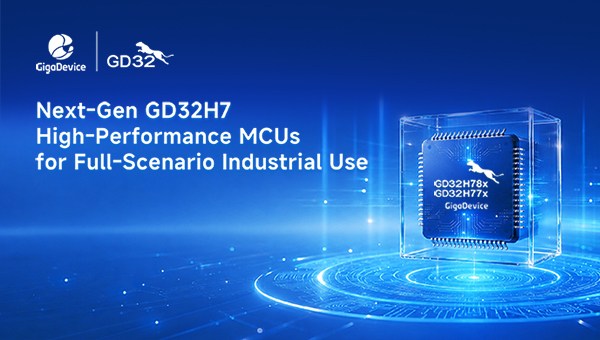
Which GD32H7 part belongs on your BOM?
Conclusion first: the family is differentiated by the interface block, not by silicon class. Every branch shares the same Arm® Cortex®-M7 core, the same memory map, the same toolchain and the same certification evidence, then diverges on what is wired onto the die. GigaDevice states the line targets three core industrial scenarios — industrial HMI human-machine interaction, general industrial automation and robotic servo joint control — so the practical rule is simple: buy the part that replaces a chip you would otherwise have placed next to the MCU.
| Branch | Clock tier | Differentiating silicon | Typical node | First thing to verify |
|---|---|---|---|---|
| GD32H7xR Series (GD32H77R) | 600 MHz(GD32H77x series) tier implied by the 77x naming — confirm against the datasheet before you budget cycles | EtherCAT® slave controller on die plus two integrated 100 Mbps Ethernet PHYs, sub-50 ns transmission latency, FSoE safety protocol, mainstream position-feedback protocol compatibility | Collaborative robot joints, humanoid robot joints, miniature servo drives, high-precision CNC axes | PCB fan-out of the 9mm×9mm BGA169 package and thermal headroom inside the gearbox envelope |
| GD32H7xD Series (GD32H78D/77D) | 750 MHz (GD32H78D) and 600 MHz (GD32H77D) | Native 2-Lane MIPI DSI driving QCIF to XVGA, Image Processing Accelerator, 4 SAI channels, 4 I²S channels, S/PDIF audio | Industrial touch panels, embedded display terminals, control consoles, portable medical HMIs, high-end smart home panels | Which GUI stack your team actually owns: LVGL, emWin, Embedded Wizard or ThreadX GUIX |
| GD32H7xE series (part of GD32H7xE/7×9 Series, GD32H78E/77E) | 750 MHz(GD32H78x series) and 600 MHz(GD32H77x series) | Hardware EtherCAT® slave controller with DC synchronization accuracy up to 62.5 μs, native EnDat, BiSS-C, Tamagawa and HIPERFACE DSL, integrated resolver-to-digital conversion | High-speed multi-axis synchronization, servo control, variable-frequency drives | Whether your encoder suppliers really drop the external signal-conditioning chain |
| GD32H7x9 series (GD32H789/779) | 750 MHz(GD32H78x series) and 600 MHz(GD32H77x series) | 14-bit high-resolution ADC with HPDF high-speed digital filter on top of the universal computing and safety set | Industrial main control units, digital power supplies, industrial gateways, process automation | Analog front-end scaling; the ADC is only as good as its source impedance and reference |
Two notes on the table. The GD32H7xR branch is a single-die device, so there is no drop-in sibling at another clock tier — that is a scheduling constraint, not a spec sheet detail. And the clock naming is consistent across the family: 600 MHz(GD32H77x series) parts and 750 MHz(GD32H78x series) parts sit on the same silicon, which is exactly what makes the reuse argument below credible.
Step 1 — Is 3,736 CoreMark® enough for your loop?
Do not treat the peak number as headroom you own. The family tops out at CoreMark® 3,736 with a peak that corresponds to the 750 MHz(GD32H78x series) parts, which works out to roughly 4.98 CoreMark/MHz — about 1% below the 5.01 CoreMark/MHz scalar performance Arm publishes for Cortex-M7 in its processor datasheet. Read that as a warning and a good sign at once: the number is honest, and there is almost no instruction-level trick left in the core. Performance in this family is bought with clock and with memory access behaviour, not with IPC.
The two levers that actually change your loop rate are the 640 KB of CPU-synchronous Tightly Coupled Memory (TCM), which gives zero-wait instruction and data execution, and the dedicated hardware math engine for trigonometric calculation, FFT and FIR filtering. In a field-oriented control loop, the accelerator tends to free cycles rather than add throughput, so the right experiment is to run the same current-loop binary with the accelerator bypassed and measure the delta. Storage is standardized across the portfolio: 2 MB high-speed executable Flash, 8 MB large-capacity storage Flash and 1.2 MB high-speed SRAM, with dual OSPI interfaces running at a 200 MHz clock in double data rate (DTR) mode for external expansion.
Step 2 — Budget the memory map before you budget the PCB
Decide what lives in TCM, what lives in SRAM and what lives off-die, then choose the branch. On the GD32H7xD Series, the sensible split is control and task code in the on-chip blocks and frame buffers in external Octal memory behind the dual OSPI ports at 200 MHz; the native 2-Lane MIPI DSI interface supports full resolution from QCIF to XVGA, and an XVGA framebuffer at realistic colour depth will not fit in the 1.2 MB SRAM. On the GD32H7xE series, the same TCM becomes the place where the EtherCAT® service loop and the position interpolator must sit, because jitter, not throughput, is the failure mode.
Worth comparing against the alternative silicon strategies now being pushed into the same segment: the industry is quietly reworking embedded non-volatile memory choices, and the way 22-nm MRAM changes the embedded flash budget is one of the more consequential threads in current industrial MCU design. The GD32H7 answer to memory pressure is different — big on-chip SRAM plus fast external execute-capable interfaces — which is a board-level trade you should price before you commit.
Step 3 — Does the communication set match your real cycle time?
Pick the topology first, then count ports. Across the lineup the family provides multiple U(S)ART, I²C, SPI and I²S interfaces, two 10/100 Mbps Ethernet ports and 3 CAN-FD high-speed buses, plus multi-channel high-precision ADC/DAC, comparators, high-speed digital filters, USB HS/FS and SDIO. Operating voltage spans 1.71 V to 3.6 V with multiple configurable low-power modes.
On the motion branches, the numbers deserve a sanity check against the fieldbus reality. Beckhoff's Dr. Guido Beckmann has described typical EtherCAT drive cycle times as sitting between 1 ms and 500 µs, with 62.5 µs reserved for the extreme case of a current control loop closed over the bus, and reported distributed-clock deviations well below 100 ns even in large networks. That is exactly the band the GD32H7xE series targets with DC synchronization accuracy up to 62.5 μs — and the same arithmetic explains why the sub-50 ns transmission latency and the two on-die 100 Mbps PHYs on the GD32H77R matter for a joint: they remove an external PHY and its magnetics routing from a board that has almost no room left. FSoE itself is a black-channel safety transport standardised in IEC 61784-3 per the EtherCAT Technology Group, so it carries safety data over the same cable; it does not supply the safety function.
Encoder interfaces are where BOM savings are most concrete: native EnDat, BiSS-C, Tamagawa and HIPERFACE DSL support plus an integrated resolver-to-digital conversion module removes external signal-conditioning circuits, which matters most in the GD32H7xR and GD32H7xE parts, where the joint or axis card is repeated dozens or hundreds of times per machine.
Step 4 — What the certification package actually covers
The safety argument is the strongest part of this launch, provided you use it correctly. The GD32H7 family has obtained IEC 61508 SC3 (SIL 2/SIL 3) functional safety certification from TÜV Rheinland, supported by safety manuals, FMEDA reports and dedicated self-test libraries. Hardware security covers AES encryption, SHA-256 hash verification, a True Random Number Generator (TRNG) and unique chip UID, with secure boot, authenticated firmware upgrade and anti-rollback mechanisms aimed at the cybersecurity requirements of the EU Cyber Resilience Act (CRA) and mainstream industrial safety standards.
Two practical consequences. First, a component-level certificate is evidence you inherit into your own safety case — it is not a machine-level SIL rating, and a SIL 3 claim in an end product still requires architectural decisions such as 1oo2 redundancy; ST has published exactly that distinction for STM32, where SIL 2 can be reached with a single MCU and SIL 3 needs two. Second, the CRA calendar now collides with this product's ramp: Regulation (EU) 2024/2847 entered into force on 10 December 2024, vulnerability-reporting duties have applied since 11 September 2026, and full application lands on 11 December 2027. A device whose first production run is scheduled for April 2027 will ship its very first year into a regulatory regime that is already live and will face the full obligation within months. Ask the vendor for the security-by-design documentation set now, not at the first audit.
Five pitfalls that show up in GD32H7 design reviews
- Assuming the R branch has a clock sibling. The GD32H77R is presented as a single die in a 9mm×9mm BGA169 package; if your roadmap needs a slower or faster joint controller, confirm availability before you lay out the drive board.
- Buying 750 MHz for a GUI that needs a display pipeline. Panel throughput on the GD32H7xD Series comes from the Image Processing Accelerator, the 2-Lane MIPI DSI interface and external memory bandwidth — clock alone will not fix a dropped frame.
- Confusing FSoE with functional safety. The protocol moves safety data over a black channel; the safety logic and its failure-rate budget stay with the integrator.
- Leaving the math engine idle. The trigonometric, FFT and FIR accelerator is the cheapest way to protect your loop period; benchmark it in your own firmware, not in the vendor demo.
- Planning qualification against the sample date instead of the mass-production date. Full sample availability is targeted for January 2027 while mass production is scheduled for April 2027 — a very tight three-month window between representative silicon and volume silicon.
What does the supply clock look like for 2027?
GigaDevice lists technical support spanning evaluation boards, firmware examples, FOC motor reference projects, joint drive development kits, GUI development kits and the complete functional safety documentation set, with samples and technical materials requested through the company's regional sales channel. Engineering questions on this briefing can be sent to our desk at info@electronicseng.com.
Timing is the real decision variable. The launch itself fell inside the Munich trade week, with electronica 2026 running November 10-13, 2026 alongside SEMICON Europa 2026, and our desk covered that window as an engineering briefing on advanced packaging, APC and fab automation. Buyers should read the sequence — launch now, full samples January 2027, mass production April 2027 — as meaning that a first article build in the second quarter of 2027 is aggressive, and volume shipping of a new joint or panel product realistically lands in the second half. On the vendor side, GigaDevice Semiconductor Inc. is a fabless supplier founded in April 2005 that moved its global headquarters to Singapore in 2025, and it states strategic alliances with leading foundries, assembly and test plants to streamline supply chain management. Its certification record — ISO26262:2018 automotive functional safety ASIL D, IEC 61508 product certification (the 61508 standard), ISO9001, ISO14001, ISO45001 and Duns — is the qualification paperwork you will want in any multi-source review, alongside the fact that GD32 and GigaDevice are trademarks of the company.
FAQ
Can I reuse one codebase across the four branches?
That is the design intent. All branches are built from a homologous silicon die with tailored IP configuration, peripheral optimisation and scenario-specific tuning on a unified chip architecture, with a consistent hardware platform, software ecosystem, toolchain and certification system — so a panel node and a servo node can share middleware. Expect to re-port only the interface drivers.
Which part should I prototype with if I only get one sample slot?
Choose the branch whose differentiating block is the reason you are evaluating the family at all. For a robot joint, that is the GD32H7xR Series, because the on-die EtherCAT® slave controller and two integrated PHYs are the parts most likely to fail an integration test. For a machine HMI refresh, the 600 MHz (GD32H77D) tier is the cheaper risk.
Is the 14-bit ADC enough for a precision process input?
The GD32H7x9 series pairs that converter with the HPDF high-speed digital filter, which is the right combination for variable-frequency speed regulation and digital power control. For a metrology-grade channel, your measurement is limited by reference, layout and filtering, not by the ADC headline.
Does the family help me meet the CRA?
It supplies mechanisms — AES, SHA-256, TRNG, unique UID, secure boot, authenticated firmware upgrade and anti-rollback — that map onto CRA expectations for products with digital elements. Documentation of your update policy, vulnerability handling and support lifetime remains your obligation.
Action checklist before you commit
- Map each planned node to one branch in the table above, and flag every place you currently buy a separate ESC, PHY, resolver converter or display bridge.
- Run your own current-loop or GUI benchmark on the evaluation board at both 600 MHz(GD32H77x series) and 750 MHz(GD32H78x series) tiers before locking a clock grade.
- Size the TCM, SRAM and external OSPI memory plan on paper first; treat the 640 KB of CPU-synchronous TCM as real-time budget, not storage.
- Request the safety manual, FMEDA report and self-test library in the same purchase order as the samples, and log the TÜV Rheinland IEC 61508 SC3 (SIL 2/SIL 3) certificate scope.
- Validate cycle time on the actual fieldbus: measure DC sync behaviour against your target period rather than trusting the 62.5 μs figure in isolation.
- Lock the qualification schedule to April 2027 mass production, not January 2027 samples, and hold a second source plan for the interface chips the MCU is meant to absorb.
Sources and further reading
- Arm, Cortex-M7 Processor Datasheet — 5.01 CoreMark/MHz scalar performance (arm.com).
- Beckhoff, "A reliable and flexible approach to precise, highly dynamic movements with EtherCAT", interview with Dr. Guido Beckmann — drive cycle times of 1 ms to 500 µs, 62.5 µs extreme case, distributed-clock deviation below 100 ns.
- EtherCAT Technology Group, "Safety over EtherCAT (FSoE)" — FSoE standardised in IEC 61784-3.
- Industrial Cyber / Dataguard, Cyber Resilience Act timelines — in force 10 December 2024, reporting duties from 11 September 2026, full application 11 December 2027.
- STMicroelectronics, X-CUBE-STL safety design package — SIL 2 on a single MCU, SIL 3 requiring a 1oo2 dual-MCU architecture.
- GigaDevice, electronica Munich 2026 event page (10-13 November 2026).