
TI CCStudio Agentic AI in Practice: A Case Review of Firmware Migration From Months to Days
Oscilloscope channel 2 was clipped to a net nobody on the review sheet remembered, because a regenerated timer block had nudged a PWM period by one tick and the code diff never showed it. That is the honest frame for agentic AI in TI's CCStudio: it does not design your control loop. It absorbs the mechanical part of a port — reading device headers, remapping pins, swapping driver calls, iterating build errors — which is where the "months" in the vendor headline actually sit. Register-level sign-off still lands on your bench.
Texas Instruments published the announcement on 10 November 2026, inside the electronica 2026 window at Messe München (10–13 November 2026, per the fair's own schedule), with live workflow demos at its booth in Hall C4. Amichai Ron, senior VP for embedded processing and DLP products at TI, calls embedded software development an incredibly manual and time-consuming process, and notes that agentic AI has changed it over the last few years: device migration, system configuration and debugging are now handled by agents built around embedded expertise. The stated result — software migration time cut from months to days — is the number worth stress-testing from an engineering seat rather than a press-release seat.
What is actually new in CCStudio
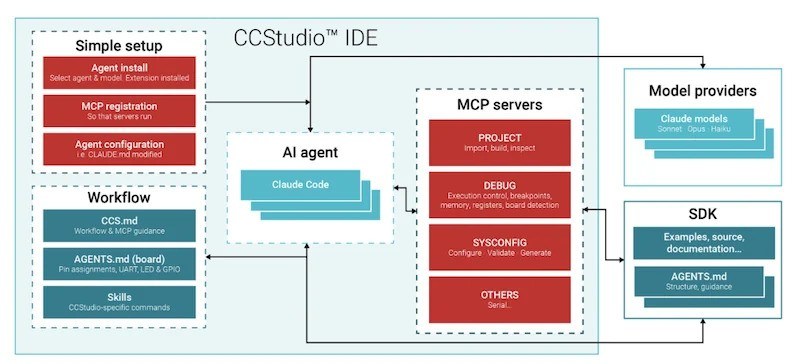
CCStudio strengthens agentic AI capabilities to streamline embedded software development across MCUs. Source: Texas Instruments
Conclusion first: the delta is context plumbing, not a cleverer model. Device-specific knowledge — software development kits (SDKs), pin configurations, peripheral data — reaches the workflow through Model Context Protocol (MCP) servers, so the agent answers with your device's real registers instead of a plausible average of the industry. TI reports the effect as better accuracy, fewer hallucinations and implementation-ready output.
The plumbing predates the news. TI's Code Composer Studio documentation already carries an AI-coding-assistant chapter and an application note, "Using AI Code Assistants with Code Composer Studio", which states that the CCStudio MCP servers interact directly with the IDE project and are designed to work with any AI client that speaks MCP. For two years, design engineers have used generative tools to type code faster while stalling on anything hardware-specific; the agent layer attacks the missing context, not the missing reasoning. That distinction decides whether the "days" figure applies to your project or only to your colleague's blinking LED.
How a migration runs end to end
CCStudio exposes its core capabilities to industry-standard AI agents, so an agent can generate code, configure peripherals, build the application, flash it to the device and debug it; the developer walks the whole flow in CCStudio IDE or CCStudio for VS Code in plain language, without switching tools or rebuilding context. Two planning details sit underneath that sentence: the IDE is built on the Eclipse Theia framework, so VS Code muscle memory survives, while the native VS Code route is TI's extension package, documented on the product page as available for selected devices. Check that device list against your bill of materials before a team-wide rollout. Our scored evaluation playbook for MCU, FPGA and firmware teams covers the same question across toolchains.
The migration path TI itself documents publicly is a useful template: the vendor's MSPM0 migration guide is written for moving application software from STM32 and MSP430 code bases into the MSPM0 ecosystem, using the MSPM0 SDK, its driver library and SysConfig. That is exactly the shape of work the agents claim to own. Reconstructed against the published sub-agent phases, the sequence looks like this.
- Source analysis. A sub-agent reads the legacy project and enumerates what the firmware truly depends on: clock tree, DMA channels, interrupt vectors, pin multiplexing, the peripheral init order buried in someone's board_init().
- Peripheral configuration. Pin mux and clock decisions are written into the device's configuration description and regenerated into driver config files, rather than hand-typed from a datasheet. Treat those generated files as reviewable artifacts, not invisible output.
- Code and API update. Vendor HAL calls are translated to the target driver library and API calls are rewritten; semantics — interrupt source naming, init-before-enable ordering, peripheral instance handles — are where a naive port breaks.
- Build-error iteration. The specialised sub-agents compile and iterate through the errors to resolution; TI positions this loop, not architecture, as the expensive repetitive part.
- Bench verification. Flash, then measure: clock accuracy, PWM period against the donor board, DMA throughput, current draw at each sleep state. No published vendor claim shortens this phase, so concentrate your remaining review hours here.
Repetitive, time-consuming migration work is offloaded to a purpose-built skillset so developers can accelerate complex design tasks from months to days and spend their time on system-level design and innovation. Agentic AI capabilities in CCStudio are available today across TI's general-purpose and real-time MCUs, wireless connectivity devices and radar system-on-chips (SoCs); because the architecture is modular — task-specific skills, MCP server integrations, context injection — TI says support for new devices, updated SDKs and emerging edge AI workflows will keep expanding. One gap worth planning around: cross-family configuration reuse is still an open question in TI's own E2E forum, where a June 2026 thread asks whether SysConfig will ease porting between MSPM0 and MSPM33 devices. Expect an agent to translate a project into a new device's language, not to silently inherit your timing decisions.
What shifts away from you, and what stays
| Migration phase | Manual port | Agent-assisted in CCStudio | Who owns the risk |
|---|---|---|---|
| Reading datasheet + header files | Hours per peripheral, copy-paste errors | Retrieved through MCP context | You still read the summary |
| Pin mux and clock tree | Tool GUI or hand-edited defines | Generated from the device description | Schematic cross-check is yours |
| Driver / API rewrite | Line-by-line porting | Automated call translation | Ordering and semantics: yours |
| Build error loop | Compile, patch, recompile | Iterated by sub-agents to resolution | Warnings you chose to ignore |
| Timing and signal checks | Bench work | Not replaced | Entirely yours |
| Functional-safety evidence | Manual traceability | Not addressed in TI's material | Entirely yours |
Four misconceptions that will bite first
- "It compiled, so it is correct." Regeneration changes behaviour: practitioners in TI's forums report peripheral timing shifting after an SDK update and config regeneration. Keep the configuration file and the generated driver source in version control — TI publishes the MSPM0 SDK as a Git repository partly so teams can run it through CI/CD — and review the diff of generated code exactly as you would review a human commit.
- "Months to days applies to my port." The claim describes mechanical translation. If your migration is really a re-architecture — different RTOS, different memory map, safety evidence to rebuild — the schedule moves by a different amount. Treat the headline as an upper bound on the easy part.
- "VS Code means my current setup works." TI's own product page qualifies the VS Code extension package as available for selected devices, while CCStudio IDE covers the broader portfolio on the Eclipse Theia framework. Verify coverage per part number.
- "The agent debugs, so I can leave the scope in the drawer." Autonomous debugging means the agent drives build, flash and the debugger; it does not own the electrical truth on your board.
FAQ from the review bench
Do I have to move my whole team into CCStudio to use the migration skill?
No. The IDE exposes its core capabilities to industry-standard agents, and the developer can drive the workflow in CCStudio IDE or CCStudio for VS Code in plain language; the prompt-driven migration path is meant to run from the AI tool you already prefer while preserving your existing software investment.
Why would an agent do peripheral configuration better than my code assistant?
Because the answer is grounded in injected device data — SDKs, pin configurations, peripheral data — instead of the model's statistical memory of every similar chip. That is the documented reason TI expects fewer hallucinated registers and implementation-ready output.
Which silicon is covered today?
TI states availability across its general-purpose and real-time MCUs, wireless connectivity devices and radar SoCs, with the modular architecture intended to absorb new devices and updated SDKs continuously.
What should a first pilot project look like?
Pick a bounded, verifiable port with a donor board you still have on the bench — a single-timer, single-UART task between two members of the same family. Measure the wall-clock split between agent time and your review time; that number, not the press release, sets your team's expectation.
Design checklist before you accept an agent-migrated build
- Confirm the target device is in the supported set for the VS Code extension or for CCStudio IDE before writing the plan.
- Commit the legacy project, the configuration description and every generated source file to Git in one reviewable branch.
- Re-verify clock source, prescalers and timer periods against the donor hardware with a scope or logic analyser, not a build log.
- Re-check interrupt priorities and nesting after API translation; ordering bugs compile cleanly.
- Re-measure sleep currents state by state, since regenerated low-power configuration is where the difference between datasheet and bench lives.
- Record which lines the agent wrote and which you rewrote; that split is the input to your next schedule estimate.
- Keep one human sign-off gate before flashing a device that is soldered into a customer-facing assembly.
Sources
- Texas Instruments newsroom: TI redefines embedded development with agentic AI in its CCStudio ecosystem (10 November 2026)
- TI CCStudio product page: Eclipse Theia-based IDE and the VS Code extension package for selected devices
- TI application note: Using AI Code Assistants with Code Composer Studio (MCP servers and IDE project access)
- TI MSPM0 migration guide video: porting application software from STM32 and MSP430 to the MSPM0 ecosystem
- Texas Instruments MSPM0 SDK Git repository (stated CI/CD use case)
- TI E2E forum thread (June 2026): ease of porting between MSPM0 and MSPM33
- electronica.de: electronica 2026 runs 10–13 November 2026 at Messe München
- EE World Online: Agentic AI takes on embedded code migration