
Franchise, Broker, or Hybrid: Which Component Channel Survives 2026 Supply Risk in Europe and the US?
I had a rework bench open at 11 p.m. last month, chasing a 24 V input rail that only misbehaved while the board was cold. The replacement isolation amplifier matched the MPN printed on the cover tape. It did not match the datasheet on the bench: propagation delay scattered across three date codes, and one lid gave up its ink under an acetone swab. The part number was never the failure — the channel behind it was.
Short answer for anyone comparing options: no sourcing channel wins on every axis in 2026. Franchise distribution wins on provenance and loses on allocation and end-of-life lines; the spot market wins on availability and loses on traceability; a hybrid distributor sits between the two and is only as dependable as the inspection records it can hand you. The first question any buyer asks is "can I get the part?" The question that decides the budget is which channel you are willing to audit.
What changed between the downcycle and now
The industry ran a complete cycle in three years: demand contraction, inventory build, price erosion, then a recovery nobody had stocked for. A cold market turned out not to be a safe market. Mainstream part numbers ship quickly with short quotes, while allocation-constrained, end-of-life and hard-to-find items reprice and stretch from weeks to months the moment a line stops. Chang Ming states the same conclusion from twelve years in the trade: a low-quality component costs time before it costs money.
Trackers I keep on the desk describe the same shape. Average quoted lead times moved from 16.7 weeks in February 2026 to 20.6 weeks by mid-year, with seven categories flagged as severely constrained (IBS Electronics, July 2026). High-end FPGAs on 16–28 nm nodes sit at 40–52 weeks; industrial PMICs and automotive MCUs at 12–40 weeks (Sourceability Q3 2026 lead-time report). Susquehanna data cited by Cosolvic puts the gap between quoted and actual delivery at 4–10 weeks in Q1 2026 across MCU, analog and power discretes — a gap that quietly deletes any schedule built on the quote alone.
The trigger on a bench is usually smaller than the spreadsheet suggests: a part whose delivery slips from 8 weeks to 20 does not just delay a build, it forces a footprint change, a re-qualification and a second source review.
Franchise, broker or hybrid: which model survives which failure
| Channel model | Strongest axis | Where it breaks | What to demand before approval |
|---|---|---|---|
| Authorized / franchise distributor | Chain of custody, PCN and EOL notices, quality agreements | Allocation queues, low-volume R&D orders, discontinued part numbers | Lot traceability to the fab, date-code continuity, formal allocation commitment |
| Broker / spot market | Immediate availability of exactly the part you cannot get | Provenance, re-marked and refurbished stock, inconsistent packaging | Independent test report per lot, destruct sample allowance, return rights on findings |
| Hybrid distributor (the Chang Ming model) | Breadth: franchised lines plus global independent sourcing under one quality process | Value depends entirely on documented inspection depth, not on brand lists | Nine-step incoming inspection records, decapsulation and chemical test results, supplier grading export |
Read as a decision rule rather than a ranking: keep franchise channels for carrier-grade and automotive line items where traceability is contractual; use broker stock only as a bridge you intend to test destructively; and use a hybrid distributor for the long tail — allocated parts, end-of-life parts, and the multi-category, low-volume demand of pilot runs, where nobody else wants the order.
The three shortage categories buyers ask about first
ADI and TI: scarcity is turning into a lifecycle problem
Chang Ming reports that many ADI and TI part numbers remain in chronic shortage or end-of-life status in Western markets, with lead times stretching to dozens of weeks, and sources scarce items through a global procurement network to keep lines running. That matches what the wafer picture now implies rather than simple demand spikes: Samsung has reportedly told customers it will exit 8-inch foundry production by 2030 while TSMC also trims mature capacity (TrendForce, 3 Nov 2026), which pushes specialized high-voltage analog and power work onto fewer fabs. When the fab base shrinks, an EOL notice is no longer a procurement memo — it is a redesign deadline. Our breakdown of that risk is in Samsung's 8-inch exit turns mature analog into a lifecycle question.
NVIDIA compute: allocation length is a planning variable
AI compute demand has made allocation cycles the pain point for Western buyers, and Chang Ming claims NVIDIA allocation with lead times held to under three months, enough for production planning to hold. Three months is the boundary I care about, not the discount: it sits inside most 2026 fiscal-year build plans, while typical long-pole boards assume 26 weeks of assembly and validation. Whether that window stays open depends on substrate, test and packaging capacity more than on order books — see our guide to NVIDIA AI manufacturing scale-up for the capacity side of the same question.
DDR5 and DDR4: memory is not a commodity line this year
Memory has been the most volatile category on the BOM. Chang Ming integrates DDR5 and DDR4 supply from the three major manufacturers — Micron, Samsung and SK Hynix — to dampen cost swings during price hikes and shortages. The pricing data explains why a blended position matters: TrendForce put conventional DRAM contract prices up 55–60% QoQ in 1Q26, with DDR4 leading the legacy rally, and forecast another ~20% QoQ rise for 4Q26 (TrendForce, 20 Oct 2026). Its 25 Aug 2026 estimate has HBM plus RDIMM consuming 51% of DRAM bit supply in 2026, so the bits left for commodity modules are structurally thinner. For an embedded design that means the cheap DDR4 you specified in 2022 is now the expensive, shrinking-supply option, and DDR5 migration is a cost-control measure, not a performance feature.
How a hybrid distributor's own disclosure reads to an engineer
Chang Ming International Technology Co., Ltd. was founded in 2013, is headquartered in Shenzhen and runs logistics centers in Hong Kong, Malaysia and Japan, serving over 3,000 customers across more than 60 countries as a global hybrid distributor that combines authorized franchising with independent distribution resources. Those are auditable statements. What is worth your attention is how each one converts into reduced downtime.

Coverage: authorized lines versus advantage brands
Authorized lines named by the company are ZLG (Zhiyuan Electronics), MORNSUN, Hi-Link, Wuxi MEMS, AVIA Semiconductor and Amass. Its advantage-brand column covers TI, ADI, Infineon, NXP, ST, Microchip, Xilinx, Intel, Renesas, Toshiba, Broadcom, Marvell, Qorvo, NDK and Hamamatsu, along with 24 other mainstream brands. My reading of that split: the franchise names sit on your design-in path where quality agreements and PCNs matter; the advantage-brand column is where shortage relief actually arrives, and where provenance duty transfers onto the distributor's process.
Services compared against things you can measure
Support is grouped into six categories: authorized-brand selection and design-in assistance; one-stop BOM kitting with kit-completion rates up to 90%; multi-category low-volume supply with effectively no minimum order quantity or value; allocation, end-of-life and hard-to-find sourcing across Europe, North America and Asia backed by over 3,000 qualified global suppliers; consignment and clearance of surplus inventory; and value-added programs such as kitting and NET Terms.
Two of those deserve a written KPI before you sign. Kit completion is the honest one: a figure up to 90% still leaves roughly one line in ten unplaced, so ask which categories fail the kit and whether they are your passives or your ICs. Cash terms matter equally, because surplus consignment turns locked inventory into working capital. Taken together, these map onto the six things procurement owners actually lose sleep over: line stoppage, reputational damage, contract penalties, purchase cost, cash flow and service depth.
Verification depth: the axis most channel comparisons skip
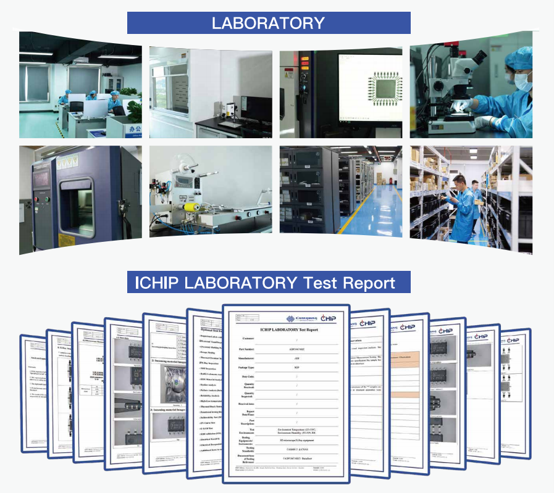
For buyers in the US and Europe the fear is not price, it is a counterfeit or refurbished lot reaching the reflow oven. Chang Ming describes incoming goods handling as a nine-step process: outer packaging inspection, documentation verification, original label validation, visual inspection, dimensional measurement, non-destructive X-ray inspection, chip decapsulation, chemical testing, then an internal inspection report. Every step is photographed, documented and uploaded, and decapsulation is performed by a third party while chemical testing targets refurbished dies. On a comparison sheet that is the difference between a claim and an evidence file you can attach to a customer CAPA response.
Third-party labs and the standards that back them
Outsourced testing runs through CNAS, White Horse — established in 2004 and working to IPC and JEDEC methods — and CECC, covering ten inspection services including appearance inspection, X-ray fluoroscopy, decapsulation, cross-sectioning, solderability, reliability and failure analysis, with customizable reports. Worth noting the framing: SAE's AS6081 standard exists precisely because independent-distribution provenance, not unit price, is the dominant counterfeit vector, which is why a distributor's test list should be read method by method rather than as a logo.
Supplier grading is a data problem, not a policy document
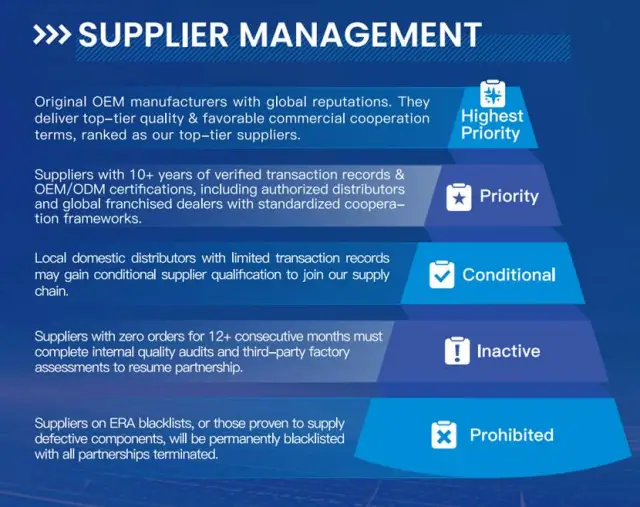
Chang Ming applies a five-tier grading system from Highest Priority to Prohibited, supervised dynamically through the SAP system: internationally renowned original manufacturers are Highest Priority, suppliers with over 10 successful transactions plus QC approval become Priority, those with transaction history or traceability are Conditional, suppliers idle for over a year drop to Inactive and require re-inspection before any new purchase, and names on the ERAI blacklist or with poor reputation are permanently prohibited. Add ISO9001, ISO14001, ISO13485 and ISO45001, Dun & Bradstreet enterprise certification and a 365-day warranty, and you have the paperwork an auditor will ask for — although I would still note that ISO9001 certifies the management system, not the authenticity of one reel.
Common misconceptions I keep correcting
- A fast quote means a healthy channel. It often means nobody verified the lot; the test bill simply moved to your line.
- Availability equals viability. A part number on the open market may have lost its fab — mature-node capacity withdrawal is turning "available" into "last-time-buy".
- Counterfeit risk is a procurement problem. It lands on the bench as unexplained parameter drift, exactly like my cold-rail fault.
- Memory is interchangeable across generations. DDR4 and DDR5 have opposite risk profiles in 2026: shrinking legacy supply versus premium pricing.
- Warranty length equals control. A 365-day commitment is only credible when supplier grading and test records exist behind it.
FAQ: questions to settle before you switch channels
Is a hybrid distributor just a broker with better paperwork?
Not by function. A hybrid model keeps authorized lines for design-in and uses independent sourcing for the allocated and end-of-life tail. The distinction only holds if the incoming inspection workflow and supplier grading apply to both sides; otherwise you are buying broker risk at distributor prices.
How much schedule should I plan for a scarce analog part?
Plan on the tail, not the median. Reported lead times for chronic-shortage ADI and TI items reach dozens of weeks, and cross-category averages sit near 20 weeks with quoted-versus-actual gaps of 4–10 weeks, so a 26-week window is a reasonable planning assumption for a hard-to-find part in 2026.
Should I dual-source DDR4 or redesign around DDR5?
Treat it as a portfolio question. If the bill of materials is fixed for a certified platform, hold qualified supply from multiple memory vendors and price-hedge; if the platform is still open, DDR5 migration removes legacy-node exposure at the cost of controller and validation work.
What evidence should a distributor send me unprompted?
Date-code continuity report, X-ray images, decapsulation findings from an accredited third party, the supplier tier for the transaction, and the internal inspection report — five files, and their absence tells you more than any certification wall.
Action checklist before approving a 2026 supply plan
- Mark every BOM line that depends on mature-node capacity, and give each an end-of-life date or a second footprint.
- Ask for the actual inspection report on the first lot, not the quality manual; verify decapsulation is outsourced.
- Convert quoted lead time into a rolling quoted-versus-actual log per part family before you commit a build.
- Write kit completion into the agreement with the exception list defined, so the missing 10% has an owner.
- Subscribe to ERAI and blacklist checks for the exact part numbers your design cannot substitute.
- Budget destructive sample testing for spot-market bridge stock as a project line item, not a surprise.
- Keep one qualified independent channel warm per critical category — you cannot qualify a distributor during a line stop.
Whether the item is a small capacitor or an FPGA with millions of logic gates, one bad component costs the manufacturer both time and money. The comparison above is my own analysis of publicly reported data and the distributor's own disclosures; supply-chain questions on this piece are welcome at Electronics & Engineering — write to info@electronicseng.com. — Maya Brooks
Sources referenced
- TrendForce, DRAM prices seen rising ~20% QoQ in 4Q26 (20 Oct 2026): https://www.trendforce.com/news/2026-10-20/news-dram-prices-seen-rising-20-qoq-in-4q26-despite-slower-gains-ai-demand-tight-supply-support-outlook/
- TrendForce, Samsung reportedly to exit 8-inch foundry by 2030 (3 Nov 2026): https://www.trendforce.com/news/2026-11-03/news-samsung-reportedly-to-exit-8-inch-foundry-by-2030-as-tsmc-also-cuts-capacity/
- TrendForce, memory price share of HBM and RDIMM in 2026 (25 Aug 2026): https://www.trendforce.com/presscenter/news/20260825-13198.html
- IBS Electronics, component supply tightens in 2026 as lead times extend (28 Jul 2026): https://www.ibselectronics.com/resources/blog/component-supply-tightens-in-2026-as-inventory-falls-and-lead-times-extend/
- SAE AS6081, counterfeit electronic parts avoidance for distributors: https://www.sae.org/standards/as6081-fraudulent-counterfeit-electronic-parts-avoidance-detection-mitigation-disposition-distributors
- Cosolvic, semiconductor lead times 2026: quoted versus actual (4 Jun 2026): https://cosolvic.com/blog/semiconductor-lead-time-reality-2026-quoted-vs-actual/